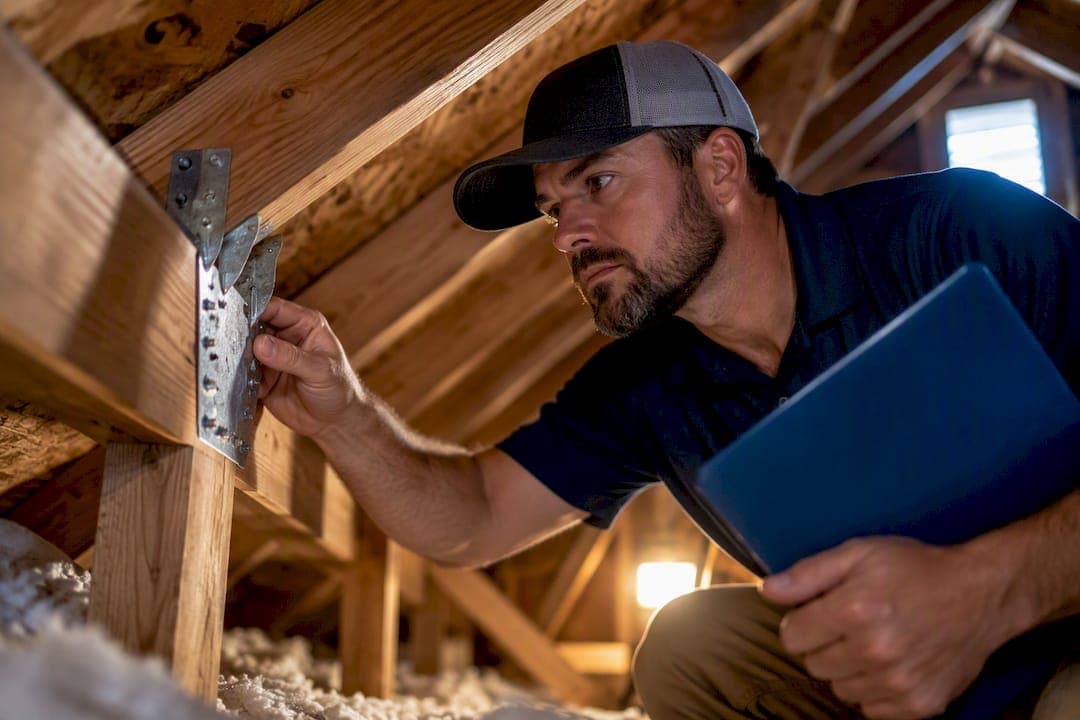
Yes, you can qualify for wind mitigation credits in Florida if a licensed, authorized inspector documents your home's qualifying features on the correct state form. Florida law requires insurers to offer these discounts, but the credit only reduces the hurricane-wind portion of your premium. Before you pay anyone for an inspection, confirm they will use the current OIR-B1-1802 form, effective April 1, 2026.
TL;DR:
- Wind mitigation credits apply only to the hurricane-wind portion of your insurance premium, not your entire bill.
- An inspection evaluates roof attachments, roof-to-wall connections, opening protection, and secondary water resistance, each affecting your total credit independently.
- Licensed professionals such as contractors, engineers, or qualified inspectors must sign the form, and they must use the current April 2026 form for eligibility.
- Inspection fees vary based on home size and attic access, and gathering documentation like permits and photos can speed up the process.
- Credits remain valid as long as the features stay unchanged, but replacing major components like the roof generally requires a new inspection and documentation.
Table of Contents
- What Are Wind Mitigation Credits and How Do They Lower Your Premium?
- What Does a Wind Mitigation Inspection Actually Check?
- Who Is Legally Allowed to Sign a Wind Mitigation Form in Florida?
- How Do You Get a Wind Mitigation Inspection Done, and What Does It Cost?
- How Are Wind Mitigation Discounts Actually Calculated on Your Bill?
- What Changed With the 2026 OIR Wind Mitigation Form?
- What Documentation Should You Gather Before the Inspector Arrives?
- How Long Do Wind Mitigation Credits Last in Florida?
- Quick Checklist: What to Do Next
- Why Insurance Savings Deserve a Seat at Your Mortgage Planning Table
- Let Lending Bankers Help You Plan Around Your Insurance Savings
- Where to Verify the Official Rules Yourself
- Sources
- FAQ
What Are Wind Mitigation Credits and How Do They Lower Your Premium?
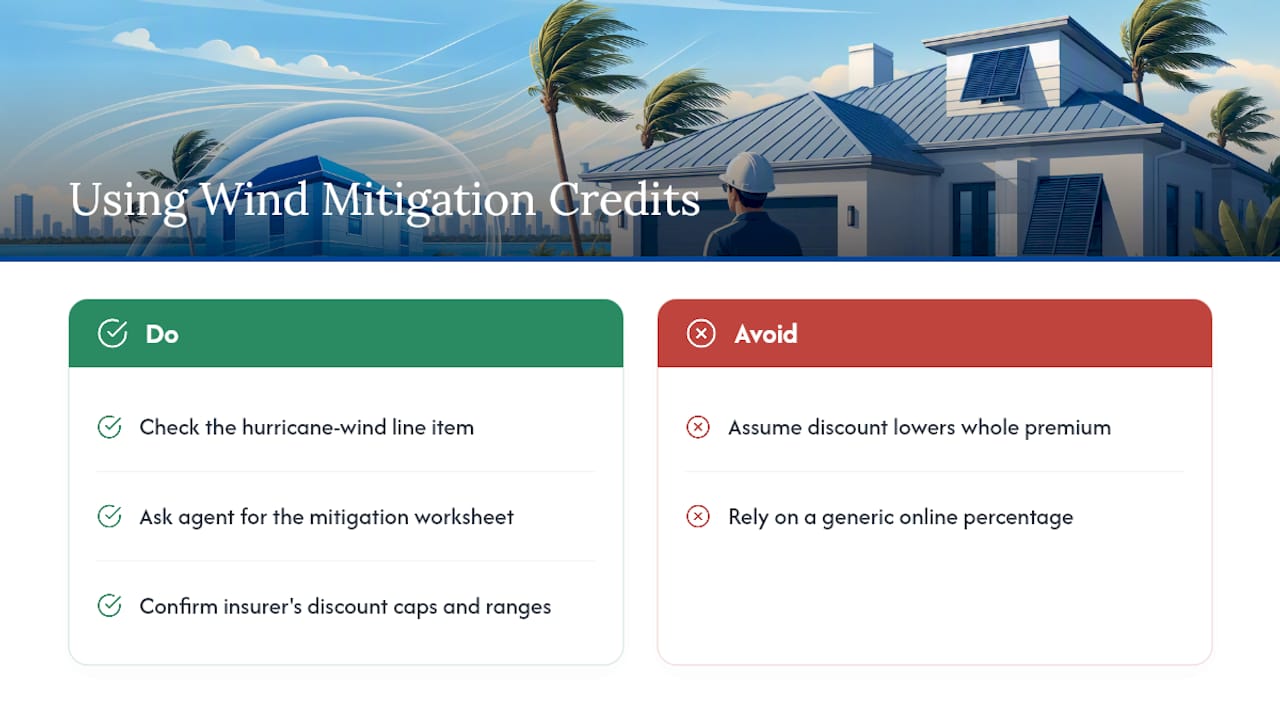
Wind mitigation credits reduce the hurricane-wind portion of your homeowners policy, not your entire premium bill. That distinction trips up a lot of homeowners who expect a discount across the board.
Florida Statute section 627.0629 requires insurers to offer actuarially justified discounts for fixtures and construction techniques that reduce windstorm losses, and it forces insurers to disclose the hurricane-wind premium as its own line item. Each insurer files its own discount ranges with the Florida Office of Insurance Regulation (OIR), and most cap how much total credit a single home can stack. Ask your agent for the insurer's mitigation worksheet so you can see how each qualifying feature affects your specific policy, rather than guessing from a generic percentage you saw online.
What Does a Wind Mitigation Inspection Actually Check?
An inspector working through the OIR form evaluates several distinct categories, and each one carries its own weight toward your final credit:
- Roof covering and roof-deck attachment, including the fastening pattern used when the roof was installed
- Roof-to-wall connections, where clips or straps score higher than simple toe-nailing, and roof shape, since hip roofs typically perform better in wind events than gable roofs
- Opening protection for every window, door, garage door, and skylight, rated by the weakest protected opening in the group
- Secondary water resistance, such as a sealed roof deck or self-adhering membrane, plus other construction techniques the OIR form formally recognizes
Each category feeds a separate line on the form, so a strong score in one area never compensates for a weak one elsewhere.
Who Is Legally Allowed to Sign a Wind Mitigation Form in Florida?
Not just anyone with a clipboard can perform this inspection. Under Florida Statutes section 627.711(2)(a), the authorized signers include licensed general, building, or residential contractors, professional engineers, architects, building code inspectors, and qualified home inspectors who meet the statute's training requirements. Before you hire anyone, verify their license number, ask whether they've completed OIR's equivalency training, and request a sample completed OIR-B1-1802 report. Confirm they're already working from the April 1, 2026 form, since an older version could delay your credit or force a redo.
How Do You Get a Wind Mitigation Inspection Done, and What Does It Cost?
Getting your wind mitigation inspection Florida homeowners rely on for insurance savings follows a fairly consistent process, though the details vary by inspector and insurer.
- Schedule the inspection. The inspector visits your home to complete the OIR-B1-1802 form, photographing the attic, roof connections, and every window or door opening.
- Review the completed form. Ask the inspector to walk you through each section before you sign off, especially the opening-protection chart.
- Submit the form. You or your agent sends the completed form to your insurer following that company's specific submission instructions. Some insurers accept email uploads through an agent portal; others require mailed originals.
- Confirm receipt and processing. Follow up with your agent to make sure the insurer applied the credit rather than letting the form sit in a queue.
Inspection fees vary based on home size and attic accessibility. Ask upfront whether the quoted price includes attic access, since a home with a difficult crawl space can cost more to inspect. It's also worth asking your agent whether the insurer already applies default code credits for homes built after certain years. That can save you money if a full inspection wouldn't change much.
How Are Wind Mitigation Discounts Actually Calculated on Your Bill?
Credits apply strictly to the hurricane-wind portion of your policy, never to the total premium. If your policy separates wind coverage as its own line, that's the number the discount touches.
The OIR's Notice of Premium Discounts for Hurricane Loss Mitigation makes clear that these discounts aren't cumulative. An insurer might apply a large discount for opening protection, then scale back a secondary credit so the combined total doesn't exceed the cap it filed with the state. Don't multiply the advertised percentages together and expect that number to show up on your bill. Instead, ask your agent for the insurer's mitigation worksheet or the actual OIR-B1-1655 notice, which shows the line-by-line impact on your hurricane-wind premium before and after each qualifying feature.
What Changed With the 2026 OIR Wind Mitigation Form?
The OIR adopted an updated Uniform Mitigation Verification Inspection Form, effective April 1, 2026, following a 2024 study by Applied Research Associates that reassessed how various construction features actually perform in wind events. If you're scheduling an inspection now, confirm your inspector is working from the current OIR-B1-1802, not a version left over from before the update.
Older-form inspections completed before the changeover may need re-submission or a fresh inspection, depending on how your insurer handles the transition. The safest approach is to treat your insurer's current submission instructions and the OIR's published form as the final word, since online explainers referencing the prior form can be outdated without any obvious warning.
What Documentation Should You Gather Before the Inspector Arrives?
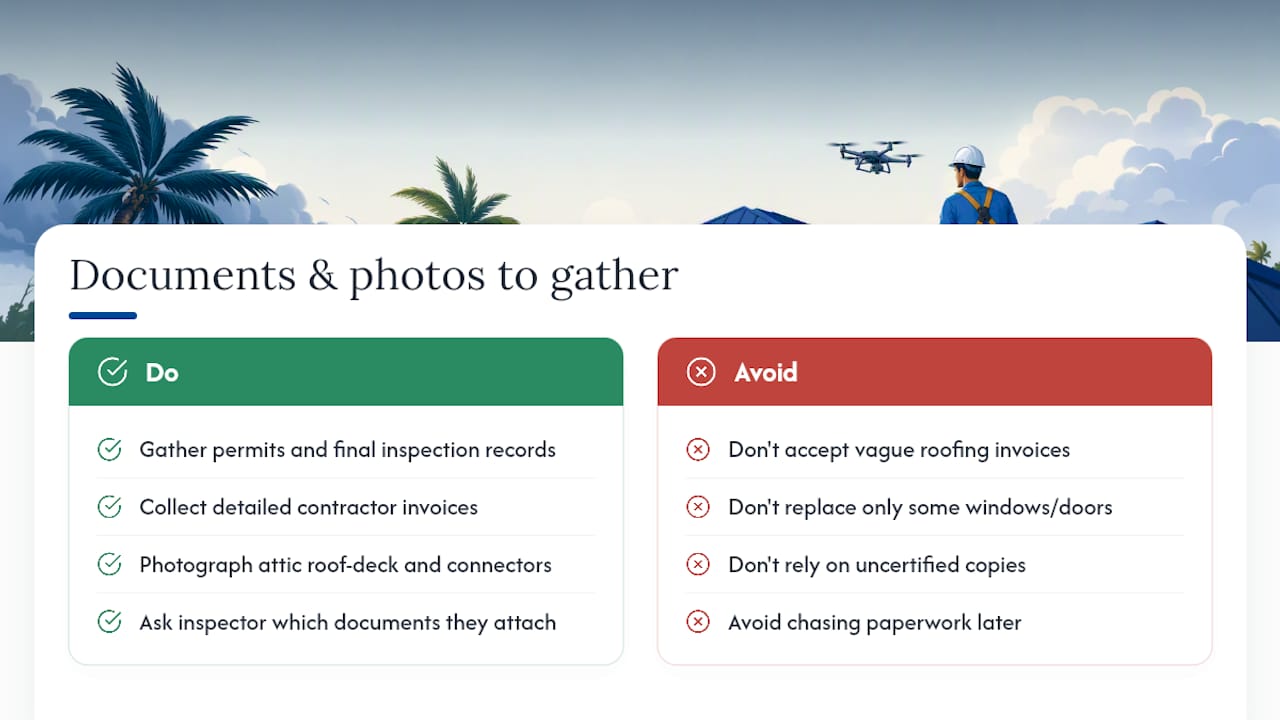
Photos and paperwork often matter as much as the physical features themselves. OIR distinguishes between a feature simply existing at your property and documented proof that it meets the required standard, so gather permits, final inspection records, detailed contractor invoices, and product approval numbers wherever you have them.
Attic photos showing the roof-deck attachment and roof-to-wall connectors frequently make or break the roof categories on the form. A roofing invoice that just says "new roof installed" rarely proves the attachment method the inspector needs to see. For openings, every glazed window and door needs to meet the same protection level. Citizens Property Insurance warns homeowners that replacing only some windows or doors, rather than the whole set, often fails to unlock the full opening-protection credit, since the weakest opening controls that entire category.
Pro Tip: Before the inspector leaves, ask exactly which photos and documents they're attaching to your OIR form, and hand them originals or certified copies on the spot. Chasing down paperwork after the fact almost always takes longer than you expect.
How Long Do Wind Mitigation Credits Last in Florida?
Credits stay in effect as long as the documented features remain unchanged and intact. Replacing your roof, swapping doors, or changing windows typically triggers the need for a new inspection. At renewal, check your insurer's notice to confirm the credit is still applied, and ask for a reassessment if you've completed qualifying work since your last inspection. Switching insurers almost always requires a fresh inspection and new documentation, since your old form doesn't automatically transfer.
Quick Checklist: What to Do Next
Before you spend a dollar on an inspection, confirm three things. First, make sure your inspector will use the current OIR-B1-1802 form adopted for April 1, 2026. Second, ask your agent for the insurer's mitigation worksheet so you know what's already credited. Third, start gathering permits, attic photos, and product approvals now, since they'll speed up the whole process considerably.
Why Insurance Savings Deserve a Seat at Your Mortgage Planning Table
Wind mitigation credits lower your hurricane-wind premium, and that number belongs in your total housing-cost math, not just your insurance file. When you're refinancing or budgeting for roof or window upgrades, factor in both the potential savings and the documentation costs. Mortgage professionals build insurance costs into mortgage conversations with Florida homeowners.
— David
Let Lending Bankers Help You Plan Around Your Insurance Savings
Some mortgage professionals help Florida homeowners incorporate insurance savings into mortgage or refinance plans, rather than just noting discounts. Once a wind mitigation credit lowers your hurricane-wind premium, that freed-up cash can shift how much home you qualify for or affect refinance calculations.

If you're weighing a refinance to fund roof or opening upgrades that could unlock a bigger credit, our mortgage refinance guidance walks through how those numbers typically play out. Curious what a lower hurricane-wind premium does to your monthly payment? Run the numbers yourself with our Miami mortgage calculator, or reach out to a Lending Bankers advisor for a personalized estimate that factors your insurance savings into your next mortgage or refinance decision.
Where to Verify the Official Rules Yourself
Don't take any homeowner's word for it, including ours. Check these sources directly before you sign anything:
- FLOIR's Wind Mitigation Resources page for the current OIR-B1-1802 form and inspection guidance
- Florida Statute 627.0629 for the statutory discount requirement
- Citizens Property Insurance's wind mitigation guidance for insurer-side practical advice
- Your own insurer's website or agent for their specific submission instructions
This article is general information, not a substitute for advice from a qualified financial advisor. Consult a qualified financial professional about your own circumstances before acting on anything here.
Sources
- Wind Mitigation Resources — Florida Office of Insurance Regulation
- Florida Statute 627.0629 — Residential property insurance; rate filings
- Wind mitigation matters: Safer home, discounts — Citizens Property Insurance Corporation
FAQ
How Do I Get a Free Wind Mitigation Inspection in Florida?
Free inspections aren't a standard state benefit, but some counties and utility programs occasionally offer them through local hurricane preparedness initiatives. Check your county's emergency management office and the Florida Division of Emergency Management's mitigation program page for current local offerings, since availability changes by county and year.
What Is the Florida $10,000 Grant for Homeowners?
References to homeowner grants typically point to state or local hurricane mitigation grant programs that help cover retrofit costs like roof-to-wall reinforcement or opening protection. These programs vary by county and funding cycle, so confirm current eligibility and amounts through your local mitigation program office rather than assuming a fixed statewide figure.
How Much Does a Wind Mitigation Inspection Cost in Florida?
Inspection cost depends on your home's size and how accessible your attic is, since difficult attic access adds time to the visit. Ask the inspector upfront whether their quote includes full attic access, and compare that against what your insurer already applies as a default code credit before paying for a full inspection.
How Long Is a Wind Mitigation Inspection Good for in Florida?
Your wind mitigation credit stays valid as long as the documented features remain unchanged, with no fixed expiration date set by statute. Replacing your roof or swapping windows and doors usually requires a new inspection, and switching insurers almost always means submitting fresh documentation.
Does Lending Bankers Help With Mortgage Planning Around Insurance Costs?
Yes, Lending Bankers works with Florida homeowners to factor insurance costs, including wind mitigation savings, into mortgage and refinance planning. Reach out through our main mortgage services page for a personalized estimate based on your situation.