
If you served on active duty, in the Reserve, or in the National Guard with an other-than-dishonorable discharge, you're very likely eligible for a VA loan. Surviving spouses of Veterans who died in service or from service-connected disabilities often qualify, too. Your first move: request your Certificate of Eligibility, then talk to a VA-savvy lender about underwriting.
TL;DR:
- Over 90 days of continuous active duty generally qualifies current service members, even before separation, while shorter service may still qualify with specific exceptions.
- A dishonorable discharge disqualifies applicants, but general or other-than-honorable discharges can be upgraded and may still qualify if documented properly.
- Certification of Eligibility must be obtained early through lenders’ online systems, VA.gov, or mail to avoid delays, especially in competitive markets like Florida.
- Underwriting standards, including credit and residual income, vary by lender; shopping around improves chances of approval despite VA eligibility.
- Active and former service members, reservists, National Guard members, certain cadets, and surviving spouses may all qualify under specific conditions, with documentation requirements depending on their category.
Table of Contents
- VA Loan Eligibility Requirements by Service Era
- Who Qualifies for a VA Loan Beyond Active Duty
- How to Get Your VA COE Explained Step by Step
- What Lenders Check After You Have a COE
- Entitlement, Restoration, and Using Your VA Loan More Than Once
- Florida-Specific Considerations for VA Loan Closings
- What Miami Veterans Get Wrong About the VA Loan Process
- How Lending Bankers Helps Florida Veterans Get to Closing Faster
- Where to Verify Your VA Loan Eligibility
- Sources
VA Loan Eligibility Requirements by Service Era
VA loan eligibility hinges on how long you served and when. The Department of Veterans Affairs sets specific active-duty thresholds depending on your service era, and the VA's official eligibility page walks through each one. Understanding where you fall on this timeline is the first real checkpoint before you go any further.
Here's how the minimum service requirements typically break down:
- World War II through the Korean War era: Typically requires a minimum period of active service, with variations depending on exact dates.
- Post-Korean War to pre-Vietnam: Generally requires a certain minimum period of continuous active service.
- Vietnam War era: A qualifying period of active service according to VA-specified dates is required.
- Post-Vietnam to the Gulf War: Requires a specified period of continuous active duty service.
- Gulf War era (August 2, 1990, to present): Requires extended continuous service or fulfilling the full period called or ordered to active duty with certain minimum conditions.
These thresholds aren't absolute walls. The VA Buyer's Guide lists several exceptions that let Veterans with shorter service still qualify for VA loan benefits. You may still be eligible if you were discharged early because of a service-connected disability, a documented hardship, a reduction in force, certain medical conditions, or an early-out program tied to your specific service period. Convenience-of-government discharges can count too, depending on the circumstances.
One rule doesn't bend: a dishonorable discharge generally disqualifies you from VA loan benefits. If your discharge paperwork lists anything other than "Honorable" or "General (Under Honorable Conditions)," don't assume the worst. Discharge upgrades happen, and if a Discharge Review Board or the Board for Correction of Military/Naval Records later upgrades your characterization, that upgraded status is what counts for VA loan purposes. Pull your DD214 and read the discharge characterization line closely before you assume you're out of the running.
Who Qualifies for a VA Loan Beyond Active Duty
VA loan qualifications extend well past the standard active-duty Veteran. If you're wondering who qualifies for a VA loan in your specific situation, the categories below cover most readers.
- Active-duty service members currently serving typically qualify after 90 continuous days, even before separation.
- Veterans who meet the era-based service length and were discharged under conditions other than dishonorable.
- Selected Reserve and National Guard members with six qualifying years of service, provided they're still serving, sit on the retired list, or have transferred to the Standby Reserve or an inactive list after completing that six-year commitment.
- Cadets and midshipmen at the service academies, along with commissioned officers of the Public Health Service and NOAA, under specific eligibility rules.
- Certain U.S. citizens who served in the armed forces of a government allied with the United States during World War II, under narrower documentation requirements.
- Surviving spouses of Veterans who died in service or from a service-connected disability, provided they haven't remarried, or who are currently receiving Dependency and Indemnity Compensation (DIC) benefits.
Surviving spouse eligibility carries its own nuance worth flagging: if you remarried after age 57 and on or after December 16, 2003, you may still qualify under a specific statutory exception. This category requires documentation like a death certificate, marriage certificate, and often a DIC award letter, according to VA guidance on home loan eligibility. If your situation touches any of these less common categories, the VA Home Loans eligibility page has official adjudication guidance rather than relying on a lender's best guess.
How to Get Your VA COE Explained Step by Step
Your Certificate of Eligibility is the document that proves to a lender you've earned the VA loan benefit. Without it, no lender can move forward, no matter how strong your credit or income looks. You have three ways to get one.
- Ask your lender to pull it through Web LGY. Most VA-approved lenders can request your COE electronically and often get it back almost instantly, according to VA's own guidance on requesting a COE. This is the fastest route for the vast majority of applicants.
- Apply directly on VA.gov. You'll log in using ID.me or DS Logon, and the system pulls much of your service data automatically if your records are on file.
- Mail VA Form 26-1880. This paper route takes longer but works if you can't access the online systems or need to submit supporting documents that don't upload cleanly.
The evidence you need depends on your category. Veterans typically submit a DD214. Reserve and National Guard members need an NGB-22 (Report of Separation) or a current statement of service signed by their commanding officer. Surviving spouses generally submit VA Form 26-1817 along with a death certificate and marriage documentation.
Pro Tip: Ask your lender upfront whether they use Web LGY. If they don't, you're stuck waiting on a mail-based process that can add weeks to your timeline, and in Florida's competitive housing market, weeks matter. If your service records were lost or you never received a copy, the National Archives handles retrieval requests, and starting that process early avoids a bottleneck right before closing. Miami-area Veterans dealing with delayed paperwork can find additional local context in these tips for VA loans in Miami.
What Lenders Check After You Have a COE
Getting your COE confirms VA eligibility. It doesn't guarantee loan approval. That second step, lender underwriting, is where a lot of Veterans get confused about who's actually setting the rules.
The VA guarantees a portion of your loan, which protects the lender if you default. That guarantee is why VA loans often come with no down payment and competitive rates. But the VA doesn't approve or deny your loan application, and it doesn't set a minimum credit score. That decision belongs entirely to the lender you choose, and VA eligibility guidance confirms that lenders establish their own credit, income, and residual income standards.
Residual income is the number that trips up more VA borrowers than any other factor. It measures what's left of your monthly income after your mortgage payment, taxes, insurance, and other debts. Lenders lean on this figure heavily for VA loans because it reflects real ability to cover living expenses in your specific region and household size, not just a debt-to-income ratio in isolation.

Because underwriting standards vary by lender, not by VA rule, a Veteran with marginal credit at one institution can often get approved at another with more flexible overlays. That's the single biggest reason to shop more than one lender rather than accepting the first quote you get.
A few other cost factors worth budgeting for:
- The VA funding fee, a percentage of your loan amount that helps sustain the program for future borrowers.
- Exemptions for Veterans with a service-connected disability rating of 10% or higher, and for certain surviving spouses.
- Lender-specific closing costs, which aren't standardized and are worth negotiating line by line.
Ask every lender for an itemized fee sheet before you commit. If you're running into documentation snags during underwriting, this guide to overcoming loan approval challenges covers common sticking points Florida borrowers face.
Entitlement, Restoration, and Using Your VA Loan More Than Once
Your VA entitlement is the dollar amount the VA guarantees on your behalf, and it isn't a one-time-use benefit. But if you've used it before, how much you have left matters for your next purchase.
- Full entitlement typically applies if you've never used your VA loan benefit or if you paid off a previous VA loan and sold the property.
- Partial entitlement occurs when you still have an active VA loan or unpaid entitlement tied to a prior purchase, which can require a down payment on a new loan depending on the loan amount and county limits.
- Restoration happens once you sell the home tied to a used loan and pay it off in full, or when a qualified buyer assumes your existing VA loan and substitutes their own entitlement for yours.
- A one-time restoration exception exists even if you still own the prior property, as long as the original VA loan has been paid in full.
- Foreclosure, deed-in-lieu, or a compromise claim on a prior VA loan can reduce your available entitlement and complicate restoration until the VA resolves the loss on its books.
If you've been through a previous VA loan, whether it closed cleanly or ended in a short sale, ask your lender to run an entitlement calculation before you start shopping. It changes your down payment math significantly.
Florida-Specific Considerations for VA Loan Closings
Florida properties come with underwriting wrinkles that Veterans in most other states never have to think about. Get ahead of these and your closing timeline stays intact.
- Flood insurance is mandatory in FEMA-mapped flood zones, and lenders enforce proof of coverage before closing, not after. If your property sits in a high-risk zone, get quotes the moment you go under contract.
- Wind mitigation inspections matter more in Florida than almost anywhere else. Roofing condition and wind-related features directly affect both your insurance premium and how an appraiser evaluates the property.
- A VA appraisal is not a home inspection. The appraisal checks Minimum Property Requirements and assigns a value opinion, but according to VA's home buying guidance, it's not a substitute for a private inspection. Get both, especially on older South Florida homes.
- Coordinate insurance, inspections, and lender document requests simultaneously rather than sequentially, since Florida's insurance market moves slowly and can otherwise stall your closing date by weeks.
Pro Tip: Order your wind mitigation inspection the same week you go under contract. Many local appraisers will flag remediation issues that can still be fixed before final underwriting, but only if there's enough runway left on the calendar. Readers weighing insurance costs against loan terms may also find this comparison of homeowners and mortgage insurance useful before they lock a rate.
What Miami Veterans Get Wrong About the VA Loan Process
Most of the confusion I see isn't about eligibility itself. It's about timing. Veterans assume the COE is the hard part, then get blindsided when a lender's overlay or a Florida insurance quote stalls things closer to closing. In Miami specifically, document delays (a missing NGB-22, an outdated statement of service) and slow wind mitigation scheduling cause more postponed closings than credit issues ever do. The fix is almost always the same: request your COE early, gather every service document before you need it, and get prequalified with a lender who actually understands VA overlays rather than treating your file like a conventional loan.
— David
How Lending Bankers Helps Florida Veterans Get to Closing Faster
Lending Bankers is the direct alternative to piecing together your VA loan process on your own, guessing which lender's overlays fit your credit profile, or waiting on a mail-in COE request while your rate lock ticks down. Because Lending Bankers works VA loans across Miami and the rest of Florida every day, you get COE assistance through Web LGY, lender matchmaking suited to your credit and income profile, underwriting support when documentation gets complicated, and closing coordination that accounts for Florida's flood insurance and wind mitigation timelines.
If you're ready to see where you stand, start with Lending Bankers' Miami mortgage lending services for a free eligibility check, or run your numbers first with the Miami mortgage calculator to see what a VA loan payment looks like on the property you have in mind. Either way, the next step is a conversation, not another form.
Where to Verify Your VA Loan Eligibility
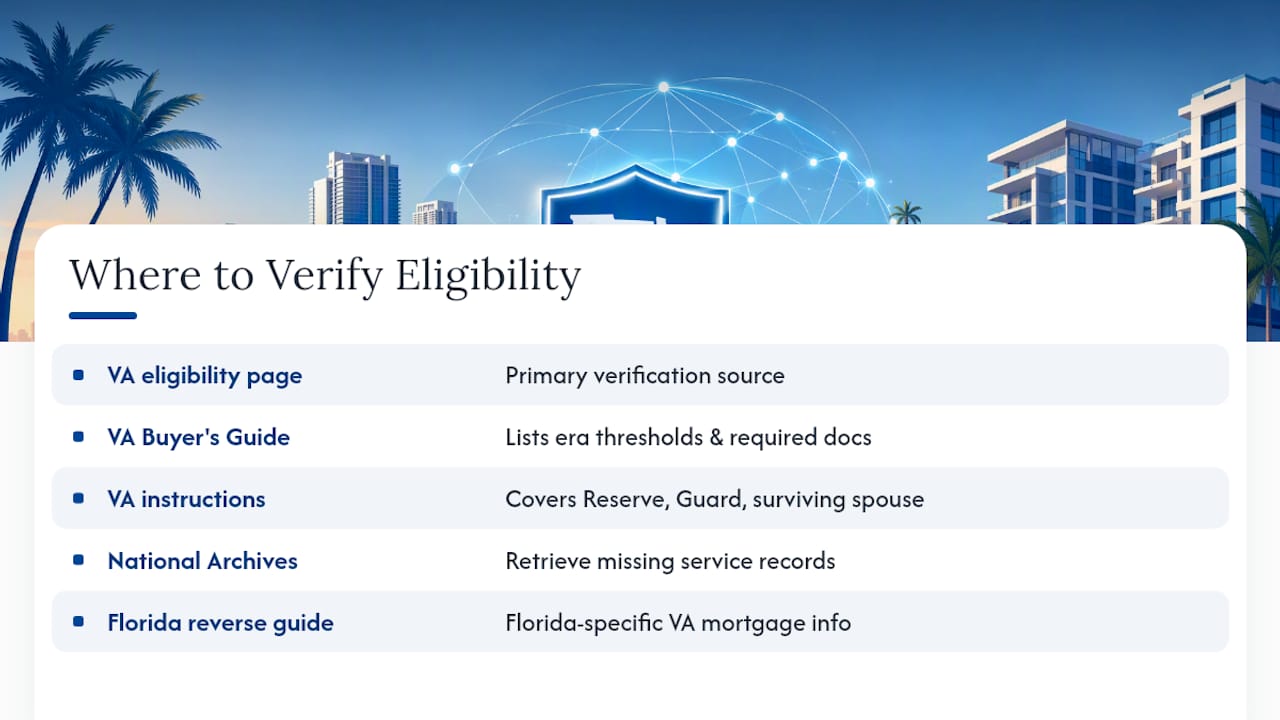
Confirm your standing directly through the VA's eligibility page and the VA Home Loan Guaranty Buyer's Guide, which lists every service-era threshold and required document. The VA Home Loans eligibility instructions cover Reserve, National Guard, and surviving spouse categories in detail. If your service records are missing, the National Archives handles retrieval. For Florida-specific mortgage products tied to Veteran benefits, this Florida guide to reverse mortgages for Veterans is a useful companion resource.