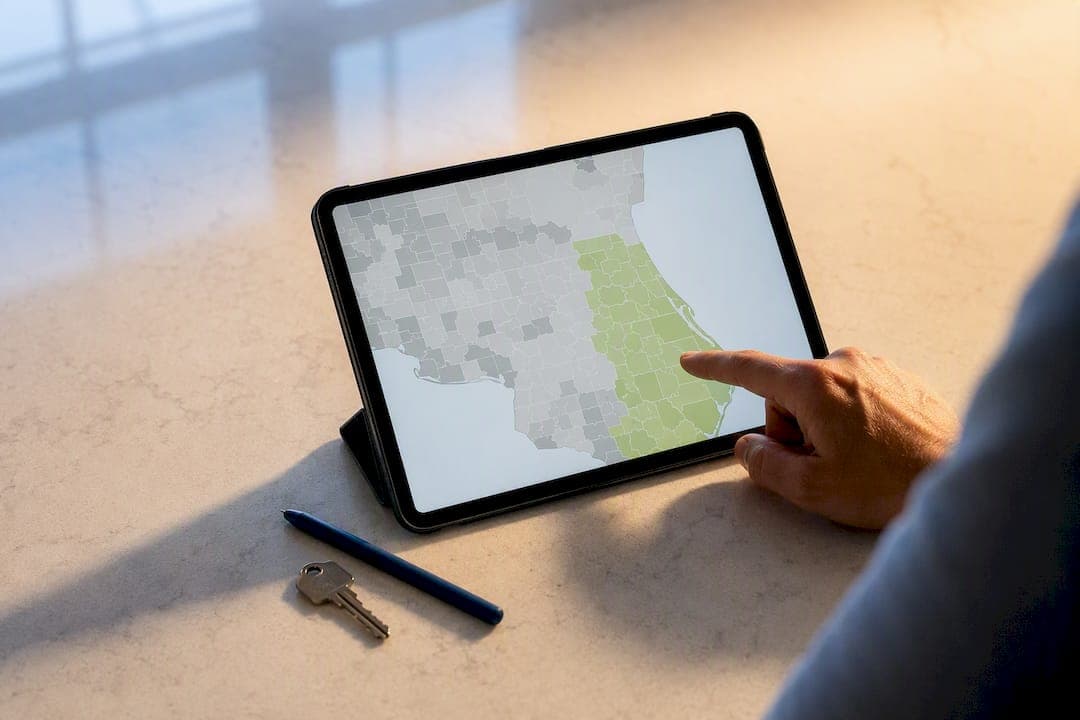
If your target property sits in a USDA-eligible area and your household income falls under the local cap, check USDA first: it typically costs less over the life of the loan than FHA. If either condition fails, FHA is your fallback, with lower credit thresholds and no location restrictions. Start by running the property address through the USDA eligibility map before you talk numbers with a lender.
TL;DR:
- USDA loans require eligibility for a specific property location, household income below approximately 115% of area median, and typically have higher credit score overlays around 640.
- FHA loans accept lower credit scores starting from 500 with a 10% down payment or 580 with 3.5%, and have no income limits but higher mortgage insurance costs.
- USDA offers no down payment and lower ongoing mortgage insurance fees, whereas FHA requires a down payment and has higher upfront and annual mortgage insurance premiums.
- Property type options differ, with USDA only for single-family homes and FHA covering multi-unit properties, condos, and manufactured homes, with some county-based loan limits.
- The approval process speed varies: FHA typically closes in 30 to 45 days, while USDA may take longer due to additional review steps, and lender overlays can impact qualification eligibility.
Table of Contents
- USDA vs FHA at a Glance
- Who Actually Qualifies: USDA vs FHA Eligibility Rules
- Down Payment, Fees, and What They Cost You Long-Term
- What Property Types and Price Limits Apply?
- How Long Does Approval Take, and What Do Underwriters Check?
- Weighing the Trade-offs: Which Loan Fits Your Situation?
- Building Your Decision Checklist
- A Broker's View on USDA vs FHA in Florida
- Compare Your USDA and FHA Options With Lending Bankers
- Where These Numbers Come From
- Sources
USDA vs FHA at a Glance
Before you dig into underwriting rules, it helps to see how these two programs stack up on the factors that actually decide your monthly payment.
USDA loans require zero down payment and have income limits and property location requirements. FHA loans accept lower credit scores and are available nationwide, but their mortgage insurance costs are generally higher.
- USDA: 0% down, income capped near 115% of area median income, lower annual mortgage insurance fee, rural and many suburban areas only.
- FHA: 3.5% down (or 10% with a 500 credit score), no income cap, higher ongoing mortgage insurance premium, available nationwide including urban cores.
- Decision axes that matter most: property location, household income, credit score, debt-to-income ratio, and how much cash you have for a down payment.
Your credit score often decides this before location does. A 620 score with income under the USDA cap in an eligible zip code points toward USDA. A 580 score in downtown Miami points toward FHA by default, since USDA won't reach that address anyway.
Who Actually Qualifies: USDA vs FHA Eligibility Rules
FHA loans accept credit scores as low as 500 with a 10% down payment, or 580 with just 3.5% down. FHA sets no income ceiling at all, which makes it the more forgiving option for buyers with strong income but thin or damaged credit.
USDA works differently. You check both conditions using the USDA property eligibility tool, which confirms whether a specific address qualifies before you get attached to a listing.
Credit score reality check: While USDA sets no federal floor, most Guaranteed loan lenders apply an overlay minimum around 640. If your score sits below that, shopping multiple USDA lenders can turn up different thresholds and compensating-factor flexibility.
Key eligibility differences to check before you apply:
- Credit score: FHA accepts lower minimum scores with varying down payments; USDA lenders typically require higher credit scores, often around 640 or above.
- Income limits: FHA has none; USDA caps household income near 115% of area median income, verified through USDA Rural Development guidance.
- Location: FHA loans are available throughout the country; USDA loans are limited to designated rural and some suburban areas, excluding most dense urban locations.
Down Payment, Fees, and What They Cost You Long-Term
USDA loans require no down payment, while FHA loans generally require a minimum down payment that varies with credit score. That upfront gap alone can push a buyer with limited savings toward USDA, assuming the property and income both qualify.
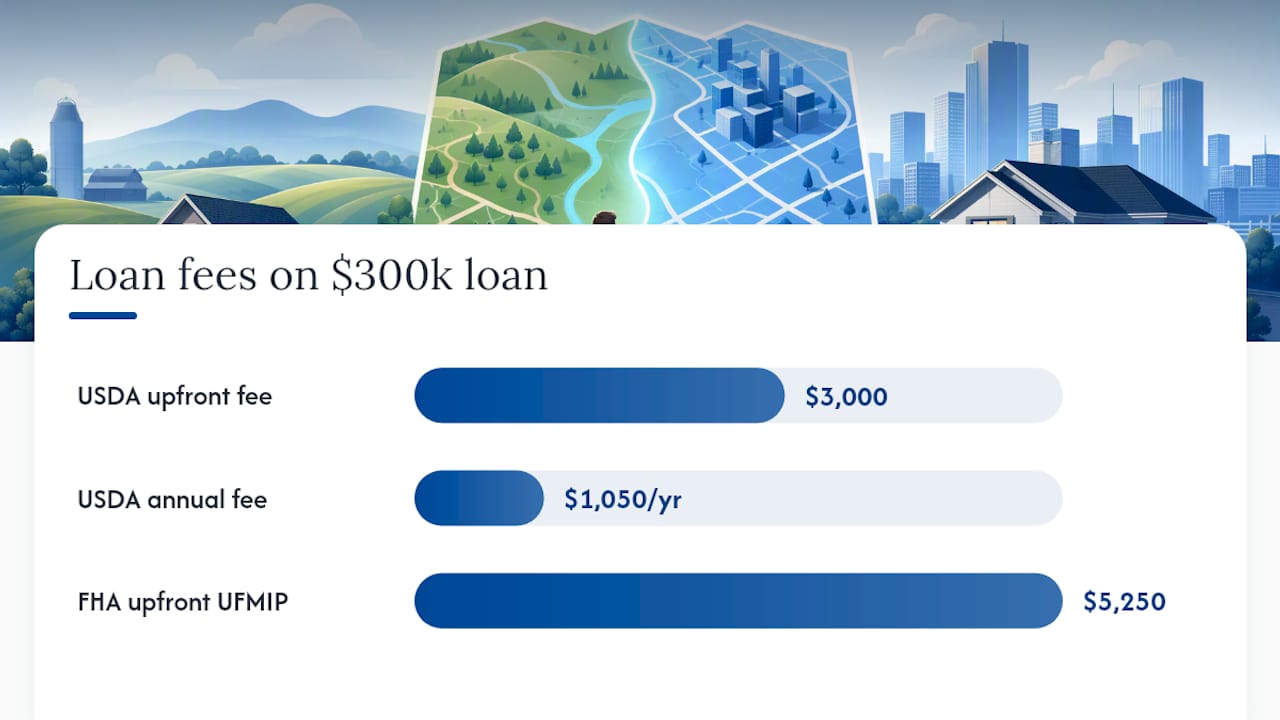
The ongoing insurance costs tell a different story. USDA charges roughly a 1% upfront guarantee fee plus an annual fee around 0.35% of the loan balance, according to USDA program guidance. FHA charges a 1.75% upfront mortgage insurance premium plus an annual MIP that varies by loan term and loan-to-value ratio, and it often runs higher than USDA's annual charge.
Cost snapshot on a $300,000 loan:
- USDA: roughly $3,000 upfront guarantee fee, plus about $1,050 a year in ongoing fees, built into your monthly payment.
- FHA: roughly $5,250 upfront UFMIP, plus an annual MIP that's frequently higher than USDA's rate depending on your down payment and term.
That fee gap compounds over time. FHA borrowers sometimes plan a refinance to a conventional loan once equity and credit improve enough to drop mortgage insurance entirely, a strategy worth discussing with your lender at closing rather than waiting until rates shift. USDA's annual fee, by contrast, usually stays on the loan for its full term, but at a lower rate, it costs less to carry. If you're weighing how insurance premiums affect your monthly budget either way, it's worth understanding how mortgage insurance differs from homeowners insurance before you commit to either program.
What Property Types and Price Limits Apply?
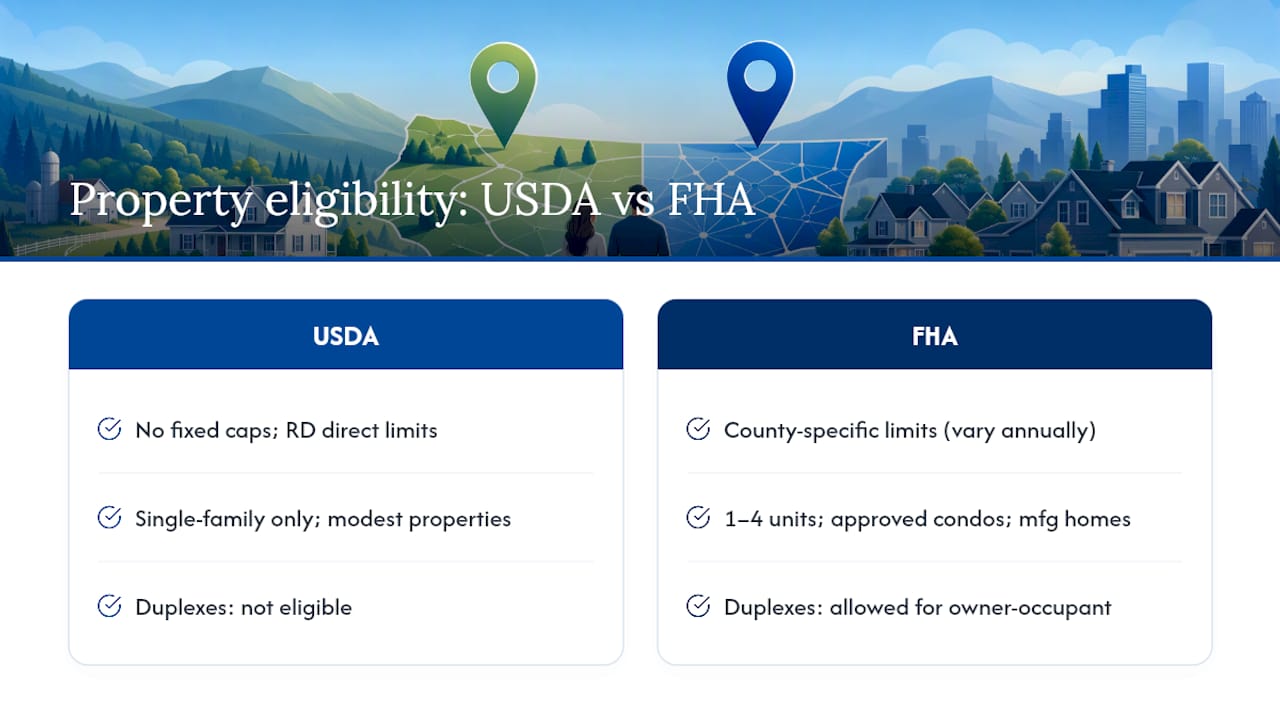
FHA loans have county-specific loan limits that vary annually and are higher in costly markets. USDA Guaranteed loans do not impose fixed loan caps but limit homes to modest properties appropriate for the area. USDA Direct loans, a separate and more restrictive program for lower-income applicants, do have published limits, detailed on the USDA RD direct loan limit map.
Regarding property types, USDA loans are for single-family homes only, whereas FHA loans also cover one- to four-unit properties, approved condos, and qualifying manufactured homes, provided the borrower occupies one unit. If you're eyeing a duplex as an owner-occupant investment, FHA is your only path between the two.
How Long Does Approval Take, and What Do Underwriters Check?
USDA's underwriting guidelines generally use conservative housing and total debt-to-income ratios, while FHA allows somewhat higher ratios. Both programs can approve exceptions with compensating factors or manual underwriting.
- DTI flexibility: USDA's numbers are conservative by design, a trade-off for offering zero-down financing; FHA gives underwriters more room to work with tighter budgets.
- Appraisal standards: USDA reviews both location eligibility and property condition; FHA applies minimum property standards focused on safety and structural soundness.
- Timeline: Most FHA loans close in 30 to 45 days; USDA often takes longer because the file routes through both the lender and a final USDA Rural Development review.
If your debt load runs higher than these benchmarks suggest, it's worth reading up on qualifying for a mortgage with a less-than-ideal DTI ratio before you assume either program is out of reach.
Weighing the Trade-offs: Which Loan Fits Your Situation?
Neither program wins across the board. It comes down to matching your specific numbers to what each one rewards.
- USDA pros: zero down payment, lower annual mortgage insurance, and coverage across a surprisingly large share of the country outside dense cities.
- USDA cons: income caps, single-family-only, tighter DTI benchmarks, and lender overlays that often push the effective credit minimum to 640.
- FHA pros: credit scores as low as 500, no income limit, works in any county, and accepts multi-unit and condo properties.
- FHA cons: higher upfront and ongoing mortgage insurance, plus that 1.75% UFMIP due at closing.
Three quick profiles: a nurse earning $58,000 buying in a USDA-eligible exurb with a 660 score fits USDA well. A restaurant owner with variable income and a 590 score buying in Miami fits FHA by both credit and location. A dual-income household over the USDA income cap, regardless of score, defaults to FHA or conventional financing.
Pro Tip: Run both scenarios through a lender before you fall in love with a listing. A $10,000 difference in upfront fees can change what down payment you actually need on closing day.
Building Your Decision Checklist
Work through these four steps in order, and you'll know which program to pursue before you ever submit an application.
- Check the address. Run it through the USDA eligibility tool. If the property falls outside the USDA boundary, stop here and move to FHA.
- Compare your income to the county limit. USDA publishes area median income figures by county; if your household sits under roughly 115% of that number, USDA stays in play. If not, FHA becomes your primary option regardless of location.
- Pull your credit score and assess your down payment savings. Below 640, expect USDA lender overlays to complicate approval; FHA's 500 to 580 range gives you more room, especially if you can put down 10%.
- Model the monthly payment both ways, including mortgage insurance, using a mortgage calculator so the fee differences show up in real dollars, not just percentages.
When you talk to lenders, ask directly what credit score overlay they apply to USDA files, whether they underwrite manually when DTI runs high, and how long their current USDA pipeline is taking to close. A red flag: any lender who can't answer the overlay question probably hasn't closed many USDA loans recently.
Pro Tip: If you're on the fence between the two, get pre-qualified for both. Comparing two real offers side by side tells you more than any calculator ever will.
A Broker's View on USDA vs FHA in Florida
Most of Florida's coastline and metro cores fall outside USDA boundaries, but plenty of inland counties and semi-rural pockets qualify, often to buyers' surprise. That's where the real value of running the USDA eligibility tool shows up: it corrects assumptions before they cost you a better rate.
Mortgage brokers work both scenarios side by side for Florida borrowers, checking USDA eligibility against a property address while modeling FHA as the parallel option. If your income sits near the cap, or your DTI runs close to the automated underwriting ceiling, a broker can identify compensating factors and lender overlays faster than shopping blind. That matters most for buyers with nonstandard income, self-employment, or a first FHA purchase and they're already eyeing an FHA loan in Miami. Bring pay stubs, two years of tax returns, and bank statements to your first conversation. It shortens everything that follows.
— David
Compare Your USDA and FHA Options With Lending Bankers
Mortgage brokerages in Florida may run both USDA and FHA scenarios side by side, so you're not guessing which program actually saves you more at closing and over the life of the loan.

Miami and Florida buyers face a specific wrinkle: much of the coast sits outside USDA boundaries, while inland counties often qualify. Mortgage brokers can check the address, run your income against the county limit, and price out both programs before you commit to an application. Three ways to start: model your numbers with the mortgage calculator, compare lenders through Finding Your Ideal Home Loan, or review how mortgage insurance affects your payment before you lock a rate. Reach out to a knowledgeable broker directly to get both scenarios priced against your actual credit and income, not a generic estimate.
Where These Numbers Come From
The USDA and FHA figures throughout this article come from primary program sources. Verify your own property and income against the USDA property eligibility tool and the HUD FHA program page directly, since both update periodically. The USDA RD direct loan limit map covers loan caps for the Direct program specifically. For a broader industry comparison that includes conventional loans, Money's guide to USDA vs. FHA vs. conventional walks through the same decision logic from a national perspective.
This article is general information, not a substitute for advice from a qualified financial advisor. Consult a qualified financial professional about your own circumstances before acting on anything here.