
Yes, self-employed Florida residents can qualify for a mortgage in 2026. The right program depends on how you document income, your credit score, and the reserves you bring to the table. Lenders now have more flexibility than most business owners expect, from conventional loans that average two years of tax returns to bank-statement programs built specifically for freelancers and 1099 contractors. Your next step is straightforward: gather your last two years of tax returns and business bank statements, then talk to a Florida mortgage broker who works with self-employed borrowers every week. That conversation will tell you which program fits your income pattern before you ever submit a formal application.
Key Takeaways
Self-employed Florida borrowers qualify by matching their income documentation style, credit profile, and reserves to the loan program built for that combination.
| Point | Details |
|---|---|
| Multiple programs exist | Conventional, FHA, VA, bank-statement, DSCR, and jumbo loans each fit different self-employed income patterns. |
| Two-year history matters | Fannie Mae and Freddie Mac generally expect two years of self-employment to prove income will likely continue. |
| Documentation drives approval | Tax returns, P&L statements, business bank statements, and a CPA letter form the core underwriting file. |
| Reserves and down payments vary | Bank-statement and jumbo loans typically require larger down payments and reserves than conventional financing. |
| Lending Bankers matches programs to income | Lending Bankers helps Florida self-employed borrowers prepare documentation and connects them with lenders suited to non-traditional income. |
Table of Contents
- Self Employed Mortgage Florida Options Compared
- What Florida Lenders Look For Before Approving You
- Documenting Your Income: What Underwriters Actually Want
- Florida Loan Costs, Down Payments, and Limits To Know
- Your Timeline From Prequalification To Closing
- How Fannie Mae, Freddie Mac, and FHA Evaluate Self-Employed Borrowers
- A Broker's View From the Florida Market
- Get Expert Help Financing Your Florida Home
- Where To Verify Program Rules and Limits
- Sources
Self Employed Mortgage Florida Options Compared
Not every self-employed borrower fits the same box, and lenders in Florida have built out separate lanes to handle that. Some programs lean on tax returns and two years of history. Others skip tax returns entirely and qualify you off bank deposits. Knowing which lane matches your income style saves weeks of back-and-forth with an underwriter.

Conventional loans (backed by Fannie Mae or Freddie Mac) remain the cheapest option for self-employed borrowers who file clean tax returns and can show consistent or growing income. FHA loans work well for borrowers with lower credit scores or tighter reserves, since HUD allows more flexible debt ratios. VA loans serve eligible veterans and service members, and the Department of Veterans Affairs applies its own documentation rules that often waive down payment entirely for qualifying borrowers. Bank-statement and non-QM loans exist for business owners whose tax returns show heavy write-offs that mask true cash flow. DSCR loans qualify real estate investors off the property's rental income rather than personal income at all. Jumbo loans kick in once the loan amount exceeds the conforming limit, and self-employed jumbo borrowers usually face tighter reserve requirements.
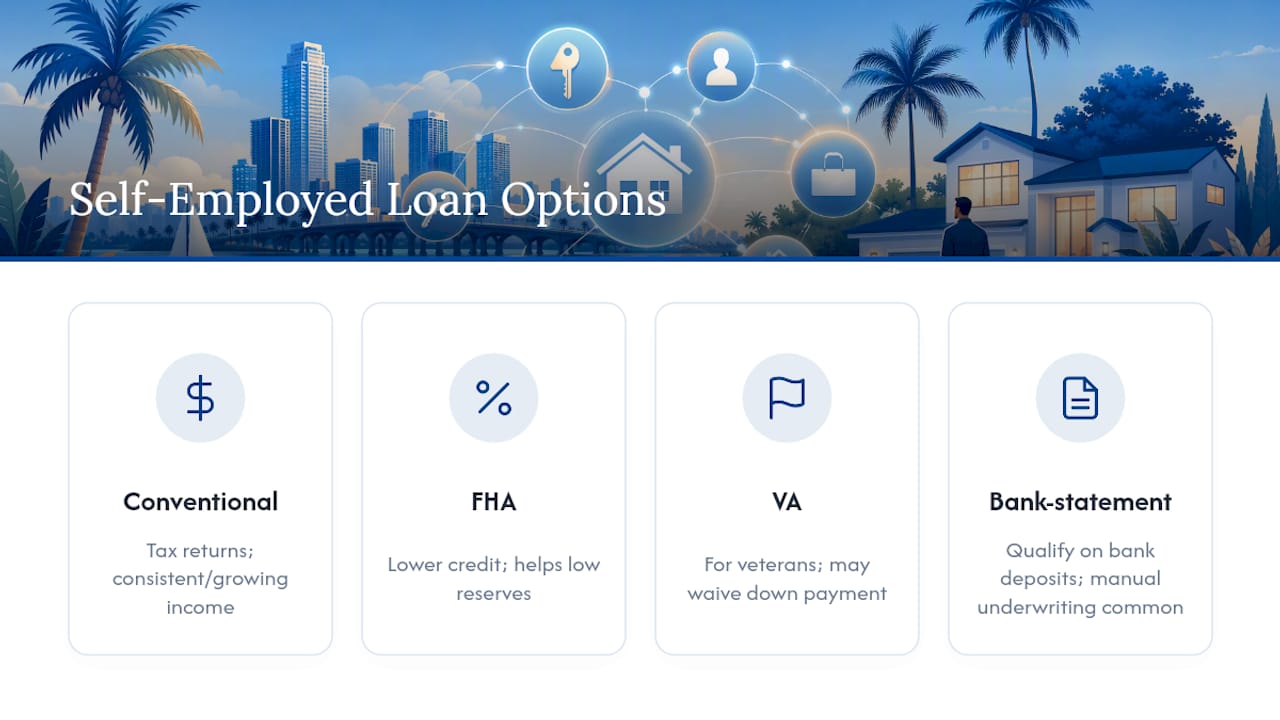
FHA, VA, and many non-QM files routinely require manual underwriting for self-employed applicants, meaning a human underwriter reviews the full file instead of relying purely on an automated approval. That process takes longer but often approves borrowers that automated systems reject outright.
What Florida Lenders Look For Before Approving You
Lenders evaluate four things before they hand you a self employment income mortgage approval: credit, debt-to-income ratio, reserves, and how long you've run your business. Each one moves the needle on which programs you qualify for and what rate you'll pay.
- Credit score: 620 opens conventional financing; 580 keeps FHA on the table; scores above 700 unlock the best pricing and the widest program selection.
- Debt-to-income ratio (DTI): Most lenders cap DTI around 43% to 50%, but self-employed borrowers often see their qualifying income shrink after underwriters strip out business deductions, which pushes the ratio higher than what your bank account suggests.
- Reserves: Conventional loans may ask for two to six months of mortgage payments in reserve; non-QM and jumbo programs frequently require six to twelve months.
- Length of self-employment: Fannie Mae's guidance generally calls for two years of self-employment history to prove your income is likely to continue, though a borrower with less than two years can sometimes qualify if they have a strong background in the same field.
Pro Tip: Pull your credit report three months before you plan to apply. Paying down revolving balances even slightly can drop your DTI enough to bump you from FHA into conventional pricing, which usually means a lower rate over the life of the loan.
If your tax returns show a rough patch two years ago, don't assume you're stuck. Freddie Mac's own guidance notes that lenders may give more weight to the most recent year when income shows a clear upward trend, which matters a lot to a business owner who had a slow 2024 and a strong 2025.
Documenting Your Income: What Underwriters Actually Want
Underwriters don't just read your tax return; they reconstruct your real cash flow from several documents at once. Knowing what to hand over, and in what order, keeps your file moving instead of stalling in a stack of conditions.
Here's what most lenders require for a self-employed mortgage Florida file:
- Two years of personal tax returns, including all schedules
- Two years of business tax returns (if you file separately as an S-corp, partnership, or corporation)
- Schedule C, Schedule K-1, or 1099s depending on your business structure
- Year-to-date profit and loss statement, often CPA-prepared or signed
- Business bank statements, typically 12 to 24 months
- A CPA letter confirming your business remains active and stable
Underwriters average your income across the two most recent years, then add back non-cash expenses like depreciation and one-time losses that don't reflect true cash flow. Fannie Mae's guidance confirms that lenders prioritize sustainable cash flow to the borrower over the taxable number on the return, which is good news if your accountant has been aggressive with deductions. S-corp owners get a different look than sole proprietors, since distributions and W-2 wages from the business get evaluated separately from retained business earnings.
If your write-offs are so heavy that your taxable income doesn't reflect what you actually bring home, a bank-statement loan sidesteps tax returns entirely and qualifies you off deposits instead. It's worth learning how these alternative documentation loans work before ruling out homeownership because of a lean tax return.
Pro Tip: Ask your CPA for a signed, dated profit and loss statement the same week you plan to apply. A P&L that's more than 60 days old often triggers an underwriter to ask for an updated version, which adds delay right when you don't want it.
Florida Loan Costs, Down Payments, and Limits To Know
Down payments for self-employed borrowers in Florida generally run higher than what a W-2 employee might see, mostly because lenders offset income variability with more skin in the game.
- FHA: 3.5% down for qualifying credit scores
- Conventional loans may require moderate to higher down payments, with better pricing for larger down payments
- Bank-statement and non-QM loans generally require moderate down payments
- Jumbo: often 10% to 20%, with stricter reserve requirements
FHFA sets the conforming loan limit values for 2026, which draws the line between conventional pricing and jumbo pricing. Because Florida has several higher-cost counties, it's worth confirming your county's specific limit rather than assuming the baseline figure applies statewide. Self-employed borrowers also tend to pay slightly more in underwriting fees when a file requires manual review, on top of standard appraisal and closing costs. Florida Housing runs down payment assistance programs that can reduce upfront cash needs for eligible buyers, which is worth exploring before you assume you need the full amount saved.
Your Timeline From Prequalification To Closing
Self-employed borrowers can expect a longer runway than W-2 buyers, mostly because document collection and underwriting review take extra rounds. Here's the realistic sequence:
- Prequalification (1 to 3 days): Provide two years of tax returns and a summary of your business structure so a broker can identify which programs you qualify for.
- Document assembly (1 to 2 weeks): Gather tax returns, P&L statements, bank statements, and your CPA letter, organized by year and clearly labeled.
- Underwriting (2 to 4 weeks): Expect follow-up requests, especially if your income shows a downward trend, commingled business and personal accounts, or gaps in self-employment history. Manual underwriting adds time but often results in approval where automated systems would decline.
- Closing (typically 30 to 45 days total from application): Final verification of employment, updated bank statements, and confirmation that reserves are still intact.
Reach out to a Florida broker for a pre-assessment before you start shopping for homes. That single conversation often surfaces documentation gaps you can fix in advance, which shaves real time off the process later.
How Fannie Mae, Freddie Mac, and FHA Evaluate Self-Employed Borrowers
Underwriting guidance from the two major agencies shares a common thread: they care less about your tax bracket and more about whether your business can keep generating income.
Lenders must analyze the stability of a self-employed borrower's business and the borrower's ability to continue to generate and distribute sufficient income to support the mortgage payment, generally requiring a two-year history to demonstrate likely continuation of income.
That's the core logic behind Fannie Mae's underwriting standard, and Freddie Mac's guidance largely mirrors it, with room for alternative documentation like year-to-date P&Ls when a borrower's history supports it. FHA and VA programs apply their own residual income and documentation rules, which is why the same borrower can sometimes qualify for one program and not another.
A Broker's View From the Florida Market
The biggest hurdles we see aren't income problems, they're paperwork problems: over-deducted returns, commingled bank accounts, and thin reserves. The fix is almost always the same. Separate your accounts, get a CPA-prepared P&L, and keep signed client contracts on hand. Florida's seasonal closing volume, especially in winter, can stretch underwriting timelines, so build in a buffer if you're targeting a specific move-in date.
Get Expert Help Financing Your Florida Home
Lending Bankers gives self-employed borrowers something a generic lender rarely offers: a broker who matches your specific income documentation to the program that actually approves it, instead of forcing your file through a one-size-fits-all checklist.
Lending Bankers works across Miami and the state of Florida, matching self-employed buyers, business owners, and 1099 contractors with lenders suited to their income style, whether that means a conventional loan, a bank-statement program, or manual underwriting advocacy for a file that needs extra explanation. The team helps prepare your documentation package before submission, so underwriters see a clean, complete file the first time rather than a stack of follow-up requests. All lending activity is conducted through properly licensed mortgage professionals, and you can verify credentials directly through NMLS Consumer Access before you commit to working with anyone.
If you want a realistic read on your numbers before you talk to anyone, run your scenario through the Miami mortgage calculator to see estimated payments across a few program types. When you're ready for a real conversation, connect with Lending Bankers' local lending team for a pre-assessment of your file and a clear next step toward closing.
Where To Verify Program Rules and Limits
Confirm current numbers directly from the source before relying on any figure you find elsewhere.
- FHFA: verifies current conforming loan limits by county
- Fannie Mae and Freddie Mac: confirm underwriting rules for self-employed income
- Florida Housing: details state-level down payment assistance programs
- HUD: provides the High Cost Look-Up tool to verify local cost adjustments
This article is general information, not a substitute for advice from a qualified financial advisor. Consult a qualified financial professional about your own circumstances before acting on anything here.
Sources
- Underwriting Factors and Documentation for a Self-Employed Borrower | Fannie Mae
- Qualifying for a Mortgage When You’re Self-Employed - My Home by Freddie Mac
- FHFA announces conforming loan limit values for 2026
- Florida Housing