
If your primary need is owner-occupied commercial property or long-life equipment, start with an SBA 504 loan. If you need working capital, funds to buy a business, or flexibility across multiple uses, start with an SBA 7(a) loan. Some borrowers qualify for both at once, which changes how you structure the deal. Your decision should hinge on use of funds, how much rate certainty you need, and your timeline.
TL;DR:
- The 504 loan is best for owner-occupied real estate and long-lasting equipment, with fixed rates locked to Treasury yields and terms up to 25 years.
- The 7(a) loan offers more flexibility for working capital, business acquisitions, and various uses, with mostly variable rates and faster processing times.
- Combining both programs is possible when a deal involves separate needs like real estate and operating cash, with limits of up to 5 million dollars per program.
- The 504 process requires longer timelines and thorough preparation, including appraisals and occupancy plans, making readiness critical.
- A well-prepared application with complete financial documents speeds up approval more than choosing the perfect program.
Table of Contents
- SBA 504 vs 7(a): How Does the 504 Program Work?
- SBA 504 vs 7(a): What Makes the 7(a) Program Different?
- SBA 504 vs 7(a): Side-by-Side Comparison
- How Do You Choose Between 504 and 7(a)?
- What Do You Need to Apply for an SBA Loan?
- Why Preparation Beats Program Choice Every Time
- Get Your SBA Loan Packaged Right the First Time
- Sources
SBA 504 vs 7(a): How Does the 504 Program Work?
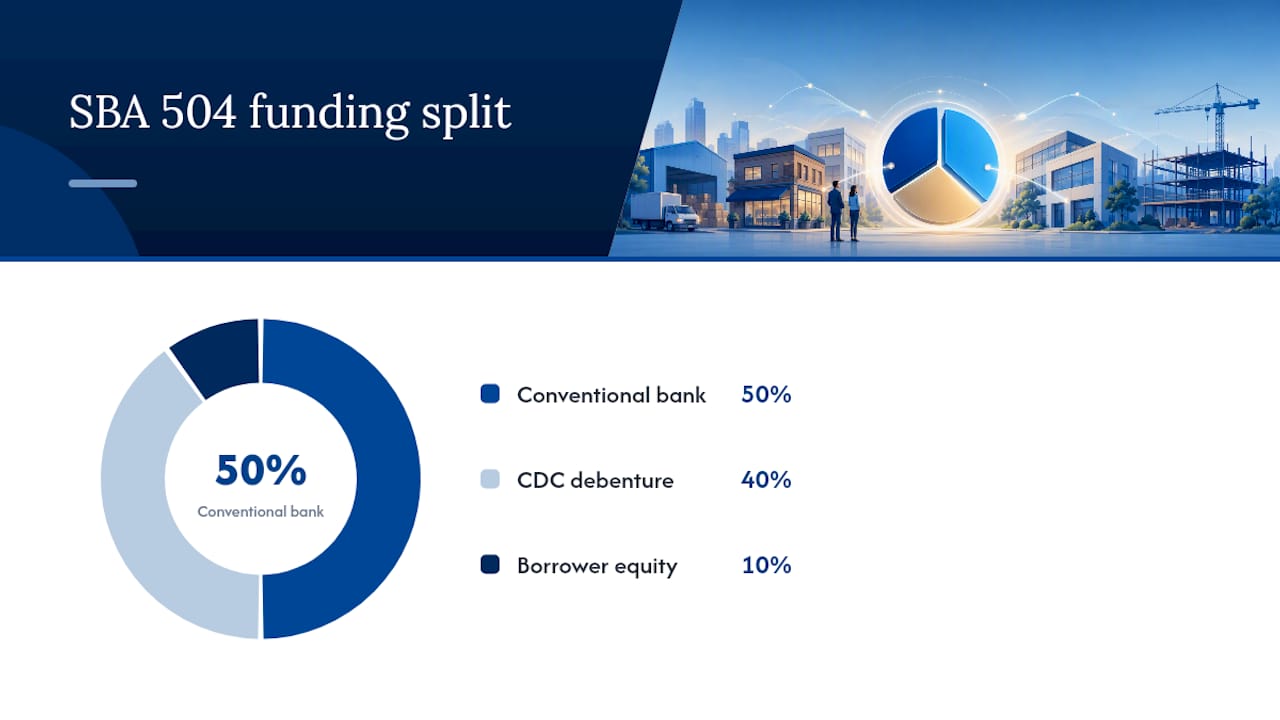
The SBA 504 loan runs through a three-party structure: a conventional bank, a Certified Development Company (CDC), and you, the borrower. The bank typically funds around 50% of the project, the CDC covers roughly 40% through an SBA-backed debenture, and you put down about 10% in equity. That CDC piece is what makes the 504 distinctive.
The program exists for fixed assets. You can use it for owner-occupied commercial real estate, ground-up construction, major renovations, or equipment with a long useful life. You generally need to occupy at least 51% of an existing building or 60% of new construction. What you can't do is use 504 funds for working capital or goodwill in a business acquisition.
The CDC-backed portion can reach $5.5 million on qualifying projects, and repayment terms commonly run 10, 20, or 25 years. The CDC debenture is priced off Treasury yields, so once it sells, your rate is locked for the life of that portion. That fixed rate is the program's biggest selling point in a rising or uncertain rate environment.
Timelines run longer than 7(a) because you're coordinating two lenders instead of one. What speeds things up:
- Two years of clean financial statements ready before you apply
- A completed appraisal and environmental report on the property
- A clear occupancy plan showing how the space will be used
Pro Tip: Ask your CDC about the annual servicing fee upfront. It's a small percentage of the outstanding balance, but it's often financed into the loan, and borrowers get caught off guard when they don't budget for it.
SBA 504 vs 7(a): What Makes the 7(a) Program Different?
The SBA 7(a) loan runs through a single lender, not a three-party structure, which is a major reason it moves faster. There's no CDC to coordinate, no second closing to schedule.
Where the 504 restricts you to fixed assets, the 7(a) is built for flexibility. You can use it for working capital, buying an existing business, refinancing debt, purchasing equipment, or acquiring real estate. Many owners use one 7(a) loan to cover several of these needs in a single transaction.
Loan caps and pricing work differently too:
- Standard 7(a) loans max out at $5 million; SBA Express and Export Express carry lower caps but faster processing
- Rates are usually variable: a base rate plus a lender spread, with SBA-imposed caps on how high that spread can go
- Fixed-rate options exist but are less common than variable pricing
- Guarantee fees apply and scale with loan size
Terms vary by use. Working capital and equipment loans often run 7 to 10 years, while real estate purchased through 7(a) can stretch to 25 years. Standard 7(a) applications typically close in 60 to 90 days, while Express loans can move in as little as 5 to 10 days for qualifying borrowers. That turnaround advantage matters most when you're racing a purchase deadline or need cash before a slow season hits.
SBA 504 vs 7(a): Side-by-Side Comparison
The clearest way to see the tradeoff is to line up what each program actually does with your money.
| Factor | SBA 504 | SBA 7(a) |
|---|---|---|
| Primary use | Owner-occupied real estate, long-life equipment | Working capital, acquisitions, refinancing, mixed uses |
| Rate structure | Fixed CDC portion, tied to Treasury yields | Variable base rate plus spread; fixed options exist |
| Typical down payment | ~10% equity | Varies, often 10 to 20% depending on use |
| Parties involved | Bank + CDC + borrower | Single lender |
| Typical terms | 10, 20, or 25 years | 7 to 25 years depending on use |
| Typical timeline | 60 to 90 days | 60 to 90 days standard; Express as fast as 5 to 10 days |
| Working capital or goodwill | Not permitted | Permitted |
On a straightforward property purchase, the 504's fixed CDC rate frequently produces lower monthly payments and lower lifetime interest cost than financing the same building entirely through a 7(a). That gap widens the longer you hold the property, since a variable-rate loan carries the risk of climbing right alongside the market.
Here's where each program clearly wins:
- 504 is the better fit when you're buying or building owner-occupied real estate and want rate certainty for two decades or more.
- 7(a) is the better fit when you're acquiring a business, need working capital alongside a purchase, or your timeline is tight.
- Combining both works well when a deal has two distinct needs: real estate through 504, operating cash through 7(a). As of July 4, 2026, eligible borrowers can hold up to $5 million in each program simultaneously, for up to $10 million in combined SBA-backed financing.
How Do You Choose Between 504 and 7(a)?
Work through these questions in order before you approach a lender:
- What are the funds actually for? If it's a building or equipment you'll own and occupy, 504 belongs on your shortlist. If it's a business purchase, inventory, or working capital, look at 7(a).
- Will you occupy the property? 504 requires majority occupancy. If you're buying an investment property to lease out, 504 isn't an option.
- How much equity can you put down? Both programs generally expect an equity injection, typically around 10%, though this varies with several factors.
- Do you need rate certainty or speed? 504 wins on long-term rate stability. 7(a) wins on turnaround time.
- Does your deal have two needs at once? If you're buying a building and need cash to operate it, ask your lender about structuring both loans together.
Three quick profiles show how this plays out. A dental practice buying its own office building, with stable finances and no urgency, is a textbook 504 case. A retailer acquiring a competitor's storefront and inventory, needing funds within 60 days, fits 7(a) better. A manufacturer buying a facility and needing new equipment plus a cash cushion often ends up combining both.
When you talk to lenders or a CDC, ask directly about total fees, how they coordinate a dual 504/7(a) structure if you need one, and what their average time-to-close has actually been on recent deals, not just their advertised range.
Pro Tip: If a lender can't clearly explain how they'd coordinate a combined 504 and 7(a) closing, that's a sign to keep shopping. Coordinating two SBA programs takes real experience, not a generic answer.
What Do You Need to Apply for an SBA Loan?
Eligibility for both programs starts with the basics: you need an operating for-profit business that meets SBA size standards, along with demonstrated ability to repay from projected cash flow. For 504, your CDC will also confirm your occupancy plan meets program rules.
Documents that shorten underwriting time include two to three years of financial statements, tax returns, cash flow projections, signed leases if applicable, and a current appraisal for any real estate involved. Missing documentation is the single biggest cause of delay in both programs, more than any underwriting complexity. Reviewing what commercial lenders actually look for before you apply helps you assemble a file that moves.
Expect these costs: an SBA guarantee fee on both programs, a CDC servicing fee on 504, and standard closing costs like appraisal and legal fees. Prepayment penalties apply differently. 504 debentures carry a declining prepayment penalty over roughly the first half of the term, while 7(a) prepayment penalties typically only apply in the first three years on loans with maturities over 15 years.
Why Preparation Beats Program Choice Every Time
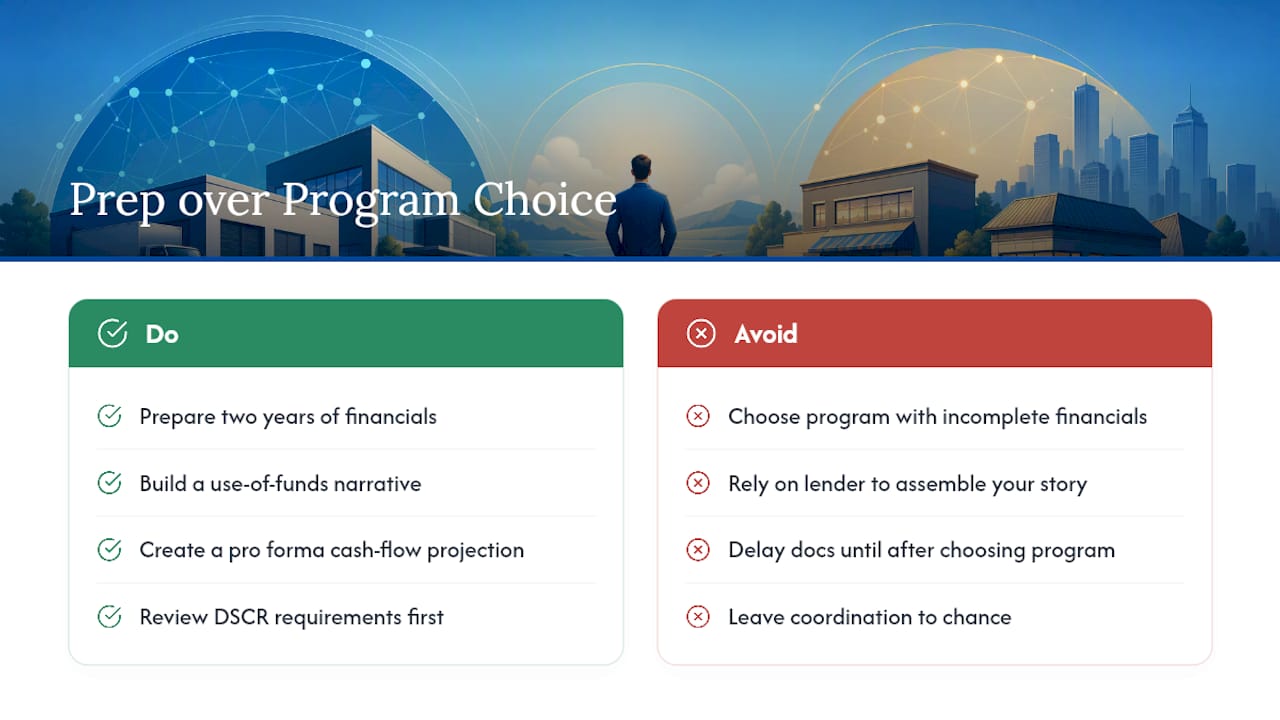
The 504 versus 7(a) decision matters, but David has seen plenty of well-matched applications fall apart on paperwork, not program fit. A borrower who picks the "right" loan but shows up with incomplete financials will lose more time than one who picks a slightly suboptimal program with a clean file.
At Lending Bankers, the evaluation starts with use of funds and occupancy, then works backward to whether a single 7(a), a straight 504, or a combined structure makes sense. Where this pays off most is coordination. When a deal needs both a CDC and a bank lender, someone has to keep both timelines moving together, and that's where deals stall without an experienced hand.
David's advice: build your two years of financials and your use-of-funds narrative before you talk to any lender, not after. A borrower who walks in with a tight pro forma cash flow projection and a clear occupancy or acquisition plan gets underwritten faster than one relying on the lender to piece the story together. If you're weighing 504 against 7(a), that prep work also protects your DSCR position going into underwriting, something worth reviewing through a DSCR loan requirements guide before you finalize numbers.
— David
Get Your SBA Loan Packaged Right the First Time
Lending Bankers is the direct route to an SBA loan that closes without the back-and-forth that stalls most applications, whether that means a straight 504, a straight 7(a), or a combined structure sized to $10 million. We package commercial loan files the way underwriters actually want to see them, and we coordinate the CDC and bank timelines on your behalf so you're not managing two lenders on your own.
On first contact, expect a straightforward assessment of your use of funds, occupancy plans, and financial documentation, followed by a checklist of exactly what to gather before you submit anything. If you're also weighing how the numbers pencil out over 10, 20, or 25 years, an amortization calculator is a useful gut check before you commit to either structure. Ready to see which program fits your deal? Start by reviewing what commercial lenders look for and reach out to Lending Bankers to get your file moving.
This article is general information, not a substitute for advice from a qualified financial advisor. Consult a qualified financial professional about your own circumstances before acting on anything here.
Sources
- 504 loans - Small Business Administration
- SBA 504 vs. SBA 7(a) Loans: Which Is Right for Your Business? | Investopedia