
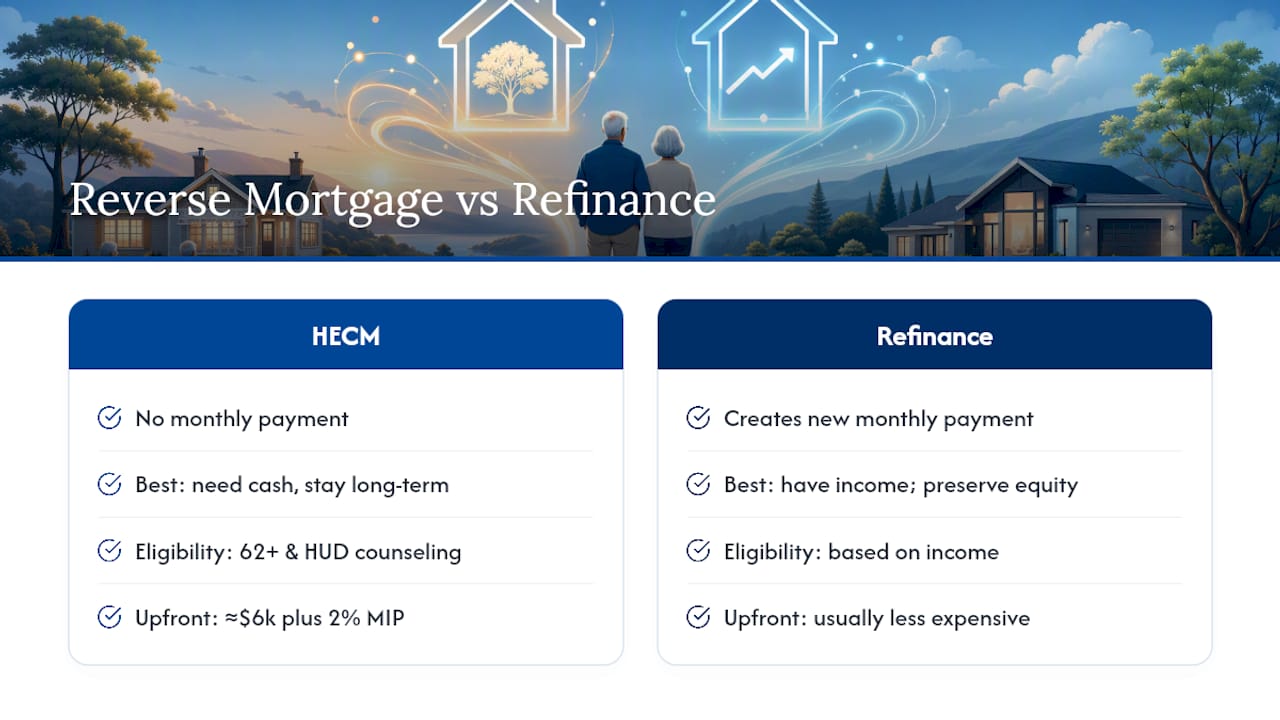
If you need steady monthly cash and plan to stay in your home for years, a HECM reverse mortgage usually fits best. If you have reliable income and want to lower your rate while preserving home equity, a cash-out refinance or HELOC is typically the smarter move. Your next step depends on which camp you fall into.
- Considering a HECM? Schedule a session with a HUD-approved counselor before you sign anything.
- Leaning toward refinance? Get a rate quote and run the numbers through underwriting first.
Neither option fits everyone. If your timeline is short, your equity is thin, or your goal is simply downsizing, selling the home or tapping a retirement account may serve you better than either loan product.
Key Takeaways
A HECM suits retirees needing monthly cash without a new payment, while a cash-out refinance or HELOC suits homeowners with income who want to preserve equity.
| Point | Details |
|---|---|
| Match product to goal | Choose a HECM for cash flow without payments; choose refinance or HELOC to preserve equity. |
| Counseling is mandatory | HUD-approved counseling is required before any HECM can close. |
| Upfront costs run high for HECMs | Origination fees near $6,000 plus roughly 2% MIP make short-term use inefficient. |
| Obligations still apply | Property taxes, insurance, and maintenance must continue, or foreclosure risk rises. |
| Get a personalized comparison | Lending Bankers runs side-by-side HECM and refinance scenarios and checks NMLS licensing before you commit. |
Where to Verify These Facts Yourself
- CFPB's reverse mortgage guide: program rules and counseling requirements.
- GAO's reverse mortgage report: default statistics and risk data.
- Forbes Advisor's reverse mortgage overview: plain-language pros and cons comparison.
Table of Contents
- Reverse Mortgage vs. Refinance: How a HECM Works
- Reverse Mortgage vs. Refinance: How Cash-Out Refinancing and HELOCs Work
- Comparing HECM, Cash-Out Refinance, and HELOC Side by Side
- What Fees and Long-Term Costs Actually Look Like
- How Do You Choose Between a HECM, Refinance, HELOC, or Something Else?
- Quick Look: HELOCs, Downsizing, and Other Alternatives
- What Federal Data and Financial Experts Say About the Risks
- Frequently Asked Questions
- Sources
Reverse Mortgage vs. Refinance: How a HECM Works
A Home Equity Conversion Mortgage, or HECM, is the FHA-insured reverse mortgage program that lets homeowners 62 and older convert home equity into cash without a monthly mortgage payment. You choose how to receive the money: a lump sum, a line of credit, monthly payments, or some combination. The loan is non-recourse, meaning neither you nor your heirs will owe more than the home's value at sale, even if the balance grows larger than the property is worth.
Before you can close, HUD requires independent counseling so you understand exactly what you're signing up for, including these ongoing obligations:
- Pay property taxes and homeowners insurance on time, every year.
- Maintain the home to FHA standards.
- Live in the property as your primary residence.
Skipping any of these can trigger foreclosure, even though there's no monthly principal payment due.
Upfront costs run high. Origination fees can reach roughly $6,000, and you'll also pay an upfront mortgage insurance premium of about 2% of your home's value. That balance then grows over time as interest and insurance premiums compound, quietly eating into your equity.
Pro Tip: Older borrowers get a higher principal limit factor, meaning a 78-year-old will typically qualify for more cash against the same home value than a 63-year-old.
Reverse Mortgage vs. Refinance: How Cash-Out Refinancing and HELOCs Work
A cash-out refinance replaces your existing mortgage with a larger one and hands you the difference in a single lump sum. A HELOC works differently. It's a revolving line of credit secured by your equity, with a draw period where you borrow as needed. Both options generally require steady income, a qualifying credit score, and an acceptable debt-to-income ratio — unlike a HECM, where the underwriting bar is lower but the ongoing obligations are stricter.
Here's the key trade-off:
- Cash-out refinance: one lump sum, fixed monthly payment, often a lower rate than a HELOC.
- HELOC: flexible draws, variable rate, interest-only payments during the draw period before principal kicks in.
Pro Tip: If current mortgage rates sit below your existing rate, a cash-out refinance can sometimes lower your payment while still handing you cash. Run that math before assuming a reverse mortgage is your only path.
Comparing HECM, Cash-Out Refinance, and HELOC Side by Side
| Factor | HECM (reverse mortgage) | Cash-out refinance | HELOC |
|---|---|---|---|
| Who qualifies | Homeowners 62+, HUD counseling required | Income, credit, and DTI qualification | Income, credit, and available equity |
| How funds arrive | Lump sum, line of credit, or monthly draws | Single lump sum at closing | Revolving draws during draw period |
| Repayment trigger | Due when borrower sells, moves, or dies | Fixed monthly payments over loan term | Monthly payments, often interest-only at first |
| Interest type | Adjustable or fixed, accrues with no monthly payment | Fixed or adjustable, paid down monthly | Usually variable |
| Upfront costs | High: origination fees plus 2% MIP | Moderate: 2% to 6% of loan amount | Low to moderate |
| Long-term equity effect | Equity typically declines over time | Equity rebuilds with each payment | Equity rebuilds as balance is paid down |
| Counseling required | Yes, mandatory HUD session | No | No |
| Best for | Retirees aging in place, limited income | Homeowners with income wanting lower rates | Homeowners needing flexible, as-needed access |
The clearest signal: if preserving equity for heirs matters most, refinance or HELOC usually wins. If monthly cash flow without a new payment matters most, the HECM usually wins.
What Fees and Long-Term Costs Actually Look Like
Numbers make this decision concrete. A typical HECM carries an origination fee up to about $6,000 plus an upfront mortgage insurance premium near 2% of home value, on top of ongoing interest that compounds because no monthly payments reduce the balance.
Pro Tip: If you expect to move or sell within five years, the FTC's own guidance suggests a HECM's high upfront costs rarely pay off over that short a window. A refinance or HELOC is often cheaper for short-term needs.
How Do You Choose Between a HECM, Refinance, HELOC, or Something Else?
- Map your timeline. How many years do you realistically expect to stay in the home?
- Check your income and credit. Strong, steady income points toward refinance or HELOC qualification. Limited income points toward a HECM.
- Decide your priority. Monthly payment relief, or preserving equity for your heirs?
- Get quotes from multiple sources. Ask lenders about rates, fees, escrow requirements, and exactly what triggers repayment.
- Complete required counseling. For a HECM, this is mandatory. For a refinance, ask your loan officer to walk you through the full amortization schedule.
Before signing anything, confirm your lender is NMLS-licensed, ask for full fee disclosure in writing, and watch for red flags like pressure to skip counseling or vague answers about repayment triggers.
- Verify HUD-approved counseling was completed (HECM only).
- Confirm the lender's NMLS license number.
- Request a written, itemized fee disclosure before closing.
Quick Look: HELOCs, Downsizing, and Other Alternatives
- HELOC: flexible draws, variable rate, requires income and credit.
- Selling or downsizing: eliminates the mortgage entirely, frees up full equity, but means relocating.
- Home equity loan: fixed lump sum, fixed payment, good for one-time expenses.
- Tapping retirement accounts: avoids new debt but may trigger taxes or reduce long-term income.
- Partial cash-out refinance: smaller loan increase, lower payment, less equity drawn down.
What Federal Data and Financial Experts Say About the Risks
HUD requires independent counseling before a HECM closes specifically because the program carries non-obvious risks: ongoing property-charge obligations, occupancy rules, and a loan balance that compounds silently in the background.
The GAO found that reverse mortgage defaults rose sharply, climbing from 2% of terminations in 2014 to 18% in 2018, almost entirely because borrowers missed property tax or insurance payments rather than any payment default on the loan itself.
Mainstream financial voices like Suze Orman and Dave Ramsey have long cautioned against reverse mortgages, citing complexity and the risk of losing the home over missed obligations.
- Counseling exists to prevent exactly these missteps.
- The core trade-off experts return to again and again: cash flow today versus equity preserved for heirs tomorrow.
How Lending Bankers Helps You Weigh These Options
We walk clients through side-by-side scenarios comparing a HECM against a cash-out refinance, using real numbers based on your home's value and your goals. We also connect you with HUD-approved counselors and verify licensing before you commit to anything. If you want a personalized eligibility check or a refinance quote, that conversation starts with a consultation.
Get a Personalized Comparison Before You Decide
Choosing between a reverse mortgage and a refinance isn't something you should figure out from a spreadsheet alone. Lending Bankers Mortgage runs the actual numbers for your specific home value, age, and income against both paths, then points you toward HUD counseling if a HECM makes sense or a rate quote if refinancing wins out.

We serve homeowners across Miami and the state of Florida, and we specialize in exactly this kind of side-by-side decision, not just one product. If a HECM looks like your best fit, our reverse mortgage FAQ walks through eligibility and payout details specific to Florida home values. If refinancing looks more practical, you can check refinance and home equity options built around your current mortgage balance. Either way, the next step is the same: reach out for a free consultation and eligibility check, and we'll help you see which path actually pencils out for your situation.
Frequently Asked Questions
Is a reverse mortgage better than refinancing for retirees? It depends on your goals. A HECM works better if you need monthly cash without a new payment and plan to stay long-term. Refinancing works better if you have income and want to preserve equity.
What's the main difference between a reverse mortgage and a HELOC? A HECM requires no monthly payment and is available only to homeowners 62 and older with HUD counseling. A HELOC requires monthly payments and qualifies based on income and credit, with no age restriction.
Does a reverse mortgage affect Social Security or Medicaid? Reverse mortgage proceeds generally don't count as income for Social Security, but if funds sit in a bank account past month's end, they could affect Medicaid or SSI eligibility based on asset limits. Check with a benefits counselor before drawing large lump sums.
How much does refinancing typically cost compared to a reverse mortgage? HECMs carry origination fees up to roughly $6,000 plus a 2% upfront mortgage insurance premium, making them pricier upfront.
When should I talk to a financial advisor instead of just a lender? Talk to an advisor or HUD-approved counselor whenever heirs, Medicaid eligibility, or long-term retirement income planning are part of your decision, not just the loan mechanics.
This article is general information, not a substitute for advice from a qualified financial advisor. Consult a qualified financial professional about your own circumstances before acting on anything here.
Sources
- Considering a Reverse Mortgage - CFPB PDF
- How much does a reverse mortgage loan cost? - CFPB
- Reverse Mortgages Present Benefits and Risks for Senior Homeowners | U.S. GAO
- Reverse mortgages - FTC consumer advice
- Cash-out refinance vs reverse mortgage - SuperMoney