
A reverse mortgage can solve monthly cash shortfalls for homeowners who plan to remain in their home long-term, but it typically reduces the equity available to heirs. That's the trade-off in one sentence, and everything else in this guide fills in the details around it.
The federally insured version, called a Home Equity Conversion Mortgage (HECM), comes with real consumer protections: HUD requires borrowers to be 62 or older, mandatory counseling is built into the process, and the loan proceeds you receive are generally not counted as taxable income. Those guardrails exist because the CFPB treats reverse mortgages as a strategic retirement tool, not a quick fix, and wants borrowers to understand the long-term consequences before signing anything.
Here's the quick decision filter:
- If you plan to stay in your home for five or more years and need steady supplemental income, a reverse mortgage can be worth serious consideration.
- If you expect to move within a few years, want to preserve maximum equity for heirs, or rely on need-based benefits, it's usually not the right fit.
Key Takeaways
A reverse mortgage works best as a cash-flow tool for long-term residents with substantial equity, and works against you if your priority is preserving inheritance or you plan to move soon.
| Point | Details |
|---|---|
| No monthly payment, real obligations | You skip mortgage payments but must keep paying taxes, insurance, and upkeep to avoid default. |
| Balance grows over time | Interest and FHA mortgage insurance compound against your equity, shrinking what heirs eventually receive. |
| HECM protections are real | FHA insurance, non-recourse limits, and mandatory HUD counseling all reduce your downside risk. |
| Fit depends on your timeline | Long stays and cash-flow needs favor the loan; short stays and inheritance goals usually don't. |
| Compare before you commit | Lending Bankers runs eligibility checks and fee comparisons across lenders before you sign anything. |
This article is general information, not a substitute for advice from a qualified financial advisor. Consult a qualified financial professional about your own circumstances before acting on anything here.
Table of Contents
- Reverse Mortgage Benefits Worth Understanding
- The Real Downsides of a Reverse Mortgage
- How HECMs Work and the Protections Built In
- Costs and Fees: Comparing Offers Without Missing Hidden Charges
- Who Actually Benefits From a Reverse Mortgage
- What to Consider Before Ruling Out Alternatives
- Spotting Counseling Requirements and Red Flags
- A Practitioner's View From South Florida
- How Lending Bankers Mortgage Can Help You Compare Reverse Mortgage Offers
- Sources
Reverse Mortgage Benefits Worth Understanding
The core appeal of a reverse mortgage is simple: it converts home equity into cash without adding a monthly bill. You still own the home, you still live there, and you don't send a mortgage payment every month, though you remain on the hook for property taxes, homeowners insurance, and upkeep. Miss those, and the loan can become due, which is why this benefit comes with fine print worth reading closely.
The tax treatment is another underappreciated advantage. Because the money you receive is a loan advance against your equity rather than income, it is generally not taxable, and it typically doesn't count against thresholds for programs like Social Security retirement benefits. That distinction matters for retirees trying to stretch a fixed income without triggering a higher tax bracket.
Reverse Mortgage Pro Tip: A HECM line of credit has a growth feature most people miss: the unused portion grows over time at a rate tied to your loan terms, meaning the borrowing power you didn't use today can be larger next year, even if your home's value stays flat. That growth feature, noted in industry analyses of HECM structures, makes the line-of-credit option meaningfully different from a HELOC, which typically doesn't grow and can be frozen or reduced by the lender.
Flexible payout options round out the list of practical benefits:
- A lump sum for a specific need, like paying off an existing mortgage
- Monthly payments to supplement retirement income
- A line of credit that grows the longer it sits unused
- Any combination of the above
Non-recourse protection is the safety net that makes HECMs distinct from private loans. If your home's value falls below the loan balance when it's time to repay, you or your heirs will never owe more than the home is worth, and FHA insurance covers the difference. Consider a retired Miami homeowner sitting on a $600,000 property with no mortgage, wanting to age in place without touching a nest egg. A reverse mortgage line of credit lets that homeowner draw funds only when needed, avoid a new monthly payment, and preserve non-recourse protection if the local housing market softens.
The Real Downsides of a Reverse Mortgage
Every dollar you borrow accrues interest, and unlike a traditional mortgage, you're not paying that interest down each month. It compounds against your balance, and mortgage insurance premiums add to that growth. Over ten or fifteen years, a loan balance that started modest can climb substantially, quietly eating into the equity that once represented your family's biggest asset.
Cost Reality Check: CFPB data shows FHA mortgage insurance on a HECM includes an upfront premium and an annual premium based on the outstanding balance, on top of origination fees, closing costs, and ongoing servicing charges. Those costs are usually financed into the loan itself, so you don't write a check at closing, but you also don't escape them. They simply become part of the balance that grows.
The obligations that come with a reverse mortgage are easy to underestimate. Borrowers still must:
- Pay property taxes and homeowners insurance on time, every year
- Maintain the home to FHA standards
- Continue occupying the property as a primary residence
Fall behind on any of these, and the loan can be called due, which puts the home at risk of foreclosure, according to consumer-law resources that track reverse mortgage risks. This is the part borrowers hear least about during the sales pitch and feel most acutely years later.
Heirs face a real consequence too. Because the balance grows over time, a reverse mortgage can significantly shrink or eliminate the equity that would otherwise pass to children or other beneficiaries. Financial commentators and consumer advocates are blunt about this: reverse mortgages tend to erode home equity over time and generally aren't recommended for homeowners who plan to move soon or who want to leave a sizable inheritance. Heirs do have the option to repay the loan and keep the home, but many end up selling instead, once they see what's owed.
There's also a benefits wrinkle worth flagging. Reverse mortgage proceeds themselves usually don't count as income for Social Security, but if you draw a lump sum and let it sit in a bank account rather than spending it down, that accumulated cash could push you over the asset limits for Medicaid or Supplemental Security Income. Anyone relying on those programs should talk to a benefits counselor before taking a large draw.
How HECMs Work and the Protections Built In
HECM eligibility and structure follow a specific set of federal rules designed to protect older borrowers:
- Age and residency. You must be 62 or older, and the home must be your primary residence. If you're married, HUD's principal limit calculation uses the youngest borrower's or eligible non-borrowing spouse's age, since a younger age generally means a lower borrowing limit but longer projected loan life.
- FHA insurance. That upfront 2% and annual 0.5% mortgage insurance premium fund the program's non-recourse guarantee, ensuring you or your heirs never owe more than the home's appraised value at repayment.
- Mandatory counseling. Every HECM borrower must complete a session with a HUD-approved counselor before closing. It's not a formality. Counselors are trained to walk through long-term costs, alternatives, and whether the loan actually fits your situation, and some lenders encourage family members to sit in, which adds a layer of oversight beyond what the borrower alone might catch, per reporting on how HECMs work.
- Repayment triggers. The loan becomes due when the last borrower dies, sells the home, or moves out permanently, defined as more than 12 consecutive months in a care facility. That 12-month rule catches people off guard more than any other provision, according to Investopedia's review of common reverse mortgage pitfalls, since a temporary hospital stay can quietly become a permanent move if health declines.
If you want a fuller breakdown of who qualifies and how these rules apply locally, our page on reverse mortgage requirements in Miami walks through the practical qualification steps.
Costs and Fees: Comparing Offers Without Missing Hidden Charges
Reverse mortgage costs cluster into four categories, and understanding each one helps you compare lender quotes on equal footing:
- Origination fees, charged by the lender for setting up the loan
- FHA mortgage insurance, the 2% upfront and 0.5% annual premiums that fund the non-recourse guarantee
- Third-party closing costs, covering appraisal, title work, and recording fees
- Servicing fees, smaller ongoing charges some lenders add to manage the account
Almost all of these get rolled into the loan balance rather than paid out of pocket, which feels convenient at closing but means every fee compounds alongside your interest. A $15,000 fee package today could represent $25,000 or more against your balance a decade from now.
That's where break-even thinking matters. If you expect to stay in your home only two or three more years, the upfront costs may outweigh the benefit you get from the loan. If you're planning to stay ten or fifteen years, those same costs spread thin against a longer runway of tax-free cash flow.
Pro Tip: Ask every lender the same five questions: What's the exact upfront MIP and annual MIP? What origination fee applies at my loan amount? Are there servicing fees, and how much? What's my projected loan balance at year five, ten, and fifteen under current rates? And what happens to my line of credit if I don't draw on it? Running the numbers side by side with a mortgage calculator makes the comparison concrete instead of theoretical.
Who Actually Benefits From a Reverse Mortgage
Fit matters more than almost any other factor in this decision. Some homeowners come out ahead; others end up worse off despite good intentions on both sides.
- Good fit: long-term stayers with substantial equity. If you own your home outright or have a small remaining balance, plan to stay put for the foreseeable future, and need to supplement fixed retirement income, a reverse mortgage line of credit can genuinely improve your monthly cash position without a new payment obligation.
- Good fit: homeowners facing a cash-flow gap, not a wealth-building goal. People using proceeds to cover healthcare costs, delay drawing down investment accounts in a down market, or simply breathe easier month to month tend to report the most satisfaction with the product.
- Poor fit: anyone planning to move within a few years. The upfront costs rarely pay for themselves on a short timeline, and selling shortly after closing usually means eating fees you never fully benefited from.
- Poor fit: those prioritizing inheritance. If leaving the house, or its full value, to your children is the primary goal, a reverse mortgage works directly against that goal by design.
- Poor fit: households near Medicaid or SSI asset limits. Accumulated, unspent proceeds can jeopardize eligibility for need-based programs, so this group needs a benefits counselor involved before signing anything.
Health and long-term care plans deserve a hard look too. If a move into assisted living or a care facility seems likely within the next few years, remember that a stay longer than 12 consecutive months can trigger repayment, sometimes forcing a sale at an inconvenient time. Retirees weighing broader income strategies may find it useful to review income-first retirement planning approaches before deciding how a reverse mortgage fits into the bigger picture.
What to Consider Before Ruling Out Alternatives
A reverse mortgage isn't the only way to unlock home equity, and for some homeowners, it isn't the best one.
- HELOC or home equity loan. These typically carry lower upfront costs but require monthly payments and qualifying income, which not every retiree has. They also don't offer the growing credit line feature or non-recourse protection.
- Cash-out refinance. If current rates are favorable and you plan to stay in the home for a while, refinancing into a new conventional loan can sometimes beat a reverse mortgage on total cost, though it still requires monthly payments.
- Downsizing or selling outright. Trading a larger home for a smaller one converts equity to cash immediately, without interest accruing against you, at the cost of the disruption that comes with moving.
- Single-purpose or proprietary reverse mortgages. Single-purpose loans, often offered by local governments, cover one specific expense like a roof repair and carry lower costs. Proprietary reverse mortgages skip FHA insurance and can serve higher-value homes above the standard HECM lending limit, but they lack some federal protections.
Our breakdown of what you can actually do with a reverse mortgage compares these paths against real borrower goals in more detail.
Spotting Counseling Requirements and Red Flags
HUD-approved counseling isn't a rubber stamp. A qualified counselor reviews your finances, walks through alternatives, and makes sure you understand what happens to the loan over time, and bringing an adult child or trusted advisor to that session adds an extra set of eyes.
Watch for these warning signs, documented in fraud bulletins from HUD's Office of Inspector General:
- Pressure to sign quickly or skip counseling
- Promises of "free government money" or grants tied to a reverse mortgage
- Contractors pushing a reverse mortgage to fund home repairs they'll perform
- Requirements to buy an annuity, insurance product, or investment alongside the loan
Pro Tip: Before signing anything, verify your loan officer's license on the NMLS Consumer Access database, and report suspected fraud to the FTC or your state attorney general. Legitimate lenders never object to you taking time, comparing quotes, or bringing family into the conversation.
A Practitioner's View From South Florida
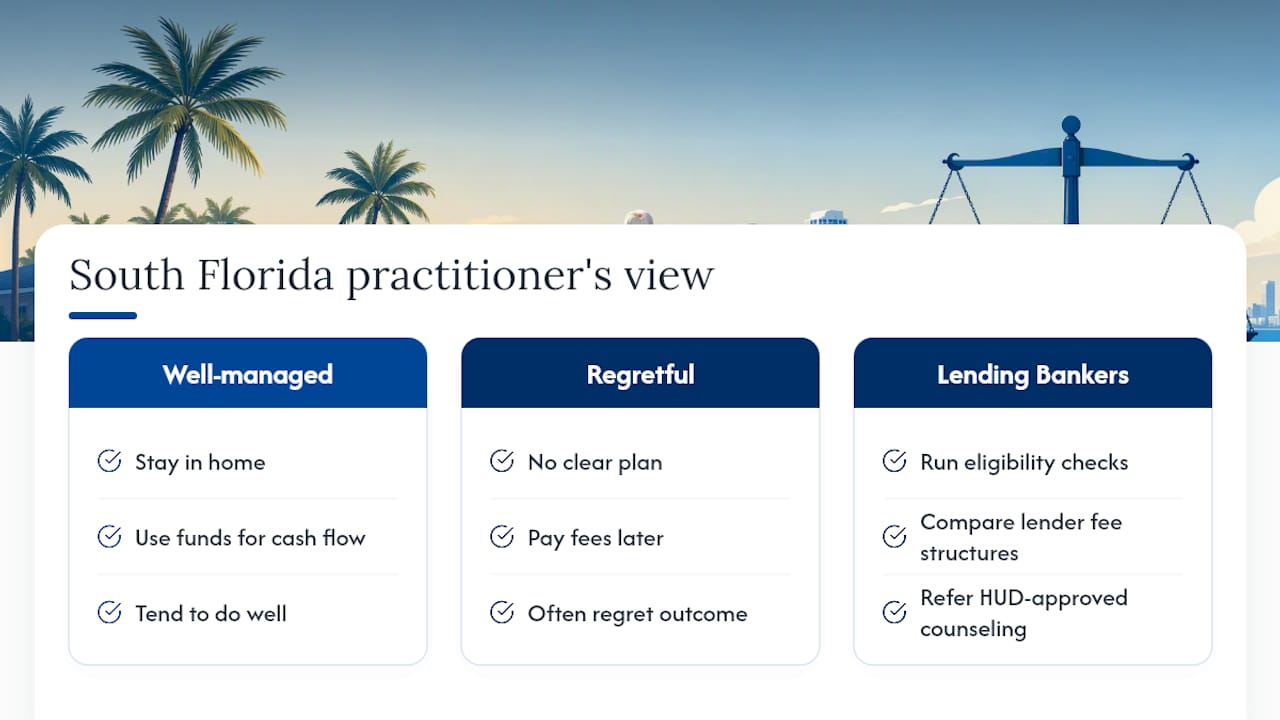
Miami's older homeowners often carry substantial, unmortgaged equity in properties bought decades ago, which makes reverse mortgages a frequent topic in consultations. The outcomes we see split cleanly: homeowners who stay put and use the funds for genuine cash-flow relief tend to do well, while those who take the loan without a clear plan often regret the fees later. Lending Bankers helps by running eligibility checks, comparing lender fee structures side by side, and pointing clients toward HUD-approved counseling before any commitment.
How Lending Bankers Mortgage Can Help You Compare Reverse Mortgage Offers
Lending Bankers gives you a side-by-side fee comparison across lenders instead of the single quote you'd get walking into one bank, which matters when origination fees and servicing charges vary as much as they do on HECMs. As a mortgage brokerage serving Miami and the state of Florida, Lending Bankers works with multiple funding sources to find terms that fit your specific home value, age, and goals, rather than steering you toward one product.
Our team can walk you through reverse mortgage requirements in Miami, connect you with HUD-approved counseling before you commit to anything, and run your numbers through our mortgage calculator so you see projected balances over five, ten, and fifteen years. We work on a brokerage model, meaning we're paid when your loan closes, not for steering you toward any single lender's product. If you're weighing a reverse mortgage against a refinance, a HELOC, or simply want an honest eligibility check, reach out to Lending Bankers for a free consultation and get real numbers before you decide.
Sources
- Consumer Financial Protection Bureau — Reverse mortgages
- HUD — HECM program (overview)
- FTC — Reverse mortgages: what to know