
A rapid rescore is a lender-ordered, expedited update to your credit reports that can reflect a recent payment or a corrected error within days instead of weeks. Your loan officer requests it directly from the credit bureaus, typically Experian, Equifax, or TransUnion, and results usually land in a few business days. It can nudge your score into a better rate tier, but it won't erase accurate negative history, and you can't order one yourself.
TL;DR:
- Rapid rescores are limited to updates initiated by your lender and cannot be requested directly by consumers, and they typically cost $25 to $40 per bureau.
- They usually update credit reports within 2 to 5 business days, compress standard reporting times of 30 to 60 days, and are most useful for small score improvements close to qualifying thresholds.
- Rapid rescoring cannot remove accurate negative items like late payments or bankruptcies and may sometimes lower your score if new negatives are reported.
- Effective rescore candidates include borrowers who have paid off collections, reduced credit card utilization, or corrected errors, especially if within 10 to 20 points of the next rate tier.
- A broker's coordination can streamline the process, ensure proper documentation, and maximize the chances of a successful rescore before underwriting deadlines.
Table of Contents
- How Does a Rapid Rescore Work for a Mortgage?
- What Does a Rapid Rescore Cost, and Who Pays?
- When Does a Rapid Rescore Actually Help?
- How to Request a Rapid Rescore During Your Mortgage Application
- What Documents Do You Need for a Rapid Rescore?
- How Long Does a Rapid Rescore Take, and What Happens Next?
- How a Mortgage Broker Coordinates a Rapid Rescore
- When We'd Recommend a Rapid Rescore
- Get Help Coordinating Your Rapid Rescore
- Sources
- FAQ
How Does a Rapid Rescore Work for a Mortgage?
Think of a rapid rescore as a shortcut through the credit bureaus' normal update schedule, not a shortcut around the facts on your report. Standard creditor reporting cycles run 30 to 60 days, meaning a payment you made today might not show up on your credit report for a month or more. That timing gap can sink a mortgage approval if your underwriter needs a specific score by closing.
A rapid rescore compresses that wait. Your lender collects proof of a change, submits it to the bureau, and the bureau updates its file in 1 to 7 business days, often closer to two to five in practice.
Changes that typically trigger a rescore include:
- A paid-off collection account
- A large credit card balance paid down, which lowers your utilization ratio
- A corrected reporting error, such as a payment mistakenly marked late
- An account status update, like a closed account showing a zero balance
You can't call Experian or TransUnion and request this yourself. Only a creditor, and in a mortgage transaction that almost always means your lender, can initiate a rapid rescore. That single rule shapes everything else about how the process works, including who pays for it.
What Does a Rapid Rescore Cost, and Who Pays?
Rapid rescoring runs $25 to $40 per credit file, and that fee applies per bureau. Rescore all three bureaus and you're looking at $75 to $120 total, paid by the lender in most cases rather than billed to you directly.
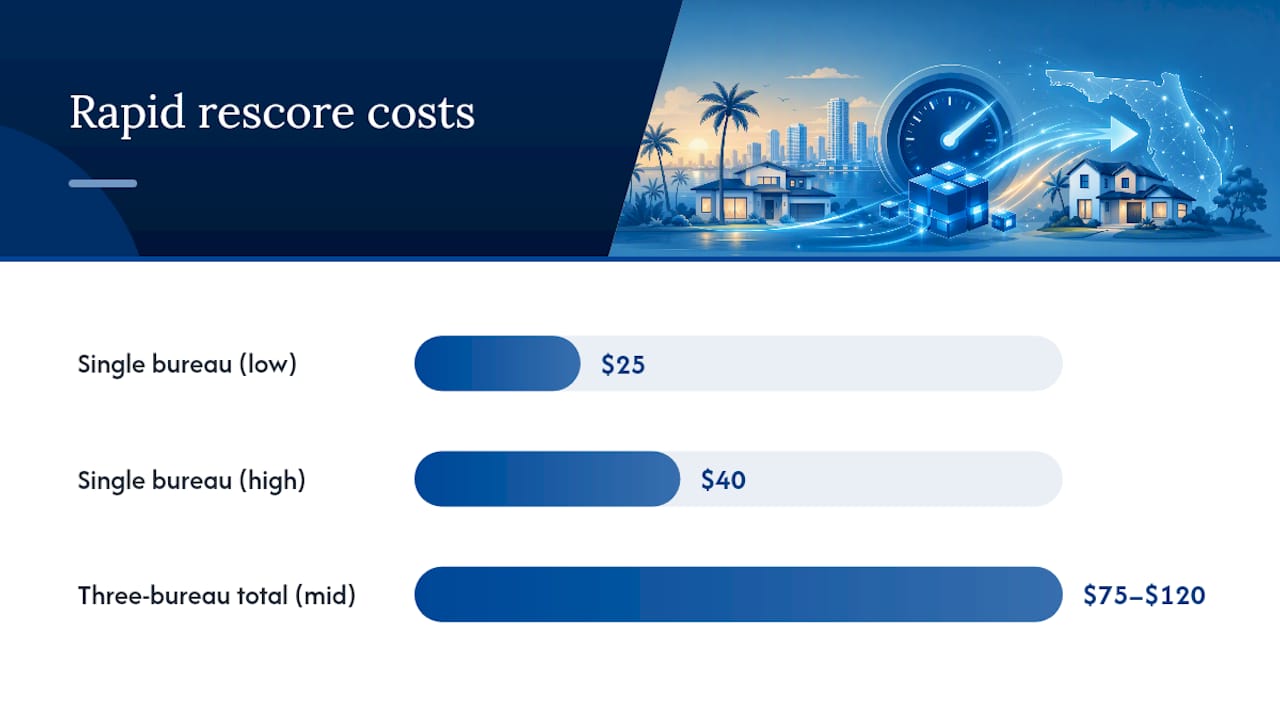
Statistic Callout: A three-bureau rescore typically costs an amount that can vary depending on the number of bureaus processed, a small line item against the interest savings a better rate tier can produce over a 30-year loan.
That cost sometimes shows up indirectly in your closing costs, so ask your loan officer how it's being handled before you agree to move forward. A few consumer-protection points matter here too:
- The Fair Credit Reporting Act governs how disputes and corrections get handled, and disputing an error through a bureau is a separate legal process from requesting a rescore.
- A rapid rescore is not credit repair. It cannot remove accurate negative information like a late payment, a charge-off, or a bankruptcy.
- Be wary of any third-party company that advertises "rapid rescoring services" directly to consumers. Legitimate rescoring flows through your lender, and consumer finance outlets consistently warn against paying an outside firm that claims it can do this for you.
When Does a Rapid Rescore Actually Help?
A rapid rescore works best when you're sitting right on the edge of a qualifying score or a better rate tier, not when your credit history has deeper problems. Reducing revolving utilization tends to produce the most predictable benefit, according to credit experts cited by Experian.
Good candidates usually include borrowers who:
- Just paid off a collection account in full
- Made a large payment against a credit card, dropping utilization significantly
- Found and corrected a reporting error, like a payment coded late by mistake
Rescoring won't help if your issue is a pattern of late payments, a charge-off, or a bankruptcy. Those stay on your report for years regardless of how fast a bureau processes an update, and there's even a risk a rescore surfaces a newly reported negative you didn't know about, which could lower your score instead of raising it.
Pro Tip: If you're within 10 to 20 points of the next rate tier, ask your loan officer to run the math before you spend money on a rescore. A jump from a 638 to a 642 might not clear the threshold, but 638 to 660 often will.
How to Request a Rapid Rescore During Your Mortgage Application
Getting a rescore right the first time saves days you don't have during underwriting. Here's the sequence that works:
- Ask your loan officer directly whether rescoring makes sense for your file and whether you're close enough to a threshold to justify it.
- Identify the accounts to target. Your loan officer can flag which balances or errors are actually pulling your score down.
- Pay down or correct those accounts. Prioritize the highest reported balances and time payments so they post before your lender submits documentation, since a payment posted after the cutoff won't count.
- Gather proof of the change, such as a payoff letter or an updated statement showing the new balance.
- Deliver the documentation to your lender, who reviews it and forwards it to the relevant bureau.
- Your lender submits the rescore request and orders a new score pull once the bureau confirms the update.
Building a stronger credit profile before you even reach this stage makes the whole process faster.
What Documents Do You Need for a Rapid Rescore?
Bureaus and lenders need clear, dated proof, not a verbal claim that you paid something off. Acceptable documentation generally includes:
- Bank statements or transaction records showing the payment date and amount
- Payoff letters from the creditor confirming a zero balance
- Updated account statements reflecting the post-payment balance
When you submit anything, include the account number, the payment date, and the amount, and highlight the relevant line so nobody has to hunt for it. When you call a creditor for a payoff letter, ask them to state the account number, the payoff amount, and the date the balance hit zero, all in writing.
Pro Tip: Pull your own report through Annualcreditreport before you start. Spotting an error yourself, before underwriting does, saves a round of back and forth later.
Follow up with your loan officer two or three business days after submission to confirm the bureau received the request.
How Long Does a Rapid Rescore Take, and What Happens Next?
Most rescores complete within a few business days, typically around 2 to 5 days. Delays happen when documentation is incomplete, illegible, or missing an account number, so a clean submission matters more than almost anything else in this process.
Statistic Callout: Standard creditor reporting takes 30 to 60 days; a rapid rescore compresses that to roughly 1 to 7 business days, which is the entire reason lenders use it during time-sensitive underwriting.
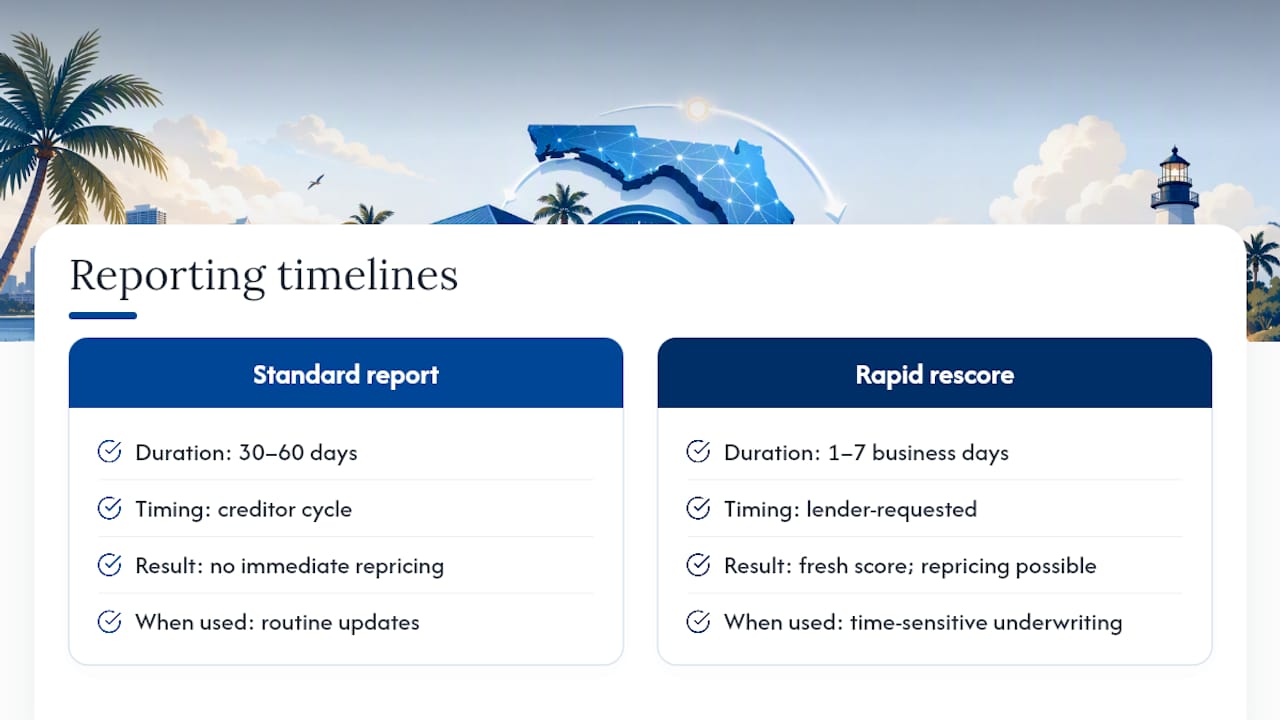
Once the bureau updates the file, your lender pulls a fresh score and re-runs it against the loan's pricing tiers. A jump of even 10 to 15 points can shift you from one tier to the next, changing your interest rate. Run the numbers on a mortgage calculator to see what that shift means for your monthly payment. If the rescore doesn't move your score enough, your loan officer can walk through other options, including a different loan program or additional time before reapplying.
How a Mortgage Broker Coordinates a Rapid Rescore
Coordinating a rescore correctly takes more than filling out a form. A broker reviews your proposed documentation before it goes to the bureau, flags anything that's likely to bounce back, and stays in contact with the lender so nothing sits untouched for an extra day. Lending Bankers works with borrowers across Miami and Florida on exactly this kind of coordination, alongside broader credit and loan-eligibility guidance for refinance scenarios and first-time purchases alike.
A broker facilitates the process, but the lender still places the actual order with the bureau. If your situation involves foreign national status, a jumbo loan, or another specialized program, that added layer of coordination often matters even more.
When We'd Recommend a Rapid Rescore
The strongest candidates are borrowers within striking distance of a rate tier, usually someone who just paid off a collection or knocked down a credit card balance enough to lower utilization meaningfully. If you're dealing with late payments, a charge-off, or bankruptcy, put your energy into other credit-improvement steps first, since a rescore won't touch those.
Weigh the $75 to $120 aggregate cost against what a rate tier change actually saves you over the life of the loan. For most borrowers on the edge, that trade clearly favors trying it.
— David
Get Help Coordinating Your Rapid Rescore
Mortgage brokers can actively manage a rapid rescore instead of leaving borrowers to chase it alone between loan officers and credit bureaus. Coordinating the tracking of payoff letters, formatting documentation, and confirming bureau submissions is part of the process that can be handled alongside the rest of a mortgage file, from initial pre-approval through closing.

Whether you're a first-time buyer trying to clear a rate threshold or an investor working through a jumbo or foreign national loan, a consult with Lending Bankers starts with a review of your credit file and a straight answer on whether a rescore is worth pursuing for your situation. If it's not, we'll walk you through what will actually move the needle instead. Reach out through Lending Bankers Mortgage to get that conversation started before your next underwriting deadline.
Sources
- What Is a Rapid Rescore?
- What Is a Rapid Rescore?
- Rapid Rescore: Boost Your Credit Score for a Mortgage (Nolo)
- Rapid rescore explanation (Capital One)
This article is general information, not a substitute for advice from a qualified financial advisor. Consult a qualified financial professional about your own circumstances before acting on anything here.
FAQ
Can I Request a Rapid Rescore Myself?
No. Only a creditor, most commonly your mortgage lender, can request a rapid rescore from the credit bureaus; consumers can't order one directly.
How Much Does a Rapid Rescore Cost?
Expect $25 to $40 per credit file, so a three-bureau rescore typically totals $75 to $120, usually paid by the lender.
How Long Does a Rapid Rescore Take?
Most rescores complete in 1 to 7 business days, with two to five days being the most common turnaround.
Will a Rapid Rescore Remove Late Payments or a Bankruptcy?
No. A rapid rescore cannot remove accurate negative information like late payments, charge-offs, or bankruptcy; it only speeds up reflecting recent corrections or payoffs.
Can a Rapid Rescore Lower My Score?
Yes, in rare cases. If the bureau update surfaces a previously unreported negative item, your score could drop instead of rise, which is why your loan officer should review your file before submitting a request.