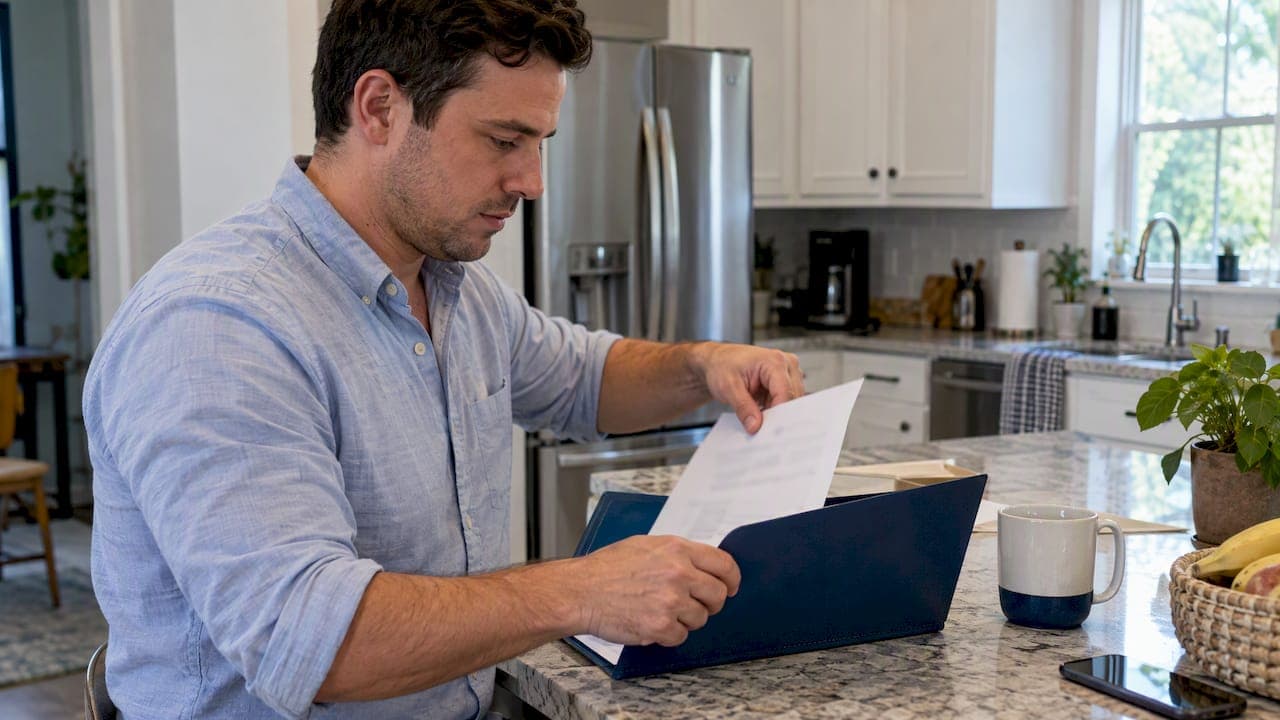
A proof of funds letter is a bank-issued or verifiable statement proving you have the liquid cash required for the down payment and related purchase costs. Sellers and their agents often request one before accepting a cash offer, and lenders may ask for similar documentation to confirm your earnest money and down payment. It does not replace full loan underwriting, which still verifies every dollar before closing.
TL;DR:
- A proof of funds letter must be recent, typically issued within the last 30 to 60 days, to reflect an accurate account balance.
- Only liquid assets like checking, savings, money market, and certain Certificates of Deposit qualify for proof of funds, while retirement accounts generally do not.
- Formal Verification of Deposit forms hold more credibility than simple bank letters or statements because they are issued directly by the bank through a controlled process.
- Buyers should coordinate with their bank early, consolidate funds if needed, and request the proof of funds document close to submitting an offer to prevent discrepancies.
- Underwriters verify proof of funds against account statements and deposits to detect large, unexplained transactions or outdated documentation that could raise questions or cause delays.
Table of Contents
- Proof of funds basics: role and common formats
- Which assets qualify as proof of funds (and which usually don't)
- How a proof of funds letter differs from a mortgage preapproval or prequalification
- When sellers, listing agents, or buyers will ask for proof of funds
- What a POF letter or acceptable documentation must include
- Step-by-step: how to get a proof of funds letter fast and without mistakes
- Common pitfalls, verification checks, and fraud red flags to avoid
- Lender perspective and how underwriting treats proof of funds
- Author David's concise advice: when to get a POF and how to protect your information
- How Lending Bankers Mortgage supports your proof of funds and loan process
- FAQ
- Sources
Proof of funds basics: role and common formats
A proof of funds letter exists to answer one question for a seller: can you actually pay for this house? The document proves three things at once: that you control liquid funds, that the account belongs to you, and that the balance existed as of a specific date.
That last point matters more than most buyers realize. A proof of funds letter verifies that a buyer has liquid assets available to complete a purchase and is commonly issued by a bank or financial institution. It is a snapshot, not a guarantee, and a balance from three weeks ago may not reflect what is in the account today.
Sellers and their agents will generally accept one of a few formats:
- A bank-issued letter on official letterhead, signed by an authorized bank representative.
- A recent account statement, often with the account number partially redacted for privacy.
- A formal Verification of Deposit, a standardized form a bank completes directly for a lender.
Each format carries different weight. A simple letter is quick to obtain but easy to question. A statement shows more detail, including recent transaction history, which can work for or against you if it reveals large, unexplained deposits. A Verification of Deposit carries more institutional credibility because the bank, not the buyer, fills it out and returns it through a controlled channel.
Because the document is only a point-in-time snapshot, timing drives everything else about how you prepare one. Request it too early and the balance may no longer be accurate by the time you submit an offer. Request it too close to a transfer or deposit and you risk raising questions about where the money came from, a concern we cover in more detail later.
Which assets qualify as proof of funds (and which usually don't)
Not every account you own counts as proof of funds. Sellers and lenders care about liquidity: how quickly money can turn into a wire transfer or cashier's check without penalty, delay, or a tax hit.

Checking and savings accounts are the easiest to document and the most readily accepted. Money market accounts and certificates of deposit typically qualify too, though a CD that has not matured may come with an early withdrawal penalty worth noting if you plan to use those funds. Brokerage and investment accounts are usually accepted but treated with more caution, since selling securities to access cash introduces settlement risk. The SEC's own guidance on trade settlement explains why a liquidation in progress is not the same as cash already sitting in an account.
Retirement accounts, unsecured lines of credit, and home equity you have not actually borrowed against generally do not qualify, since none represent funds you can access on short notice without cost or a separate loan process.
| Asset type | Typically accepted | Notes |
|---|---|---|
| Checking or savings | Yes | Most straightforward to verify |
| Money market account | Yes | Treated like savings |
| Certificate of deposit | Conditional | Early withdrawal penalty may apply |
| Brokerage or investment account | Conditional | Settlement time adds risk |
| Retirement account | Usually not | Penalties and access delays |
| Unsecured credit line | Usually not | Not liquid funds you own |
| Home equity (unborrowed) | Usually not | Requires a separate loan to access |
How a proof of funds letter differs from a mortgage preapproval or prequalification
These two documents answer different questions, and confusing them is one of the more common mistakes buyers make early in a search.
- A preapproval letter states the loan amount a lender is conditionally willing to extend based on your credit, income, and debt.
- A proof of funds letter shows the cash you already have on hand, independent of any loan.
- For a financed purchase, sellers often want both: the preapproval to confirm the loan is likely to close, and the proof of funds to confirm your down payment and closing costs are covered.
- Neither document is final. Underwriting will still verify your assets and the source of your funds before the loan is approved and the sale closes.
Think of the preapproval as a promise from a lender and the proof of funds as evidence from you. A seller weighing two similar offers often leans toward the one backed by both, since it signals a buyer unlikely to stall at the financing stage.
When sellers, listing agents, or buyers will ask for proof of funds
Requests for proof of funds tend to cluster at a handful of predictable moments in a transaction.
- Cash offers: Any all-cash purchase almost always requires proof of funds up front, since there is no lender underwriting to fall back on for verification.
- Competitive or multiple-offer situations: In a market with several bids on one property, sellers use proof of funds to separate serious buyers from speculative ones.
- Investor transactions: Buyers purchasing rental or flip properties are frequently asked to document funds early, since investors move fast and sellers want certainty.
- Large earnest money deposits: A bigger-than-typical deposit signals strength, but the seller's agent will usually want proof the money actually exists before relying on it.
- Short escrow timelines: When a buyer asks for a fast close, proof of funds reassures the seller that cash is already in place rather than still being assembled.
- Appraisal gap coverage: If you are offering above asking price and agreeing to cover any appraisal shortfall in cash, expect a request for documentation showing you can cover that gap.
What a POF letter or acceptable documentation must include
A proof of funds letter only works if it contains enough detail to be checked. Missing information is one of the fastest ways to have a document rejected or questioned.
A usable letter generally includes:
- The account holder's full name, matching the name on the offer.
- The financial institution's name, address, and contact information.
- The date the letter was issued.
- The available balance or a verified amount, stated clearly.
- An authorized signature from a bank representative, with a title and direct contact number.
You can redact account numbers down to the last few digits without weakening the letter, since the balance and signature are what carry the verification weight, not the full account number. On a bank statement, the same rule applies: cover what identifies the account precisely, leave what confirms ownership and balance.
A short example of acceptable wording from a bank letter might read: "This letter confirms that [Account Holder Name] maintains an account with [Bank Name] with a verified available balance of [amount] as of [date]. This letter is issued at the customer's request for the purpose of a real estate transaction." Keep the letter recent. Many sellers and agents expect it dated within the last 30 to 60 days, a window that follows the same logic lenders use when reviewing asset statements during underwriting.

Step-by-step: how to get a proof of funds letter fast and without mistakes
Getting this document right the first time saves you from a second trip to the bank and a delay on your offer.
- Calculate your cash-to-close first. Add your down payment, closing costs, and any reserve requirement before you decide how much to document, so the letter reflects what you actually need to show, not a rough guess.
- Consolidate funds if it makes sense. If your down payment is spread across several accounts, consider moving it into one account ahead of time, but do this early and keep every transfer record, since lenders require detailed sourcing for large deposits made in the two months before a loan application.
- Request the letter from your bank. A branch manager or your online banking portal can usually issue one within a day or two. Some institutions charge a small fee per letter, so ask before you request it.
- Use a Verification of Deposit for stronger credibility. A lender can request this directly from your bank using a standardized form, and it generally carries more weight with sellers and underwriters than a simple letter.
- Have a backup plan. If a branch refuses to issue a letter, a recent downloaded statement with account numbers redacted is usually an acceptable substitute, or your loan officer can request verification directly from the bank.
Pro Tip: Request your proof of funds letter within a week of making an offer, not weeks in advance, so the balance still matches reality when a seller calls to confirm it.
Common pitfalls, verification checks, and fraud red flags to avoid
Most rejected proof of funds documents fail for the same handful of reasons, and most of them are avoidable with a little planning.
- Screenshots and edited PDFs get flagged immediately. Anything that looks altered, cropped, or inconsistent in formatting invites a direct call to the bank.
- Unexplained large deposits raise questions. A sudden jump in balance shortly before the letter's date often triggers requests for a paper trail showing where the money came from.
- Outdated documents lose credibility. A letter older than 30 to 60 days may be treated as stale, especially in a fast-moving market.
- Missing signatures or contact information slow everything down. A letter without a way to verify the signatory is often sent back for correction.
Many sellers will accept a current bank statement with account numbers redacted, though some prefer to contact the bank directly to confirm authenticity before moving forward with an offer, according to guidance on what sellers want from proof of funds. That verification step is becoming more common as fraud attempts increase, with agents calling the bank's published number rather than any number listed on the letter itself.
Lender perspective and how underwriting treats proof of funds
Underwriters do not simply take a proof of funds letter at face value. They corroborate it against statements, deposit histories, and, when needed, a formal Verification of Deposit before closing a loan.
A practical checklist we see hold up well during underwriting:
- Keep balances stable in the weeks leading up to application, since large swings invite extra scrutiny.
- Document every transfer between your own accounts, even when consolidating funds for convenience.
- Expect a request to explain any deposit that looks unusual relative to your normal account activity.
- Prefer accounts you can verify quickly over accounts that require liquidating investments under time pressure.
Buyers who prepare this paperwork early, rather than scrambling after an offer is accepted, tend to move through loan approval with far fewer hurdles. The same discipline that satisfies a seller's request for proof of funds is largely what an underwriter wants to see later anyway.
Author David's concise advice: when to get a POF and how to protect your information
Even when a seller does not require proof of funds, having one ready strengthens a competitive offer and shows you are prepared, not scrambling. I would only share these documents directly with your agent, the listing agent, or your lender, never by email to an unknown party, and I would confirm any bank contact information independently before trusting it. Coordinate timing with your lender and agent so the balance on the letter still matches reality when someone picks up the phone to verify it.
— David
How Lending Bankers Mortgage supports your proof of funds and loan process
Preparing a proof of funds letter is easier when someone is already coordinating your financing in the background. We work with homebuyers and investors across Florida to line up documentation early, so a seller's request for proof of funds never catches you off guard.

- We arrange residential mortgages and private lending for buyers who need both a loan strategy and clean, verifiable documentation.
- We support foreign national borrowers who often face extra scrutiny on sourcing funds from overseas accounts.
- We offer hard money loans when speed matters more than a conventional underwriting timeline.
- We coordinate with escrow and title so your proof of funds, earnest money, and closing documents stay consistent from offer to close.
If you want a mortgage team already lined up before you make an offer, reach out to Lending Bankers Mortgage and we will walk through exactly what documentation your situation calls for.
This article is general information, not a substitute for advice from a qualified financial advisor. Consult a qualified financial professional about your own circumstances before acting on anything here.
FAQ
What is an example of a proof of funds letter?
A typical example states the account holder's name, the bank's name and contact information, a verified balance as of a recent date, and an authorized signature from a bank representative. It is usually one short paragraph on official letterhead, written specifically to confirm funds for a real estate transaction.
Is it normal for a realtor to ask for proof of funds?
Yes, it is common, especially for cash offers, competitive bidding situations, or when a buyer is requesting a short escrow period. Listing agents often ask to confirm a buyer can actually complete the purchase before advising their seller to accept an offer.
How long is a proof of funds letter good for?
Most sellers and lenders expect a letter dated within the last 30 to 60 days, since a balance can change quickly. Fannie Mae's own asset verification standards favor statements covering the most recent 60 days and generally prefer documentation within about 45 days of application.
What is an alternative to a proof of funds letter?
A recent bank statement, with the account number partially redacted, is widely accepted as a substitute when a formal letter is not available. A Verification of Deposit, completed directly by the bank at a lender's request, is another accepted alternative that often carries more weight.
Sources
- Proof of Funds (POF): What It Is, Qualifying Documents, and How to Obtain — Investopedia
- Submit documents and answer requests from the lender — Consumer Financial Protection Bureau
- Fannie Mae: Verification of Deposit guidance (Form 1006) — Fannie Mae
- Do You Need a Proof of Funds Letter? What Sellers Want — ListWithClever