
PMI is private mortgage insurance on conventional loans, and you can usually cancel it once your equity builds up. MIP is the FHA's mortgage insurance premium, which adds an upfront fee at closing and often sticks around for the life of your loan. The cheaper option depends on your credit score, your down payment, and how long you plan to keep the mortgage, so it pays to model both before you sign anything.
TL;DR:
- Borrowers with credit scores above 720 and plans to keep the loan for more than a decade typically benefit from conventional loans with PMI, as it cancels automatically after reaching 78% LTV.
- FHA's MIP usually lasts for the life of the loan unless there's a substantial down payment of 10% or more, which cuts the term to 11 years.
- Long-term costs favor PMI if you can cancel it, but comparing total expenses over 5 and 10 years is essential, especially if refinancing or moving is likely early.
- FHA MIP ignores credit scores and is often financed into the loan, causing the principal to grow and increasing total interest paid over the life of the loan.
- Running a personalized cost comparison based on your actual expected holding period can prevent costly mistakes when choosing between PMI and MIP options.
Table of Contents
- What Is Private Mortgage Insurance (PMI)?
- What Is Mortgage Insurance Premium (MIP) for FHA Loans?
- Key Differences at a Glance
- How to Remove or Avoid Mortgage Insurance
- Which Tends to Be Cheaper: Credit Score, Down Payment, and Holding Period
- Checklists, Broker Questions, and Two Quick Scenarios
- Editorial Take: The Real Variable Nobody Prices Correctly
- Sources
What Is Private Mortgage Insurance (PMI)?
Lenders require it to protect themselves against default risk on that thinner equity cushion, and they price it using two main factors: your credit score and your loan-to-value (LTV) ratio at closing.
You can pay PMI a few different ways, depending on your lender and loan program:
- Monthly premium added to your mortgage payment (the most common structure)
- Lender-paid PMI, folded into a slightly higher interest rate instead of a separate line item
- Single upfront premium paid at closing, sometimes offered as an alternative to monthly billing
The Homeowners Protection Act gives you real leverage here. Pay extra principal, and you get there faster.
What Is Mortgage Insurance Premium (MIP) for FHA Loans?
Unlike PMI, FHA's MIP structure ignores your credit score entirely. Pricing runs off your loan amount, loan term, and LTV instead, which is part of why FHA loans attract borrowers who can't qualify for competitive conventional rates.
Duration is where MIP gets tricky. Here's how it breaks down:
- Put down 10% or more, and MIP ends after 11 years, no request needed
- Put down less than 10%, and MIP typically lasts for the life of the loan
- The standard way out for life-of-loan MIP is refinancing into a conventional mortgage
But it raises your loan principal, and you pay interest on that added amount for as long as you carry the loan. A loan with the premium rolled in increases the principal amount, and that gap compounds every single month.
Key Differences at a Glance
The gap between PMI and MIP boils down to six variables that determine what you'll actually pay and how long you'll pay it.
| Feature | PMI (Conventional) | MIP (FHA) |
|---|---|---|
| Loan type | Conventional loans, under 20% down | FHA loans, all down payment levels |
| Upfront cost | Usually none | Commonly financed percentage of loan amount |
| Monthly cost | Billed monthly, sometimes lender-paid | Annual premium billed monthly |
| How price is set | Credit score and LTV | Loan amount, term, and LTV (no credit check) |
| When it ends | Cancelable at 80% LTV; auto-terminates at 78% LTV | 11 years if 10%+ down; often life of loan otherwise |
| Standard exit | Request cancellation or wait for automatic termination | Refinance into a conventional loan |
A few quick takeaways follow from that table. Borrowers with credit scores above 720 who plan to stay put for a decade or more tend to come out ahead with conventional financing and PMI, since it eventually disappears.
Pro Tip: Don't compare month one against month one. Run the numbers over 5 years and again over 10 years, factoring in when PMI would drop off and what refinancing to escape MIP would actually cost in closing fees. The loan that looks cheaper today can flip within 36 months.
How to Remove or Avoid Mortgage Insurance
Getting rid of PMI or MIP isn't automatic in every case, but the path is well-defined once you know the rules.
- Track your loan balance against your original purchase price and flag the moment you cross 80% LTV.
- Submit a written cancellation request to your servicer once you hit that threshold; most require you to be current on payments with no history of late payments in the past year.
- Ask about appraisal-based removal if home values in your area have climbed faster than your amortization schedule. Servicers often accept a new appraisal to prove you've crossed 80% early, and buyers frequently recoup the appraisal fee within a few months of dropped premiums.
- If your loan hits 78% LTV and you haven't requested cancellation, your servicer must terminate PMI automatically, no paperwork from you required.
- For FHA borrowers stuck with life-of-loan MIP, request refinance quotes once you estimate you've built 20% equity, then compare the new interest rate and closing costs against what remaining MIP payments would cost you.
Refinancing out of FHA only makes sense when the math clears a real bar. Add up your closing costs, divide by your monthly MIP savings, and see how many months it takes to break even. If you're planning to sell or refinance again within that window anyway, staying put is often the smarter move.
Which Tends to Be Cheaper: Credit Score, Down Payment, and Holding Period
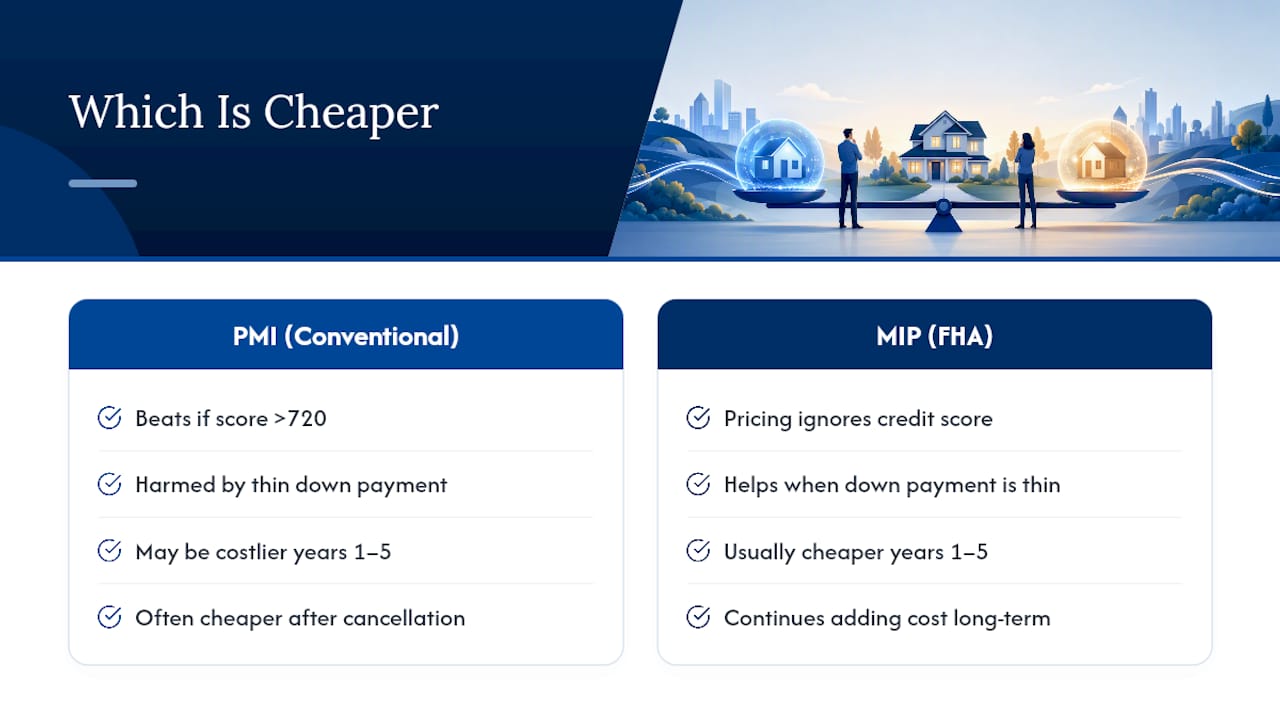
The honest answer is "it depends," but the pattern is consistent enough to build a rule of thumb around it. Analysts who track both loan paths generally point to credit score above 720 as the tipping point where conventional financing with PMI wins, especially for anyone holding the loan long-term, since PMI eventually cancels and MIP often doesn't.
Below 680, or when your down payment is thin, FHA usually looks cheaper in years one through five because MIP pricing ignores your credit history. If you expect to sell or refinance within a short window, that early-year FHA advantage can matter more than the long-run picture. Hold the loan past 10 years, though, and cancellable PMI typically pulls ahead since it stops adding to your payment while MIP, absent a large down payment, keeps going. Before choosing either path, run a 5-year and 10-year total-cost comparison using your actual credit score and expected timeline, not a generic assumption.
Checklists, Broker Questions, and Two Quick Scenarios
Before comparing FHA and conventional offers, gather your credit score from all available sources, your available down payment, your expected holding period, and recent comparable sales in your target neighborhood. Ask your broker how PMI pricing bands apply to your specific score, whether lender-paid PMI makes sense given your rate goals, and what a realistic refinance timeline looks like if you start with FHA.
Consider two quick sketches. Run your own numbers with our mortgage calculator, and check current FHA MIP mechanics before you commit.
Editorial Take: The Real Variable Nobody Prices Correctly
Most advice on PMI versus MIP treats it like a static comparison: one premium versus another, frozen in time. That framing misses the point. The number that actually decides this for you isn't the monthly premium at all. It's how long you plan to keep the loan.
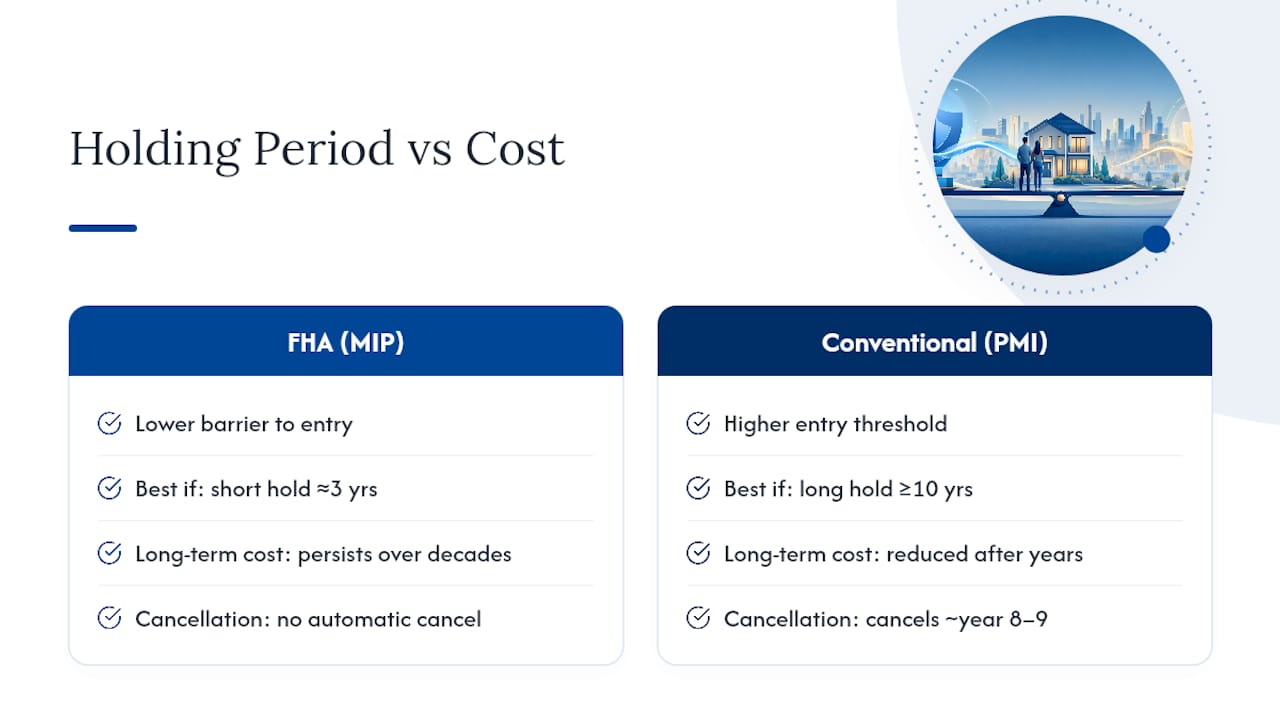
Conventional wisdom pushes people toward whichever option has the lower payment in month one. That's backwards. A borrower who expects to move in three years should weigh FHA's lower barrier to entry heavily, because MIP's long-term downside never has time to materialize. A borrower planning to stay a decade should weight PMI's cancellation clause just as heavily, because that clause is worth real money once it kicks in around year 8 or 9.
It's a rounding error on paper and a real drag on your amortization schedule over 20 years. Before you decide, run your own 5-year and 10-year numbers, using Lending Bankers' mortgage calculator or a comparable tool, and let your actual holding period drive the decision instead of the sticker price at closing.
— David
Sources
For the exact legal thresholds and program rules, go straight to the source. The CFPB's PMI removal guidance covers your cancellation rights in plain language, while HUD's FHA premium structure page breaks down current upfront and annual MIP rates. You can also verify any lender's licensing through NMLS Consumer Access before signing paperwork, and Urban Institute's mortgage insurance data offers useful context on broader cost patterns across both programs.
Ready to see which path fits your numbers? Lending Bankers helps Florida homebuyers compare FHA and conventional financing side by side, including how MIP or PMI would actually play out over your expected timeline. If you're weighing loan structures more broadly, our breakdown of conventional versus non-conventional loans is a useful next stop, and outside resources like this guide to mortgage protection insurance can clarify how that product differs from the PMI or MIP you're required to carry. Whatever you decide, run the comparison with a loan officer who can plug in your actual credit score, not a generic estimate.
- CFPB: When can I remove private mortgage insurance (PMI)?
- HUD / FHA: What is the FHA Mortgage Insurance Premium structure for forward mortgage loans
- MortgageDaily: PMI vs MIP — The one that never goes away