
Physician mortgage programs are active and available across Florida, and they typically let you buy a home with 0% to 5% down, no private mortgage insurance, and underwriting that qualifies you on a signed employment contract rather than two years of pay stubs. Florida is home to one of the nation's largest physician workforces, and lenders here compete hard for that business. You'll find flexible student-loan treatment, higher loan limits than conventional financing allows, and, if you're relocating, the ability to close before your job even starts. The sections below walk through eligibility, loan sizes, Florida's condo quirks, and how to compare your options.
TL;DR:
- Physician mortgage programs in Florida often allow zero to five percent down payments and waive private mortgage insurance, reducing upfront costs.
- Qualification can be based on signed employment contracts rather than two years of pay stubs, making it ideal for residents and those relocating.
- Loan limits and credit score requirements vary by lender, with stronger scores leading to better interest rates and more favorable terms.
- Condo financing is a critical factor in Florida, as stricter reserve and structural requirements can cause delays or denials; pre-screening helps avoid issues.
- The mortgage process typically takes two to four weeks, with many lenders allowing closing before the job start date, enabling early homeownership.
Table of Contents
- What Is a Physician Mortgage and How Does It Differ From a Conventional Loan?
- Who Qualifies for a Physician Mortgage in Florida?
- How Much Can You Borrow, and What Credit Score Do You Need?
- How Are Student Loans Treated in a Physician Mortgage?
- What Should Florida Physicians Know About Condo Financing?
- How Long Does the Physician Mortgage Process Take in Florida?
- How Do You Compare Physician Mortgage Options in Florida?
- How Lending Bankers Mortgage Supports Florida Physicians
- Cash Now or Rate Later: The Real Tradeoff
- Get Started With a Physician Mortgage Through Lending Bankers
- Sources
- FAQ
What Is a Physician Mortgage and How Does It Differ From a Conventional Loan?
A physician mortgage is a loan program built specifically for doctors, dentists, and select other medical professionals whose income doesn't look like a typical borrower's. You might have six figures of student debt, a brand-new job offer, and almost no cash reserves. Conventional underwriting punishes all three. Physician mortgage programs are designed around them instead.
The core features that separate a physician loan from a conventional or jumbo mortgage come down to three things: down payment, mortgage insurance, and how your employment counts.
- Down payment: Physician programs commonly allow 0% to 5% down, even on loan amounts that would require 10% to 20% down under conventional or jumbo guidelines.
- No PMI: Most physician mortgage products waive private mortgage insurance entirely, regardless of your loan to value ratio. That alone can save you several hundred dollars a month compared to a low down payment conventional loan.
- Contract based qualifying: Instead of two years of tax returns, many lenders will qualify you using a signed employment contract, which matters enormously if you're a resident matching into a new position or an attending switching hospitals.
- Loan limits: Physician programs often extend well beyond conventional conforming limits without forcing you into jumbo pricing or jumbo reserve requirements.
Terms vary meaningfully from one lender to the next. Some cap the 0% down tier at a lower loan amount and require 5% or 10% down above it. Others treat residents differently than attendings with two or more years of income history. Before you assume a program fits your situation, get the specific loan limit, PMI policy, and student-loan treatment in writing rather than relying on a general description.
Who Qualifies for a Physician Mortgage in Florida?
Eligibility is broader than most people expect, but it's not universal. The credentials most Florida lenders recognize include:
- MD and DO physicians, including those still in residency or fellowship
- DDS and DMD (dentists)
- DPM (podiatrists)
- DVM (veterinarians)
- PharmD (pharmacists)
- CRNA (certified registered nurse anesthetists)
- Nurse practitioners and physician assistants, though this is lender dependent and included in some programs but not others
Residents and fellows generally qualify using their employment contract, which is one of the more useful mechanics in this entire product category. If you've matched into a Florida residency or accepted an attending position that starts in a few months, most physician mortgage lenders will let you lock in financing based on that offer letter rather than waiting for your first paycheck.
Documentation typically includes:
- A signed employment or offer contract specifying start date and salary
- Recent student loan statements showing balance, payment type, and enrollment status
- Two to three months of bank statements for reserves
- Government issued ID and Social Security verification
- Proof of licensure, or, if you're still completing state licensing, documentation showing where you stand in that process
If your medical license is pending, tell your loan officer early. Some lenders will proceed with a conditional approval while licensing finalizes; others want the license in hand before they'll issue final approval. That distinction changes your timeline by weeks.
How Much Can You Borrow, and What Credit Score Do You Need?
Loan sizes and down payment tiers usually scale together. A common structure looks like this: 0% down up to a certain threshold, then 5% or 10% down as the loan amount climbs into jumbo territory. The exact thresholds differ by lender, so treat any number you hear from a friend or a forum post as a starting point for questions, not a guarantee.
- Entry tier: 0% down, often available up to a moderate loan amount depending on the lender.
- Mid tier: 5% down, extending the ceiling higher without triggering standard jumbo reserve requirements.
- Upper tier: 10% down or more, used for larger homes or higher cost coastal markets, with amounts varying by lender.
Credit score requirements tend to start in the high 600s to low 700s, but the pricing benefit for a stronger score is real. A borrower with a 760 or higher FICO score will typically see a noticeably better rate than one at 680, even within the same physician program. On a $600,000 loan, a rate difference of even a quarter point adds up to tens of thousands of dollars over the life of the loan, so it's worth spending a few months improving your score before you shop if you have the runway.
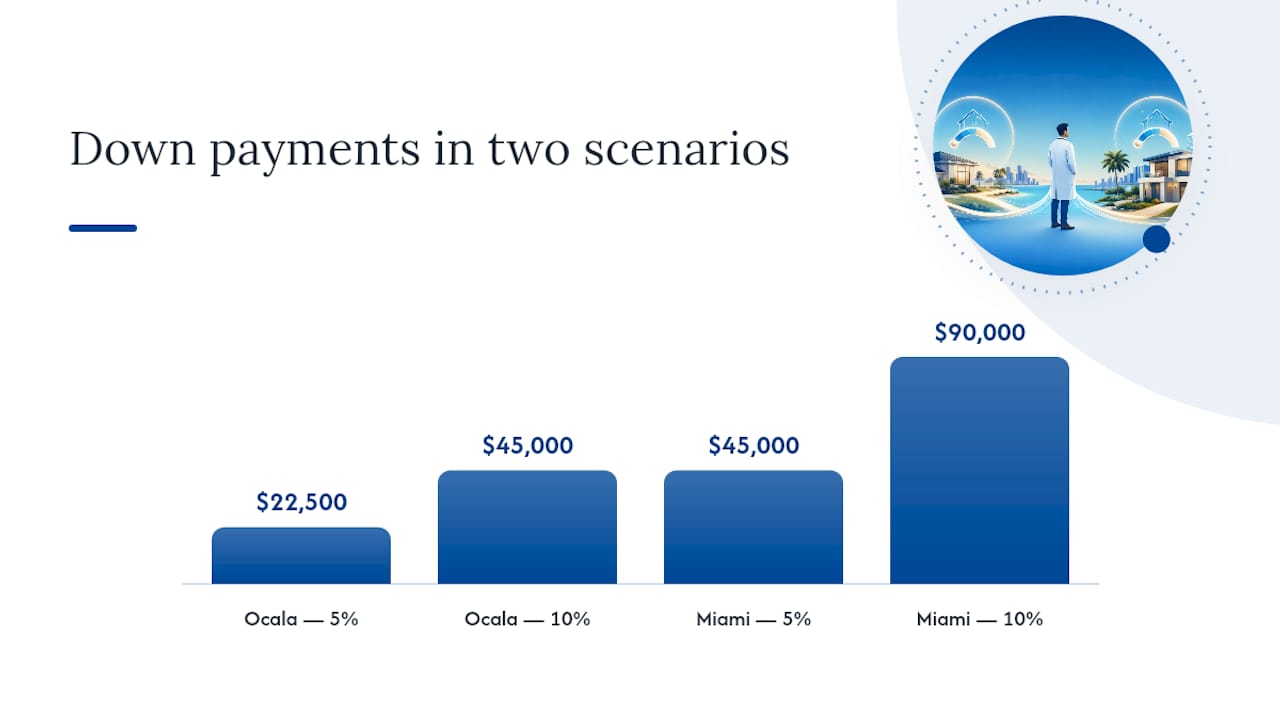
Florida's local market pricing matters here too. Miami, Fort Lauderdale, and coastal Southwest Florida carry a premium over inland metros, and Florida Realtors market reports consistently show that gap widening in waterfront and new construction segments. A physician targeting a $900,000 condo in Miami is working with different loan limit and down payment math than one buying a $450,000 house in Ocala, even under the same lender's physician program. Use a mortgage calculator to model both scenarios before you fall in love with a listing.
How Are Student Loans Treated in a Physician Mortgage?
This is often the single biggest lever in the entire application, bigger than down payment, bigger than credit score. Conventional underwriting typically calculates your debt to income ratio using either your full student loan payment or a flat percentage of the balance if the loan is in deferment. Physician mortgage lenders take a more workable approach.
Common treatments include:
- Excluding deferred loans entirely from the DTI calculation if payments won't begin within a set window, often 12 months.
- Using your actual income driven repayment (IDR) payment instead of a standard amortized payment, which can be a fraction of the conventional number.
- Applying a fixed assumed payment (a flat dollar figure per $1,000 borrowed) that's still typically lower than a standard 10 year repayment calculation.
Here's why that matters in real numbers. Say you owe $220,000 in student loans and earn $220,000 as a new attending. Under conventional rules using a standard repayment estimate, your loan payment might be calculated near $2,400 a month, which chews through your DTI room fast. Under a physician program using your actual IDR payment of $400 a month, that same debt barely dents your borrowing power. The difference can mean qualifying for a $200,000 to $300,000 larger loan on identical income.
Lenders will still ask for documentation to verify all of this: your servicer statement showing loan status, your IDR enrollment confirmation, and sometimes a letter explaining your repayment plan election.
Pro Tip: Request your IDR recertification letter before you apply. It's the single document underwriters ask for most often, and requesting it from your loan servicer can take one to two weeks, so get ahead of it.
What Should Florida Physicians Know About Condo Financing?
Condo eligibility is, by a wide margin, the most common reason a Florida physician mortgage gets delayed or denied. It's also the piece of this process that's most specific to Florida, and it deserves more attention than most articles give it.
A "warrantable" condo is one that meets standard eligibility rules: enough owner occupancy, adequate insurance, no pending litigation, and healthy reserve funding. Florida's condo market has faced unusual scrutiny since the Surfside collapse, and Florida Realtors reporting shows associations statewide responding with stricter reserve requirements and more frequent structural inspections. That's good for building safety. It also means more condo buildings, especially older coastal ones, are getting flagged during underwriting.
Before you make an offer on a Florida condo, check for:
- Pending special assessments or litigation against the HOA
- Reserve funding that meets current state requirements, not just what was adequate five years ago
- A recent structural or milestone inspection report, particularly for buildings over 30 years old
- Owner occupancy ratios above the lender's minimum threshold
Pro Tip: Ask your lender to run a preliminary condo review before you write an offer, not after. A quick questionnaire to the HOA management company can surface a warrantability problem in days instead of weeks, potentially saving your deposit and your timeline.
How Long Does the Physician Mortgage Process Take in Florida?
Most physician mortgage timelines follow a familiar shape, but the standout feature for doctors is how far in advance you can lock things down.
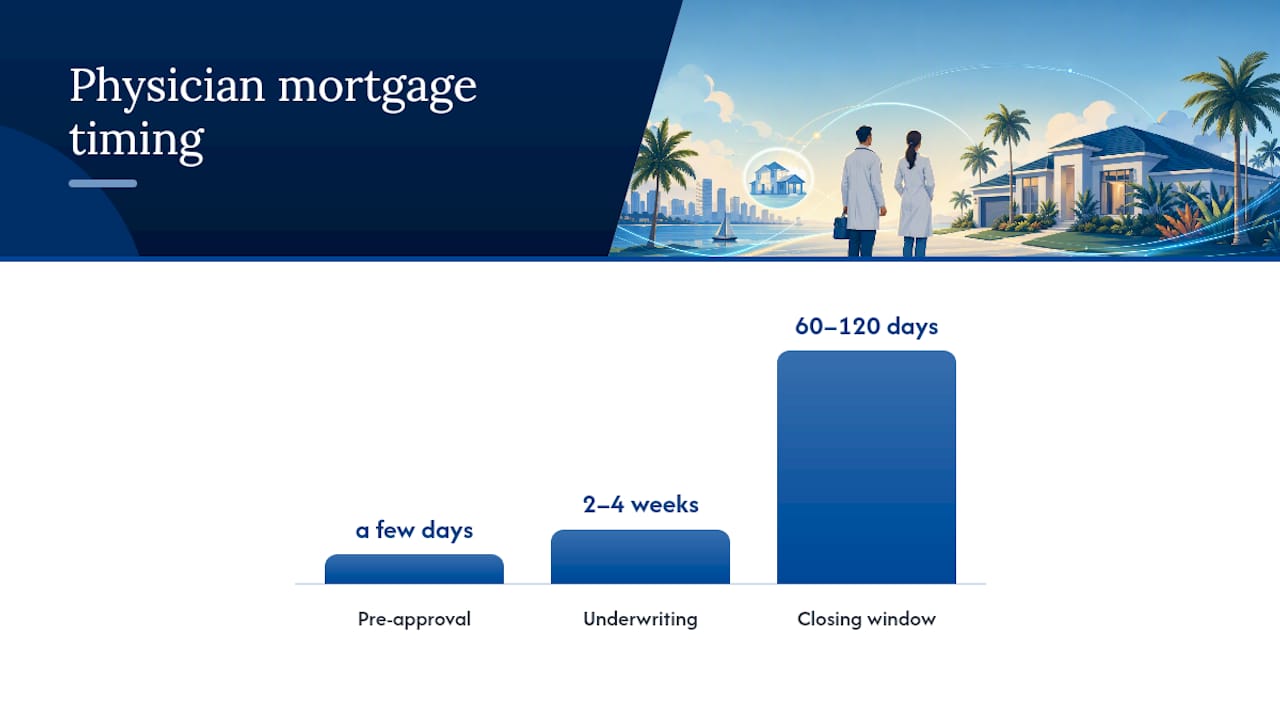
- Pre-approval: Submit your employment contract, ID, and student loan documentation. This usually takes a few days once paperwork is complete.
- Home search and offer: Timeline varies, but in competitive Florida metros, expect to move quickly once you find the right property.
- Underwriting: Typically two to four weeks, faster with clean documentation and slower if condo review or licensing verification is pending.
- Closing: Many physician lenders will close 60 to 120 days ahead of your actual job start date, based entirely on your signed contract.
That pre-start closing window is genuinely useful if you're relocating for residency or a new attending role. You can close on a home in Tampa or Jacksonville, move your family, and start unpacking before your first shift.
Speed up the process with a clean documents checklist: a signed contract with start date and salary clearly stated, your two most recent student loan statements, two months of bank statements, and a photo ID. If you're moving across state lines, coordinate your mortgage timeline with your Florida licensing application early. Board licensing and credentialing timelines vary widely and can stretch out longer than the mortgage process itself, so don't assume your loan will be the bottleneck. Review a step-by-step approval guide if you want a fuller walkthrough of what underwriters ask for.
How Do You Compare Physician Mortgage Options in Florida?
Rate is the number everyone asks about first, and it's the least useful number to lead with. The terms that actually determine whether a physician mortgage works for you are structural.
Run through this checklist before committing to a lender:
- Loan limit versus your target price. Does the 0% down tier cover your actual price range, or does it force you into a 5% or 10% down tier you weren't expecting?
- PMI policy. Confirm PMI is genuinely waived, not just deferred to a later loan to value threshold.
- Condo eligibility process. Ask whether the lender can pre-screen a specific building before you make an offer.
- Student loan DTI handling. Get a written explanation of whether they use IDR payments, a fixed assumed payment, or full amortization.
- Resident and fellow qualification. If you're not yet an attending, confirm your contract alone is sufficient.
- Fees and rate lock policy. Ask what happens to your rate lock if your closing date shifts by 30 or 60 days.
On your first call with any lender, ask directly: "What's your maximum 0% down loan amount, how do you calculate my student loan payment, and can you review a specific condo building before I make an offer?" A lender who can't answer all three clearly and quickly is a signal to keep shopping.
Pro Tip: Residents should prioritize contract-based qualifying and low cash requirements. Newly employed attendings should focus on student loan DTI treatment. Established earners with strong reserves often benefit more from comparing rate and term against a conventional or jumbo loan, since they may no longer need the physician program's flexibility. Comparing a range of Miami loan products side by side makes this easier than trying to hold five lenders' terms in your head at once.
How Lending Bankers Mortgage Supports Florida Physicians
Lending Bankers works with Florida homebuyers across residential and specialty lending, including Residential Mortgages, conventional and jumbo options, and the full range of loan programs physicians typically need to compare.
For medical professionals specifically, support can include:
- Reviewing employment contracts to assess qualification standards prior to submission.
- Positioning student loan documentation to reflect income-driven repayment enrollment, affecting DTI calculations.
- Running condo eligibility checks on Florida buildings before committing to an offer to identify potential warrantability issues.
- Coordinating closing timing to accommodate physicians relocating ahead of a residency or attending start date.
Cash Now or Rate Later: The Real Tradeoff
The advice that gets repeated most in physician lending circles, put more money down and skip the physician loan premium, ignores what most new physicians actually need: liquidity. If you're a resident, a relocating fellow, or a new attending three months into your first job, keeping cash in reserve matters more than shaving an eighth of a point off your rate. A 0% down physician loan that leaves $40,000 in your bank account is often the smarter move, even if the rate runs slightly higher than a 20% down conventional loan.
That calculation flips once you've built savings and settled into a permanent role. An established physician with strong reserves and no near-term plans to move should seriously compare a conventional or jumbo loan against a physician program, especially if the physician loan pushes you into a Florida condo with tighter warrantability limits. Two scenarios, two very different right answers. Know which one you're in before you pick a product.
— David
Get Started With a Physician Mortgage Through Lending Bankers
Comparing lender websites only gets you so far when the terms that matter most, loan limits, PMI policy, and student loan treatment, rarely show up in the marketing copy. Lending Bankers works directly with Florida physicians to sort through those specifics before you make an offer, not after.
That means reviewing your employment contract for qualifying purposes, positioning your student loan documentation correctly, and running condo eligibility checks on Florida buildings ahead of time so a warrantability problem doesn't surface after you've already put down a deposit. Lending Bankers also handles refinancing if you close now and want to revisit your rate later, along with commercial and investment lending if your plans extend beyond a primary residence. If you're a Florida physician ready to see actual numbers rather than general ranges, start a consultation on the Lending Bankers homepage and get a real read on what you qualify for before you start touring homes.
Sources
FAQ
Do Physicians Get Lower Mortgage Rates in Florida?
Not automatically. Physician mortgage programs are built around down payment flexibility and PMI waivers, not necessarily a lower base rate than conventional financing. A physician with a strong credit score may still qualify for a competitive rate, but the primary savings usually come from skipping PMI and reducing upfront cash needs.
Which Lenders Offer Physician Mortgages in Florida?
Physician mortgage programs are offered by a range of banks, credit unions, and mortgage brokerages across Florida, with terms varying widely on loan limits, PMI policy, and student loan treatment. Lending Bankers works with Florida physicians to compare loan options and match them to the program structure that fits their situation.
How Does a Physician Mortgage Work?
A physician mortgage qualifies you using a signed employment contract, allows a low or zero down payment, and typically waives private mortgage insurance regardless of loan to value ratio. Underwriters also apply more flexible student loan calculations, often using your income driven repayment amount instead of a full amortized payment.
Do PAs Qualify for Physician Mortgage Loans?
Physician assistants qualify for physician mortgage programs with some lenders, though inclusion is not universal across the market. If you're a PA, confirm eligibility directly with your lender early, since some programs limit qualifying credentials to MD, DO, and a handful of other doctoral level professions.