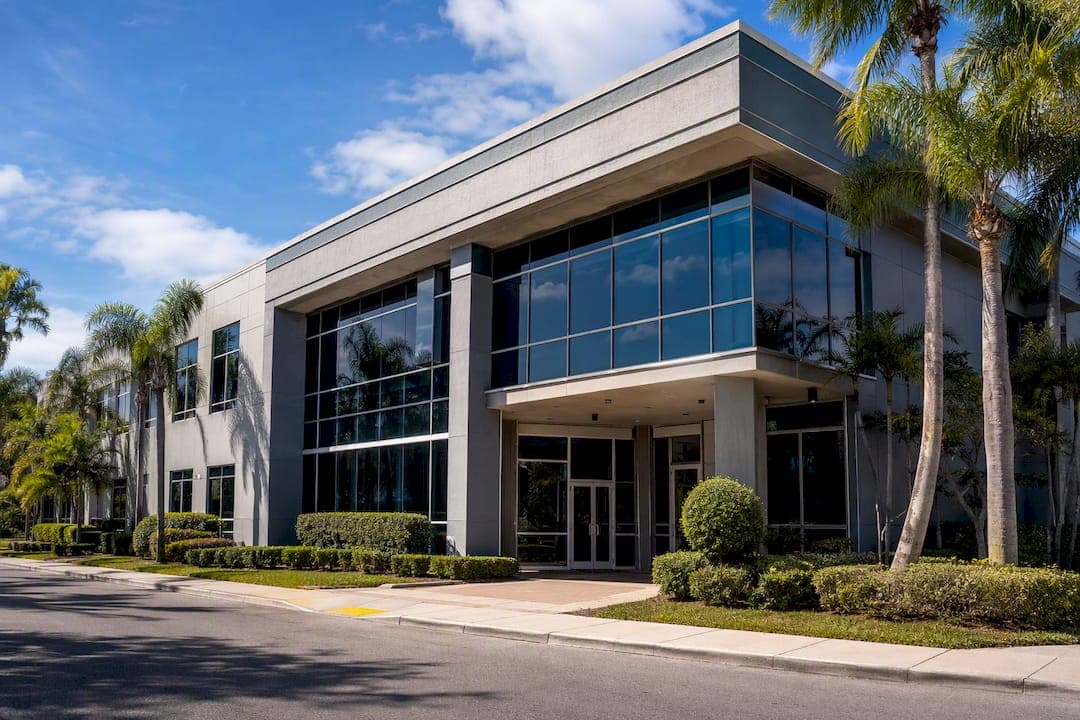
An owner-occupied commercial loan finances a property where your own business occupies most of the space, rather than one you lease out to tenants. The occupancy gatekeeper is strict: lenders generally require you to occupy at least 51% of an existing building, or 60% at opening for new construction under SBA program rules. Your best-fit program depends on what you value most: For an in-depth overview, see What Are SBA Loans? a Small Business Guide.
- Low down payment and a fixed long-term rate? SBA 504 usually wins.
- Working capital bundled with your real estate purchase? SBA 7(a) offers more flexibility.
- Speed and simplicity, and you have strong equity? A conventional commercial mortgage gets you to closing faster.
Key Takeaways
Choosing the right owner-occupied commercial loan involves aligning your occupancy percentage and business goals to the appropriate SBA, conventional, or bridge loan structure before application.
| Point | Details |
|---|---|
| Confirm occupancy first | You need to occupy 51% of an existing building or 60% of new construction to qualify for most SBA-backed programs. |
| Match program to priority | SBA 504 suits low down payments and fixed rates; SBA 7(a) suits working capital needs; conventional suits speed. |
| Prepare documents early | Business financials, personal tax returns, and floor plans should be ready before you approach a lender. |
| Budget for timeline and fees | SBA 504 closings take the longest; appraisal, environmental, and title fees add up beyond your down payment. |
| Work with a broker for placement | Lending Bankers matches borrowers to SBA, conventional, or bridge lenders and supports the file through closing. |
Table of Contents
- Owner Occupied Commercial Loan Basics: What Counts as Occupied
- Which Loan Programs Fit Owner-Occupied Commercial Real Estate?
- What Down Payment, Rate, and Loan Terms Should You Expect?
- What Documents Do Lenders Require for Underwriting?
- How Long Does Closing Take, and What Fees Should You Budget For?
- How Do You Choose the Right Loan and Lender?
- What Tax Benefits Come With Owner-Occupied Commercial Financing?
- Does Your Business Structure Affect Loan Approval?
- How Can You Improve Your Odds of Loan Approval?
- When Should You Refinance an Owner-Occupied Commercial Loan?
- How Lending Bankers Helps You Navigate Owner-Occupied Financing
- Ready to Explore Your Owner-Occupied Loan Options?
Owner Occupied Commercial Loan Basics: What Counts as Occupied
Occupancy isn't a guess lenders take your word on. For an existing building, you need to occupy at least 51% of the usable square footage yourself; new construction typically requires 60% at opening, with a path to full occupancy over time under SBA guidelines. Lenders verify this with floor plans, lease schedules, payroll records tied to the address, utility bills, and sometimes a site visit.
Mixed-use buildings and partially leased properties are where borrowers get tripped up. If you occupy the ground floor and lease the second floor to a tenant, the math has to clear 51% before the rest counts as investment space. Shared ownership arrangements, where multiple businesses under common ownership occupy the building, also need documentation showing each entity's footprint.
Pro Tip: Pull your floor plan and current lease agreements before you talk to a lender. Occupancy verification is often the fastest way a deal gets rejected, and having proof ready up front saves weeks.
Which Loan Programs Fit Owner-Occupied Commercial Real Estate?
Four structures dominate this market, and each solves a different problem.
- SBA 504. This splits into a bank first mortgage covering roughly 50% of the project, a CDC/SBA debenture covering a substantial portion, and borrower equity a smaller share, according to Lev's breakdown of 2026 SBA 504 structures. The debenture portion carries a long-term fixed rate, which makes 504 attractive if you want to lock in payments for 20 to 25 years and keep your cash outlay small. It can finance acquisition, new construction, and major renovation up to program caps, per Linton Global Solutions' guide to SBA 504 financing.
- SBA 7(a). More flexible than 504 because proceeds can cover working capital, equipment, or debt refinancing alongside the real estate purchase. Pricing tends to be variable, and Financely Group's comparison of owner-occupied CRE options notes the eligibility tradeoffs differ from 504 in ways that matter if your business needs cash beyond the building itself.
- Conventional commercial mortgages. Banks and credit unions move faster and keep paperwork simpler, but they typically demand stronger credit, several years in business, and a larger down payment than SBA programs, according to NerdWallet's review of small-business real estate loans.
- Hard money or bridge loans. Useful when you need to close fast or don't yet meet bank requirements, at a materially higher cost and shorter term.
What Down Payment, Rate, and Loan Terms Should You Expect?
The numbers vary sharply by program, and they drive your monthly cash flow more than almost any other decision you'll make on this loan.
- Down payment and LTV. SBA 504 borrowers often put down a low single-digit percentage because the CDC debenture covers a large share of the project cost. Conventional lenders usually want a significantly higher down payment, sometimes more depending on the appraised value and your business's cash flow strength.
- Rate structure. The CDC portion of an SBA 504 loan is fixed for the life of that piece, while the bank-funded first mortgage on the same deal is typically set by the lender and may adjust. Conventional loans offer either fixed or variable pricing, and SBA 7(a) rates usually float with a base index plus a lender spread.
- Amortization and guarantees. Amortization schedules commonly run for two to three decades on SBA 504 debentures, while conventional loans often amortize over 20 to 25 years but may carry a balloon payment at 5 or 10 years. Nearly every owner-occupied structure requires a personal guarantee, and some lenders ask for cross-collateralization if you own multiple properties or entities.
A borrower with strong equity and stable cash flow generally gets the best tradeoff with conventional financing: faster closings and less paperwork, according to NerdWallet. If minimizing your rate is the priority, small adjustments to loan structure and timing can move the needle, as outlined in this breakdown of tips for minimizing commercial mortgage rates.
What Documents Do Lenders Require for Underwriting?
Owner-occupied deals get underwritten on two fronts at once: your business and the property itself. Woodsboro Bank's explainer on owner-occupied commercial real estate confirms lenders review both sides before issuing approval.
- Business financials: profit and loss statements, balance sheets, two to three years of business tax returns, and cash-flow statements.
- Owner documents: personal tax returns, credit reports, and a resume or summary of management experience in your industry.
- Property due diligence: a full appraisal, title search, Phase I environmental review, and lease schedules if any portion of the building is leased out.
- SBA-specific flags: size standard compliance, proof your business operates for profit, and documentation confirming you'll occupy the required percentage of the space.
Bank underwriting standards on commercial lending are shaped in part by federal regulatory guidance, which is why documentation requirements can feel more rigid at traditional banks than with SBA-focused lenders. Reviewing what commercial lenders actually look for before applying can save you a round of back-and-forth.
How Long Does Closing Take, and What Fees Should You Budget For?
Timelines differ a lot by program, and the gap is often bigger than borrowers expect.
- Conventional loans close fastest, often in 30 to 60 days when your financials are clean and the property doesn't need extensive review.
- SBA 7(a) loans typically take longer than conventional financing because of additional SBA paperwork and eligibility verification.
- SBA 504 loans usually take the longest, since they involve both a bank and a Certified Development Company, plus the debenture funding process; SBA-focused lender guidance confirms realistic planning for appraisal and environmental timing is critical here.
Budget for appraisal fees, environmental Phase I costs, title and recording charges, and underwriting or origination fees on top of your down payment. The most common mistakes that delay closing: starting the loan search too late, submitting incomplete occupancy evidence, and underestimating how long third-party reports take to come back. A closer look at common commercial loan mistakes covers several more that catch first-time borrowers off guard.
Pro Tip: Order your appraisal and environmental review the moment you go under contract, not after your loan application is submitted. Those two reports are almost always the longest pole in the tent.
How Do You Choose the Right Loan and Lender?
Match your priority to the program before you shop lenders. If cost matters most and you can wait out a longer close, SBA 504 usually delivers the lowest long-term rate on the debenture portion. If you need working capital folded into the same loan, SBA 7(a) gives you that flexibility. If speed matters most and you have 20% to 30% to put down, conventional financing gets you to the closing table faster.
Before signing with any lender, ask these questions directly:
- What's your realistic timeline from application to closing, in writing?
- How much equity will you actually require, and does that change if the appraisal comes in low?
- What's the APR versus the quoted rate, including all fees?
- Are there prepayment penalties, and how are they structured?
- Who handles the SBA paperwork, and have you closed 504 or 7(a) deals in the last year?
Watch for red flags: a lender who won't show you a sample term sheet, vague answers about timeline, or a request for an unusual upfront retainer before any underwriting begins. Comparing a few tips for choosing a commercial mortgage company before you commit puts you in a stronger negotiating position.
What Tax Benefits Come With Owner-Occupied Commercial Financing?
Owning your building instead of leasing changes your tax picture in ways that compound over the life of the loan. Mortgage interest on an owner-occupied commercial property is generally deductible as a business expense, and depreciation on the building (though not the land) reduces taxable income year over year. That depreciation schedule typically runs on a straight-line basis over the property's useful life, which for commercial real estate is longer than for residential property.
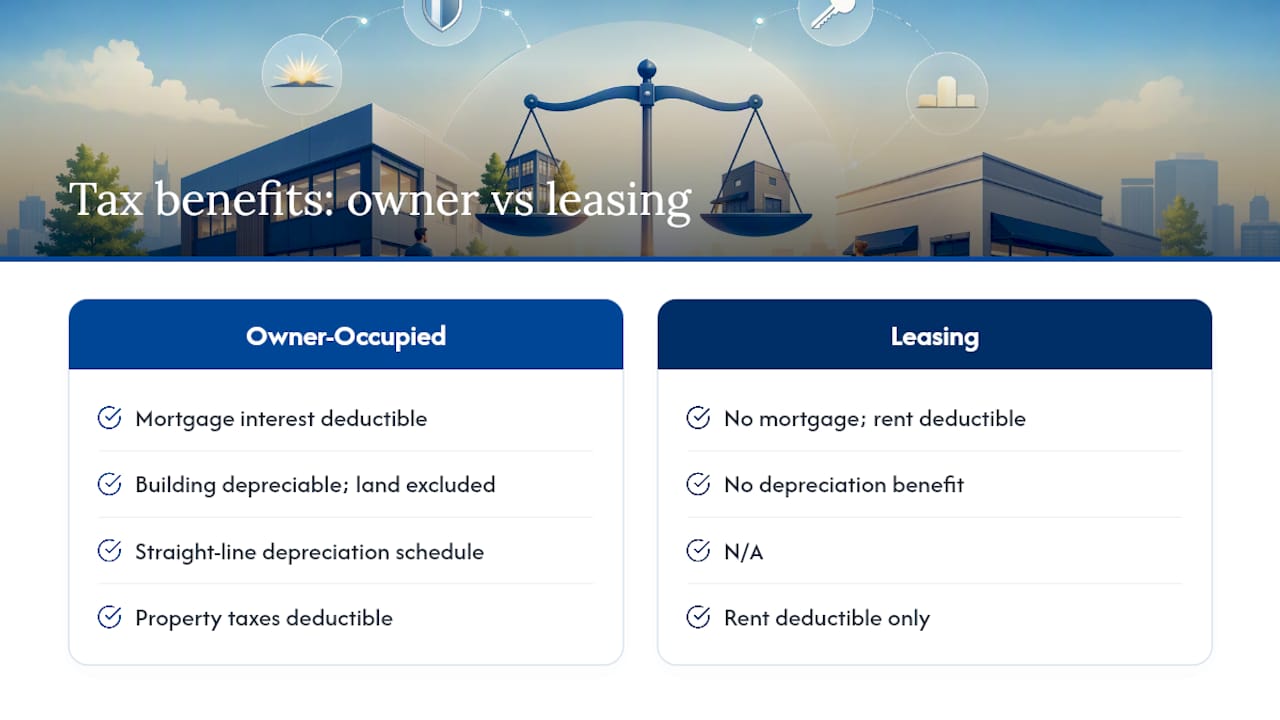
Property taxes paid on the building are also usually deductible, and if you're financing improvements or renovations as part of an SBA 504 or 7(a) loan, those capital costs may qualify for accelerated depreciation treatment in certain cases. This is a meaningful shift from leasing, where your rent is deductible but you build no equity and capture none of the depreciation benefit.
There's a cash-flow angle too. When you occupy your own building, your monthly loan payment often lands close to what you'd otherwise pay in rent, except now a portion of that payment builds equity instead of disappearing into a landlord's pocket. Over a 20 or 25-year amortization schedule, that difference adds up to a meaningful asset on your balance sheet.
None of this replaces a conversation with your accountant, since deduction rules shift based on your entity structure, how the property is titled, and whether you're claiming Section 179 or bonus depreciation on qualifying improvements. But the general shape holds across nearly every owner-occupied deal: financing the building yourself converts what used to be a pure expense into a mix of expense, equity, and long-term tax planning.
Does Your Business Structure Affect Loan Approval?
How your business is legally structured shapes both your eligibility and how a lender underwrites the deal. If you operate as an LLC, most lenders will still require a personal guarantee from any owner holding 20% or more equity, which means the liability shield your LLC provides for operations doesn't fully extend to the loan itself. The lender wants a real person standing behind the debt, not just the entity.
S-Corp structures introduce a different wrinkle: because income and losses pass through to the owner's personal tax return, your personal tax returns become just as important to underwriting as the business's own financials. A lender reviewing an S-Corp borrower will often ask for both the business return and your personal return side by side to reconcile owner draws, distributions, and reported income.
Multi-member LLCs and partnerships can complicate SBA eligibility checks, since the SBA requires documentation on every owner holding a meaningful stake, along with proof the business qualifies under SBA size standards. If you've recently changed your entity structure, converting from a sole proprietorship to an LLC, for example, expect the lender to ask for a clear paper trail showing how assets and liabilities transferred.
The practical takeaway: talk to your lender about entity structure early, not after you've submitted an application. A mismatch between how your business is titled and how the loan needs to be guaranteed is one of the more common reasons underwriting stalls midway through the process, and it's almost always avoidable with a five-minute conversation up front.
How Can You Improve Your Odds of Loan Approval?
Prequalification isn't just a formality. It's the step that tells you whether you're chasing a deal you can actually close, before you've spent money on an appraisal or gotten emotionally attached to a property.
Start by pulling your own credit report and business financials before a lender does. Clean up anything you can, pay down revolving debt where possible, and make sure your business tax returns and personal returns tell a consistent story. Lenders cross-reference these documents, and discrepancies between what you report on paper and what shows up in your bank statements are one of the fastest ways to stall an application.

Get a letter of prequalification from a lender or broker before you start touring properties seriously. This does two things: it tells you your realistic price range, and it signals to sellers that you're a credible buyer when you make an offer. Preparing the documentation a stated income loan requires, even if you're not pursuing that specific product, is a useful exercise for understanding what any lender will eventually ask for.
A few concrete moves tend to move approval odds the most: maintaining at least two years of consistent or growing business revenue, keeping your debt-service coverage ratio comfortably above what your target lender requires, and having your occupancy documentation (floor plans, proof of operations) ready before you apply rather than scrambling for it mid-underwriting. Borrowers who treat prequalification as a real diagnostic step, not a rubber stamp, close faster and negotiate from a stronger position.
When Should You Refinance an Owner-Occupied Commercial Loan?
Refinancing makes sense in a handful of specific situations, and recognizing which one applies to you determines what kind of refinance to pursue.
If your original loan carries a variable rate and market rates have moved favorably, refinancing into a fixed-rate SBA 504 or conventional structure can lock in predictable payments for the remaining life of your ownership. If you originally financed with a hard money or bridge loan to close quickly, refinancing out of that short-term, higher-cost debt into a conventional or SBA structure is often the entire point of the bridge loan in the first place. Waiting too long on that transition means paying bridge-loan rates far longer than necessary.

A balloon payment coming due on a conventional loan is another common trigger. If your loan was structured with a 20 or 25-year amortization but a 5 or 10-year balloon, you'll need to refinance, sell, or pay off the balance well before that date arrives, and starting the refinance conversation six months ahead gives you room to shop terms rather than scrambling.
Business growth is the fourth scenario. If your business has grown enough that you now qualify for better terms than you did at origination, stronger cash flow, better credit, more time in business, refinancing can lower your rate or free up cash by extending your term. The math only works if the savings outweigh prepayment penalties and new closing costs, so run the comparison before committing. Reviewing your options for refinancing out of a hard money loan is a useful starting point if that's your current structure.
How Lending Bankers Helps You Navigate Owner-Occupied Financing
Choosing between SBA 504, SBA 7(a), conventional, and bridge financing isn't a decision you should make alone, and Lending Bankers works across all four categories rather than pushing one product. The process starts with an eligibility check against your occupancy percentage and business financials, followed by a documentation checklist tailored to whichever program fits your situation. From there, Lending Bankers matches you with lenders suited to your profile, whether that's an SBA-focused CDC or a conventional bank, and stays involved through closing.
For borrowers who don't fit a standard bank box, including foreign nationals pursuing eligible commercial financing, Lending Bankers also handles that qualification path directly. Reviewing what commercial lenders actually require during underwriting gives you a head start before that first conversation.
— David
Ready to Explore Your Owner-Occupied Loan Options?
You don't have to compare SBA 504 debenture structures against conventional rate sheets on your own. Lending Bankers is the direct alternative to shopping five different banks yourself: one point of contact who packages your file for SBA, conventional, or bridge financing and matches you with the lender most likely to approve it, instead of you guessing which door to knock on first.
That matters most in owner-occupied deals, where occupancy documentation, entity structure, and personal guarantees all have to line up correctly before a lender will even schedule underwriting. Lending Bankers reviews your financials and your target property upfront, flags eligibility issues before they become closing delays, and brings hard money or bridge options to the table if speed matters more than rate. If you're weighing a purchase or a refinance and want a clear read on which program actually fits your numbers, get in touch with Lending Bankers and start with a straightforward review of what commercial lenders look for before you submit anything.