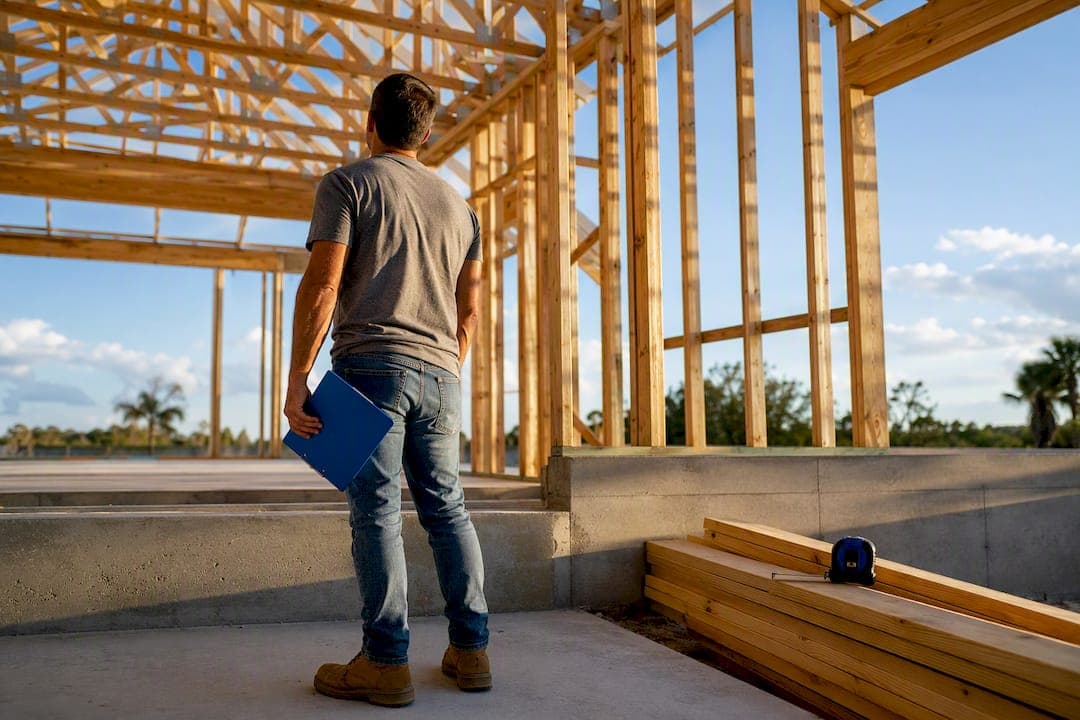
Yes, owner-builder construction loans exist, but they're a niche product with tighter underwriting than a standard mortgage. They fit borrowers with construction experience, strong credit and income, or significant land equity to offset the risk lenders take on when you serve as your own general contractor. If that describes you. Your next move is assembling a borrower package and approaching a broker or specialty lender who already works with self-builders.
TL;DR:
- Owner-builder construction loans have tighter underwriting and require strong credit, income, or land equity to offset the higher risk for lenders.
- These loans release funds in draws tied to construction milestones, with inspections confirming work before each disbursement.
- Expect larger down payments of 20% to 30% of the project cost, but land owned free and clear can reduce this requirement.
- Lenders demand detailed documentation including plans, budgets, signed subcontractor bids, and proof of permits or applications.
- Owner-builder financing is mainly available through local community banks, credit unions, and specialty lenders, not large retail banks.
Table of Contents
- What Is an Owner-Builder Construction Loan?
- Construction-Only vs. One-Time Close: Which Fits You?
- What Do Lenders Require to Approve You?
- How Much Cash Do You Need, and What Will It Cost?
- How Do Draws and Inspections Actually Work?
- Where Do You Find Lenders Willing to Fund Owner-Builders?
- What Are the Real Risks, and How Do You Manage Them?
- Insurance and Risk Management You Can't Skip
- Permits, Compliance, and Legal Considerations for Owner-Builders
- Who Owner-Builder Financing Actually Fits
- How Lending Bankers Helps You Finance Your Self-Build
- Sources
- FAQ
What Is an Owner-Builder Construction Loan?
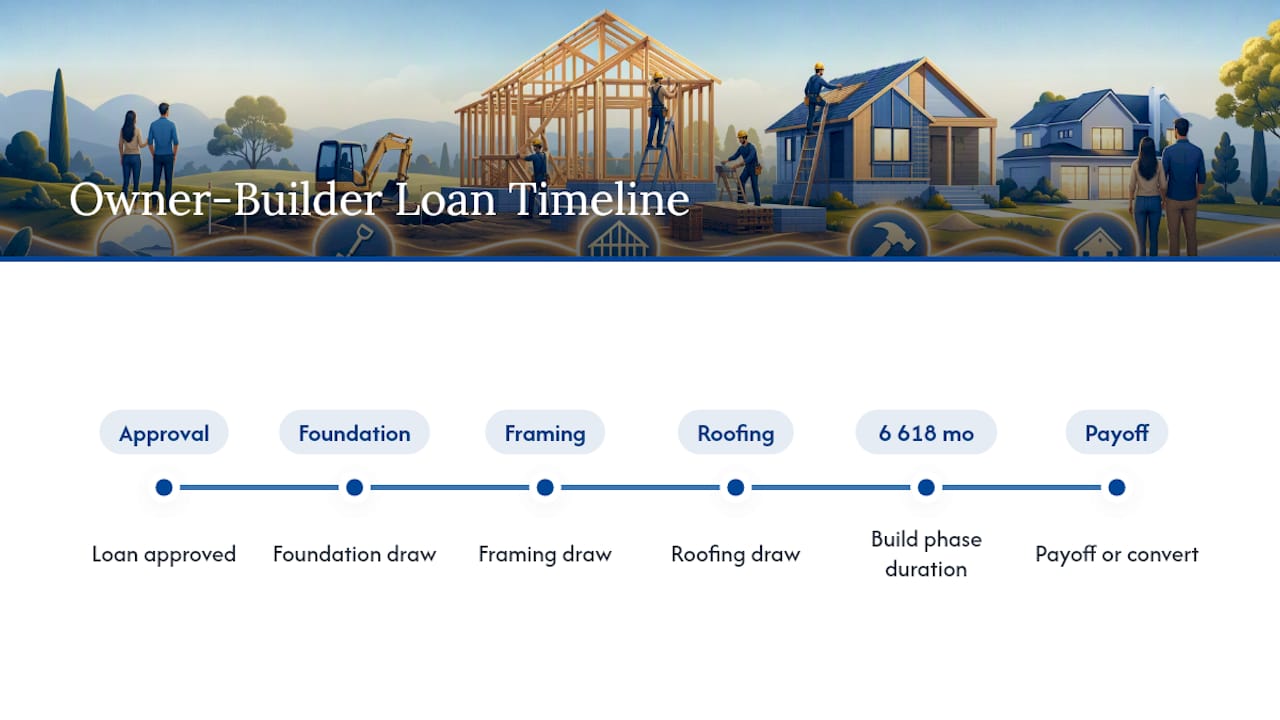
An owner-builder construction loan finances a home build where you act as your own general contractor instead of hiring one. The lender doesn't hand you the full loan amount up front. Funds release in draws tied to construction milestones, such as foundation, framing, and roofing, and you typically pay interest only on the amount drawn so far rather than the full loan balance.
This structure protects the lender while the home is still collateral in progress. Most construction loans run 6 to 18 months, covering the build phase before the loan either pays off or converts into permanent financing. Compared to a contractor-led loan, expect more paperwork upfront, since the lender is underwriting your ability to manage the project, not just your finances.
Construction-Only vs. One-Time Close: Which Fits You?
A one-time close construction-to-permanent loan combines your construction financing and your permanent mortgage into a single closing, locking your rate before the first shovel hits the ground. You avoid a second underwriting review at completion, which matters if your income or the rate environment might shift mid-build.
Construction-only loans offer more flexibility for owner-builders whose plans might change, but they require a second closing (and a second round of qualifying) once the home is finished. That second-close risk is exactly why many advisors steer self-builders toward one-time close whenever they qualify.
Government-backed programs add wrinkles. FHA one-time close loans can work for owner-builders in some cases with lower down payments, while VA construction loans generally require a licensed, approved builder, which often rules out true self-management.
What Do Lenders Require to Approve You?
Lenders scrutinize owner-builders more closely than they scrutinize buyers using a licensed general contractor. Expect stricter benchmarks on credit, debt-to-income ratio, and cash reserves, plus a demand for evidence you can actually manage a build, not just finance one.
A typical borrower package includes:
- Stamped, permit-ready architectural plans
- A detailed line-item construction budget
- Signed bids from subcontractors for major trades
- Permits or proof of permit applications in progress
- Two years of tax returns and recent bank statements
- Proof of liquid reserves beyond your down payment
If you lack formal construction experience, some lenders will accept a licensed construction consultant or project manager on your team as a substitute. Our own construction loan application guide walks through gathering these documents in the right order.
Pro Tip: Get your subcontractor bids as fixed-price contracts, not estimates. Lenders view firm bids as evidence your budget will hold, and it protects you from mid-project cost creep.
How Much Cash Do You Need, and What Will It Cost?
Owner-builder loans typically require a larger down payment than a conventional purchase mortgage, often in the range of 20% to 30% of the total project cost, depending on the lender and your experience level. Loan-to-cost ratios tend to run more conservative than loan-to-value ratios on a finished home purchase.
If you already own the land free and clear, many lenders will count that equity toward your down payment requirement, which can meaningfully cut the cash you need to bring to closing.
Construction lending carries higher default and completion risk than a standard mortgage, which is why the FDIC has flagged construction loan portfolios as requiring closer underwriting scrutiny industrywide, translating into higher rates, added fees, and holdback provisions for borrowers.
Expect rates that run above standard mortgage pricing, along with retainage (typically 5% to 10% held back per draw) and per-draw inspection fees that add up over a multi-month build.
How Do Draws and Inspections Actually Work?
Your lender releases money in stages, not all at once, and each stage requires proof the prior work is complete and paid for.
- You or your builder submit a draw request tied to a completed milestone, like framing or drywall.
- A third-party inspector visits the site to verify the work matches the draw request.
- You provide lien waivers and paid invoices from subcontractors, along with progress photos.
- The lender releases funds, typically within a few business days of a clean inspection.
- The cycle repeats through the remaining milestones until the home is complete.
Delays usually trace back to permitting holdups, weather, or incomplete lien documentation. Ask your lender upfront about their extension policy so a slow winter doesn't put your loan in default. Using a project tracking tool built for contractor task management can help you keep draw documentation organized as milestones pile up.
Where Do You Find Lenders Willing to Fund Owner-Builders?
National retail banks rarely touch owner-builder deals. Your realistic options are narrower but more receptive once you know where to look.
- Community banks with local construction lending desks familiar with your market
- Credit unions, which often show more underwriting flexibility for member-owners
- Farm Credit institutions, especially for rural or larger-acreage builds
- Specialty owner-builder lenders that focus exclusively on self-build financing
A mortgage broker earns their fee here by knowing which of these lenders are actively approving owner-builder files this quarter, since appetite shifts. On your first call, ask about minimum down payment, whether they require a licensed GC as backup, their draw and inspection process, and whether they offer one-time close. Our loan options overview covers program differences worth raising in that same conversation.
What Are the Real Risks, and How Do You Manage Them?
Cost overruns are the number one risk. Self-builders routinely underestimate labor timelines and material costs, and lenders won't advance more than the approved budget without a change order and re-underwriting.
Underwriting itself is stricter, which surprises first-time self-builders expecting mortgage-style approval speed. You also can't count your own labor as equity in most loan structures, even if you're a licensed tradesperson doing the work yourself.
The mitigations are straightforward: lock fixed-price subcontractor bids instead of estimates, build a contingency of at least 10% to 15% into your budget, and consider hiring a construction consultant to manage inspections and paperwork if you lack that background. Keep reserves untouched during the build rather than treating them as spending money. If your credit, reserves, or experience are thin, an owner-builder structure probably isn't the right fit yet, and a licensed-GC construction loan may be the more realistic path.
Insurance and Risk Management You Can't Skip
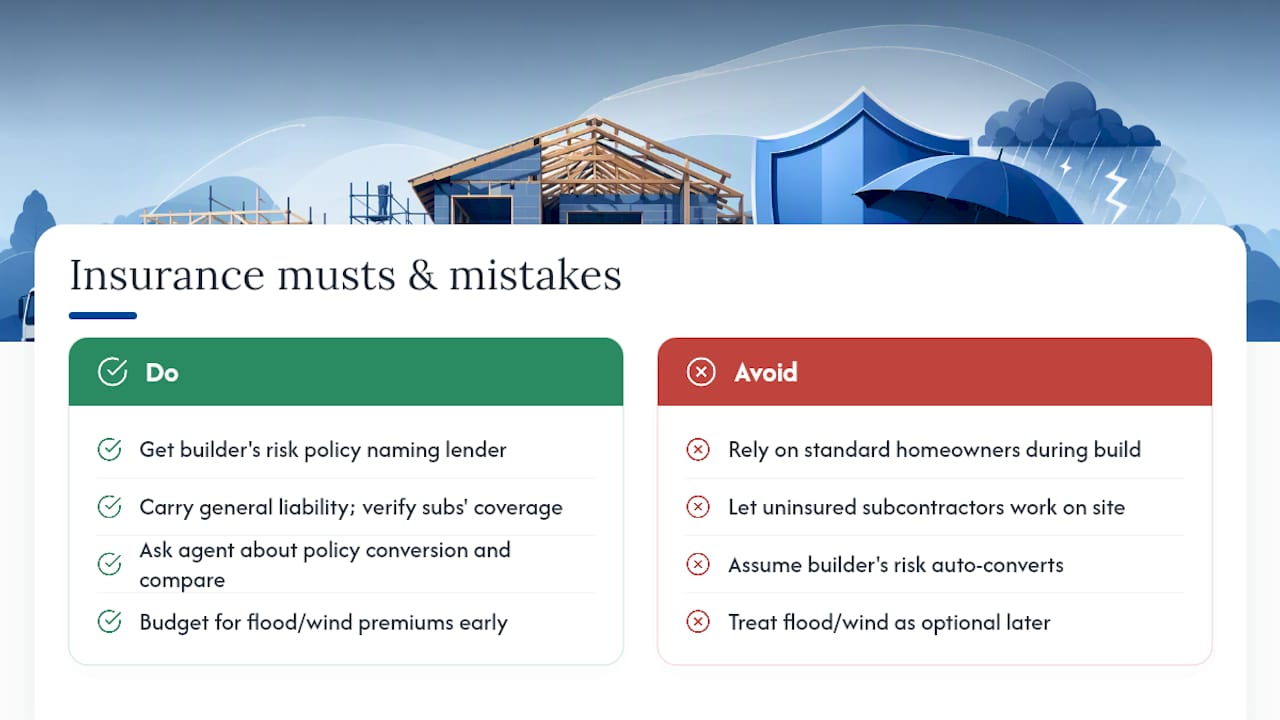
Standard homeowners insurance doesn't cover a property mid-construction, so lenders will require a builder's risk policy before releasing your first draw. This covers the structure, materials on-site, and often theft or vandalism during the build, and your lender is typically named as a loss payee on the policy.
You'll also need general liability coverage, especially critical for owner-builders since you're the one holding legal responsibility that a licensed general contractor would normally carry. If subcontractors work on your site, confirm each one carries their own liability and worker's compensation coverage. A single uninsured sub causing an injury on your property can expose you personally in ways a licensed GC's insurance would have absorbed.
Ask your insurance agent whether your builder's risk policy converts automatically into a standard homeowners policy at completion, or whether you need to arrange a new policy at closing on your permanent loan. Gaps here are common and avoidable with one phone call. It's also worth comparing homeowners insurance against mortgage insurance so you understand what each actually protects once the home is finished and occupied.
Flood and wind coverage may also apply depending on your build location, and your lender will flag this during underwriting if your parcel sits in a mapped hazard zone. Budget for these premiums as a project cost, not an afterthought once construction wraps.
Permits, Compliance, and Legal Considerations for Owner-Builders
Every owner-builder project runs through your local building department, and permit requirements typically cover zoning compliance, structural plans, electrical, plumbing, and mechanical work, plus a final certificate of occupancy before you can legally move in.
Some states and counties require owner-builders to sign an affidavit acknowledging they're acting as their own contractor, which can carry legal implications if you later sell the property within a set timeframe. Check your local rules before you assume this is a formality.
Building codes are enforced through scheduled inspections at each construction phase, and skipping one to save time can stall your draw schedule entirely, since lenders require proof of passed inspections before releasing funds. If you're managing subcontractors directly, confirm each trade carries proper state licensing, since unlicensed work can trigger code violations that delay your certificate of occupancy.
Consult your local building department and a real estate attorney familiar with owner-builder statutes in your area before breaking ground. The rules vary meaningfully by state and even by county, and getting this wrong can stall your project long after financing is already in place.
Who Owner-Builder Financing Actually Fits
We see owner-builder financing work best for licensed tradespeople managing their own trade while subcontracting the rest, experienced DIY project managers who've run a renovation or build before, and buyers sitting on substantial land equity that offsets a lender's risk. If none of those describe you yet, a licensed-GC construction loan is usually the smoother path.
When you're ready to explore financing, Lending Bankers can walk through your borrower package and match you with lenders actively approving self-build projects in your market.
— David
How Lending Bankers Helps You Finance Your Self-Build
Building your own home means juggling contractors, permits, and inspections all at once, and chasing down a lender willing to finance an owner-builder deal shouldn't be one more headache on that list. A mortgage brokerage works directly with lenders who understand self-build projects, so you get someone shopping your file to the right underwriters instead of guessing which bank might say yes.

Before you call us, pull together your stamped plans, line-item budget, subcontractor bids, and two years of tax returns. Having that package ready speeds up how quickly we can match you with a lender and get a real answer on terms. Our team also handles commercial and developer construction financing if your project extends beyond a single-family self-build. Reach out to Lending Bankers today to start the conversation and find out which lenders are actively approving owner-builder projects like yours.
Sources
For rules on closing disclosures, see the Consumer Financial Protection Bureau. For FHA and VA program details, consult HUD. For construction lending risk standards, review FDIC resources. For a practical borrower checklist, see Build Your House.
This article is general information, not a substitute for advice from a qualified financial advisor. Consult a qualified financial professional about your own circumstances before acting on anything here.
- Construction loans explained | Opendoor
- What are self-build construction loans and how do they work? (Nav)
- Construction Loans for Owner-Builders — How to Get Approved | Build Your House
FAQ
How Do Owner-Builder Construction Loans Work?
You act as your own general contractor while the lender disburses funds in draws tied to completed construction milestones. Interest typically accrues only on the amount drawn, and the build phase usually runs 6 to 18 months before the loan pays off or converts to a permanent mortgage.
What's the Monthly Payment on a $200,000 Construction Loan?
During construction, you generally pay interest only on the funds actually drawn, not the full loan amount, so your payment grows as draws release. Exact payments depend on your rate and draw schedule, so ask your lender for a projected amortization based on your specific milestone timeline.
Do I Need 20% Down for a Construction Loan?
Down payment requirements for owner-builder loans often run higher than a standard mortgage, commonly in the 20% to 30% range of total project cost. If you own your land outright, many lenders will let that land equity count toward your down payment, reducing the cash you need at closing.
Can I Get a Construction Loan as an Owner-Builder in Florida?
Owner-builder financing is available in Florida through community banks, credit unions, and specialty lenders, though national retail banks rarely offer it. Lending Bankers works with lenders across the state who evaluate owner-builder files on construction experience, land equity, and financial reserves.