
Yes, non-QM loans are available throughout Florida, and they come in several forms: bank statement loans, DSCR loans for investors, asset depletion programs, 1099/P&L options, ITIN and foreign national mortgages, and limited no-income-verification products. Each trades some conventional documentation for flexibility, which usually means you'll see higher rates, larger reserve requirements, or bigger down payments in exchange.
TL;DR:
- Non-QM loans in Florida include financing options like bank statement, DSCR, asset depletion, and foreign national programs, each with higher rates and reserve requirements.
- Borrowers with unconventional or hard-to-document income, such as self-employed professionals, investors, or retirees, find these loans suitable, especially in sectors like tourism or seasonal work.
- The application process involves gathering documents first, choosing the right program with a broker’s help, manual underwriting, and closing involves typical signatures, usually within a few weeks.
- Always verify a lender’s license through NMLS; avoid guarantees of approval and compare rates, fees, and experience to ensure the best fit for your financial situation.
Table of Contents
- What Non-QM Loans in Florida Actually Cover
- Who Should Consider Non-QM Financing in Florida?
- What Documents and Limits Apply to Florida Non-QM Loans?
- How Do You Apply for a Non-QM Loan in Florida?
- Lending Bankers Mortgage: Local Florida Experience Placing Non-QM Loans
- Questions to Ask Before Choosing a Non-QM Lender
- A Florida Mortgage Advisor's Take on Non-QM Trade-Offs
- How Lending Bankers Puts Non-QM Financing Within Reach
- Sources
- FAQ
What Non-QM Loans in Florida Actually Cover
A "Qualified Mortgage" follows strict federal underwriting rules built around verified income and a borrower's documented ability to repay, as the Consumer Financial Protection Bureau explains. Non-QM loans sit outside that framework. They still require proof you can repay the loan, but lenders get to define what proof looks like, which opens the door for borrowers whose income doesn't fit a W-2 mold.
Non-QM isn't one product. It's an umbrella covering several distinct programs, each with its own documentation rules and ideal borrower.
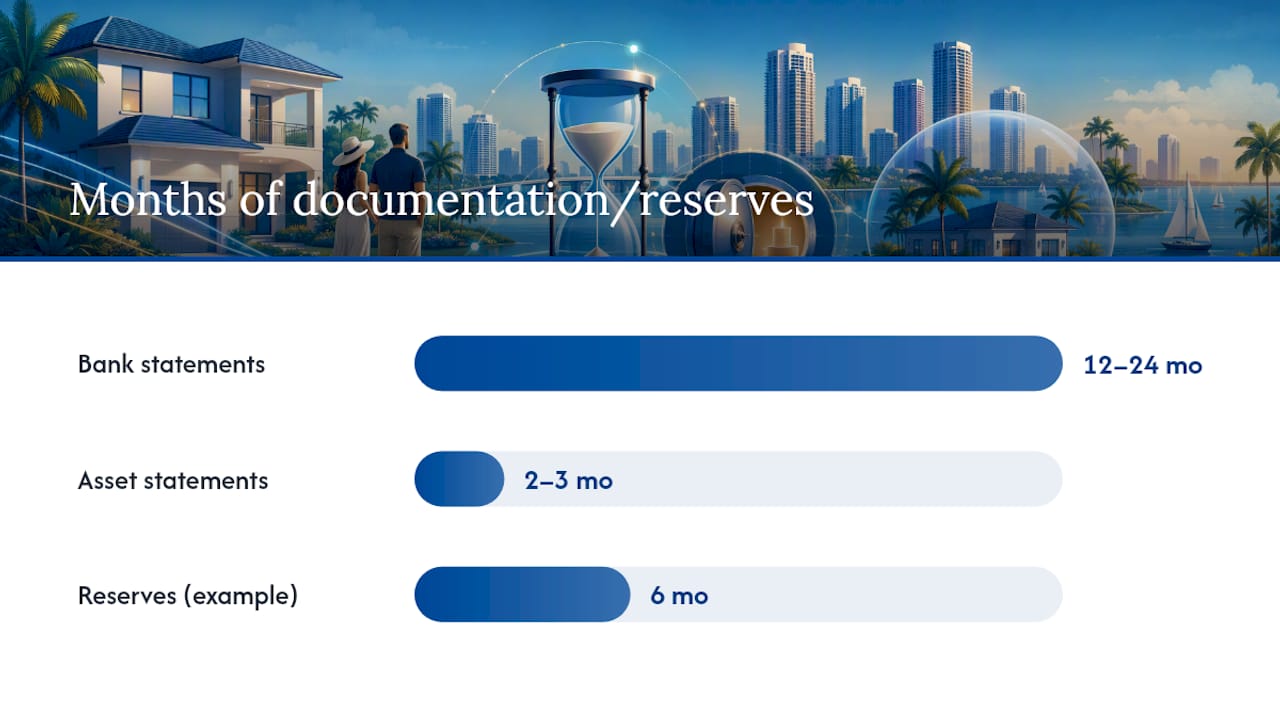
- Bank statement loans use 12 to 24 months of personal or business bank statements instead of tax returns, which helps self-employed borrowers whose write-offs make their taxable income look smaller than their actual cash flow.
- DSCR loans qualify you based on a property's rental income rather than your personal income, using the Debt Service Coverage Ratio, a calculation lenders favor for investors and short-term rental owners.
- Asset depletion loans convert savings, investments, and retirement accounts into a qualifying income figure, a strong fit for retirees or asset-rich borrowers with little traditional paycheck history.
- 1099 and profit-and-loss (P&L) programs work well when tax returns understate real earnings, common among contractors and commission-based workers.
- ITIN and foreign national loans give buyers without a Social Security number or U.S. credit history a path to Florida property ownership, using alternative credit and income documentation.
- No-income-verification loans exist but come with narrower use cases, typically for investment properties, and carry some of the steepest rate and reserve trade-offs in the Non-QM space.
Who Should Consider Non-QM Financing in Florida?
Non-QM makes sense when your income is real but hard to document the way a conventional underwriter wants it documented. Florida's economy, heavy on tourism, seasonal work, and self-employment, produces a lot of exactly that kind of borrower.
- Self-employed professionals and business owners whose tax returns show aggressive deductions.
- Real estate investors and owners of short-term rental properties in markets like Miami, Orlando, or the Gulf Coast, where DSCR loans let the property qualify itself.
- Retirees and asset-rich borrowers living off investment portfolios rather than a salary.
- Buyers with a past credit event, like a bankruptcy or short sale, who have since rebuilt strong repayment capacity.
- Non-U.S. citizens and ITIN holders purchasing primary residences, second homes, or investment property in Florida.
If your income looks stable to you but confusing on paper, Non-QM was built for that gap. Borrowers rebuilding credit after a rough patch may also want to review strategies for overcoming loan approval challenges before applying.
What Documents and Limits Apply to Florida Non-QM Loans?
Documentation shifts depending on the program, but every Non-QM file still needs to prove you can handle the payment.
- Bank statement loans: 12 to 24 months of statements, sometimes with a CPA letter confirming your expense ratio.
- DSCR loans: a signed lease or market rent estimate, plus the property's operating expenses.
- Asset depletion: two to three months of asset statements from checking, brokerage, and retirement accounts.
- Foreign national files: passport, visa status, foreign credit references, and larger reserve accounts.
Credit score minimums and reserve requirements vary by program and by how strong the rest of the file looks; a borrower with six months of reserves and a 700 credit score often gets better pricing than one who barely clears the minimum on both fronts.
Pro Tip: Florida condo buyers should ask early whether the building is warrantable. Non-warrantable condos, buildings with high investor concentration, pending litigation, or insufficient reserves, typically carry lower maximum loan-to-value ratios than warrantable ones, even within Non-QM programs.
Florida's condo market runs on stricter LTV limits than most single-family purchases, largely because of insurance exposure and building reserve requirements following recent statewide reforms. Loan amounts for Non-QM in Florida commonly range from standard conforming levels well into jumbo territory, with down payments frequently starting at moderate or higher percentages and climbing higher for investment property or non-warrantable condos. Before signing with anyone, confirm the company and loan originator are properly licensed through NMLS Consumer Access, and review HUD's housing resources for broader federal context on how these programs fit within national housing policy.
How Do You Apply for a Non-QM Loan in Florida?
Getting from application to closing on a Non-QM file follows a fairly predictable rhythm, even though the underwriting looks different from a conventional loan.
- Gather your documents first. Pull bank statements, asset statements, signed leases, and P&L reports before you talk to anyone. A complete file moves faster than one built piecemeal.
- Get matched to the right program. A broker reviews your income pattern, credit profile, and property type, then points you toward bank statement, DSCR, or asset depletion financing, whichever fits your paperwork.
- Move through underwriting. Non-QM underwriting is manual, meaning a human reviews your file rather than an automated system. Expect it to take a bit longer than a conventional loan, though a clean, complete file at submission is the single biggest factor in speeding things up.
- Close. Once conditions clear, you sign at the title company or attorney's office, same as any other Florida closing.
Expect several cost drivers layered into a Non-QM loan: a rate premium above conventional pricing, lender and broker fees, larger reserve requirements, and sometimes a bigger down payment. Some programs include interest-only periods or balloon payment structures, which lower initial payments but require a plan for the payoff or refinance down the road.
If you need funding faster than a Non-QM underwrite allows, a hard-money bridge loan can cover the gap while your permanent financing gets finalized. For a full walkthrough of paperwork and pacing, see this Miami home loan approval guide.

Lending Bankers Mortgage: Local Florida Experience Placing Non-QM Loans
I'm David, a mortgage advisor with Lending Bankers, and Florida's Non-QM market is what I work in every week. Lending Bankers places bank statement loans for self-employed borrowers, DSCR loans for investors, asset depletion files for retirees, and foreign national mortgages for buyers without U.S. credit history, alongside hard-money bridging when timing gets tight.
- Loans placed typically go through licensed channels.
- Borrower files are matched to the program that fits, rather than forcing one product on everyone.
- Proactive communication helps improve the closing experience.
- Non-QM files can move from application to closing within a few weeks once documentation is complete.
For borrowers weighing their options, our guide to choosing a mortgage product walks through how conventional and alternative paths compare.
Questions to Ask Before Choosing a Non-QM Lender
A short call can tell you a lot about whether a lender or broker actually knows this space.
- Ask for their NMLS number and how many Non-QM loans they've closed in Florida this year.
- Ask for sample rates, fees, and reserve requirements in writing, not just verbally.
- Ask specifically about their experience with non-warrantable condos, since that trips up lenders who mostly work conventional files.
Pro Tip: Treat "guaranteed approval" as a red flag, not a selling point. Every legitimate Non-QM lender still underwrites for ability to repay; anyone skipping that step is skipping a federal consumer protection, not doing you a favor.
Weigh speed against price against program fit. The fastest lender isn't always the cheapest, and the cheapest quote sometimes hides a program mismatch that surfaces during underwriting.
A Florida Mortgage Advisor's Take on Non-QM Trade-Offs
Non-QM gets recommended when a borrower's real financial picture doesn't match what a conventional underwriter is allowed to count. It's rarely the cheapest option, and reserve requirements catch people off guard more than the rate does. What surprises most first-time Non-QM borrowers isn't the paperwork, it's how much a strong reserve position can improve pricing compared to a thin one. If your income is genuine but unconventional, a preapproval conversation is worth having before you assume you're stuck.
— David
How Lending Bankers Puts Non-QM Financing Within Reach
Instead of forcing your file into a conventional box it doesn't fit, Lending Bankers builds your loan around the income you actually have, whether that's rental cash flow, business bank deposits, or investment assets. We work across bank statement, DSCR, asset depletion, and foreign national programs throughout Miami and the rest of Florida, and we handle the underwriting matchmaking so you're not guessing which product fits.
Before reaching out, pull together your last 12 to 24 months of bank statements, a list of your assets, and any lease agreements if you're financing a rental. If you're comparing loan structures first, our conventional versus non-conventional loans breakdown is a useful starting point, and investors specifically should look at how no-income investor loans work. Borrowers rebuilding credit before applying may also benefit from a partner resource on credit repair to qualify for a mortgage. When you're ready to see real numbers, run your scenario through our Miami mortgage calculator and then reach out to start your preapproval conversation.
Sources
- What is a Qualified Mortgage? (CFPB)
- NMLS Consumer Access
- U.S. Department of Housing and Urban Development (HUD)
FAQ
How hard is it to get a non-QM loan in Florida?
It's generally easier to qualify on documentation than a conventional loan, since underwriters accept bank statements, assets, or rental income instead of tax returns, but you'll typically need stronger reserves and a solid credit history to get competitive pricing.
Where can I get a non-QM loan in Florida?
Non-QM loans come through mortgage brokers and specialty lenders rather than most retail banks; Lending Bankers places these programs for clients across Miami and the rest of Florida.
What types of non-QM loans are there?
The main categories are bank statement loans, DSCR loans, asset depletion loans, 1099/P&L programs, ITIN and foreign national mortgages, and limited no-income-verification options.
How do I verify a Florida non-QM lender is legitimate?
Check license status through NMLS Consumer Access before signing any paperwork or paying fees.