
A non-occupant co-borrower is a person who signs the mortgage and adds their income and credit to help you qualify, but who will not live in the property. Fannie Mae, HUD/FHA, and Fannie Mae's Desktop Underwriter (DU) all govern how this works, and the rules affect your application in three immediate ways.
- Income and credit count together. The co-borrower's income helps your debt-to-income ratio, but their existing debts count against you too.
- Legal liability is real and shared. A non-occupant co-borrower is fully responsible for the mortgage, not just a reference for your character.
- Underwriting limits shift depending on the path. DU may allow financing up to 95% loan-to-value, while manual underwriting caps it at 90%.
If you're buying in Miami, Tampa, Orlando, or anywhere else in Florida, your lender follows these same federal and GSE rules. What changes locally is the paperwork sequencing and which lenders will actually run with a non-occupant file without friction.
Key Takeaways
A non-occupant co-borrower adds income and credit to help you qualify, but their existing debts and credit score shape your rate just as much as your own.
| Point | Details |
|---|---|
| Definition matters | A non-occupant co-borrower signs the note and often holds title but never lives in the home. |
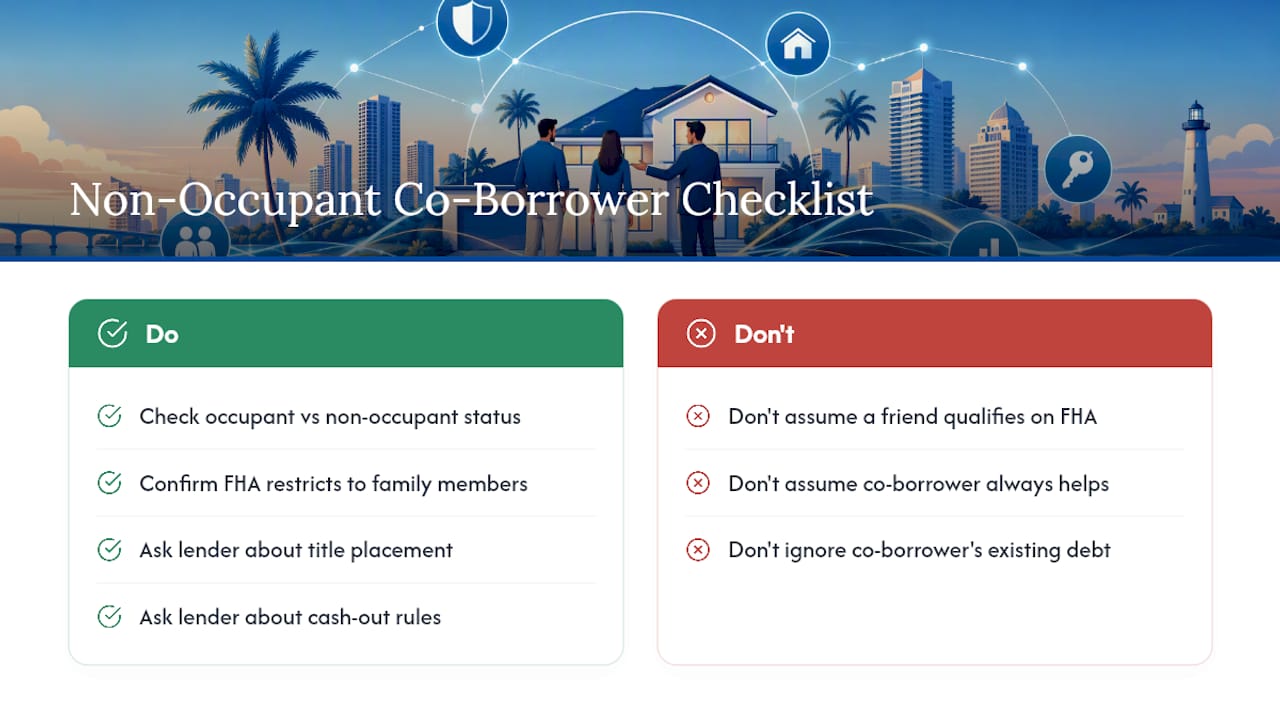
| FHA requires family ties | HUD generally restricts FHA non-occupant co-borrowers to family members, unlike conventional loans. |
| LTV depends on underwriting path | DU allows up to 95% LTV; manual underwriting caps it at 90% with separate occupant DTI rules. |
| Debts count against you too | A co-borrower's existing mortgage or high debts can raise combined DTI and hurt qualification. |
| Removal isn't automatic | Taking a co-borrower off the loan typically requires a full refinance and requalification. |
| Lendingbankers guides the process | Lendingbankers helps Florida borrowers choose the right lender and program for non-occupant co-borrower loans. |
Table of Contents
- What Is a Non-Occupant Co-Borrower, and How Does It Differ From a Cosigner?
- FHA and HUD Rules for Non-Occupant Co-Borrowers
- Fannie Mae Rules: DU Automated Underwriting vs Manual Underwriting
- Who Qualifies as a Non-Occupant Co-Borrower?
- How a Non-Occupant Co-Borrower Changes Your Qualification Odds
- What Documents Do Lenders Require, and How Long Does It Take?
- When Does a Non-Occupant Co-Borrower Make Sense?
- Can You Remove a Non-Occupant Co-Borrower Later, and What About Refinancing?
- A Florida Lender's View on Non-Occupant Co-Borrowers
- How Lendingbankers Helps You Structure a Non-Occupant Co-Borrower Loan
- Frequently Asked Questions
- Sources
What Is a Non-Occupant Co-Borrower, and How Does It Differ From a Cosigner?
A non-occupant co-borrower signs the note, appears on the loan, and typically holds an ownership interest in the property, even though they never move in. An occupant co-borrower does all of that while also living in the home as their primary residence. A cosigner, a term borrowers often use loosely, usually means the same thing as a non-occupant co-borrower in mortgage lending, though some loan programs distinguish a guarantor (who backs the debt without ownership) from a full co-borrower (who has both liability and title rights).
| Role | Lives in home? | On the note? | Typically on title? |
|---|---|---|---|
| Occupant co-borrower | Yes | Yes | Yes |
| Non-occupant co-borrower | No | Yes | Usually yes |
| Guarantor | No | Sometimes | Rarely |
Picture a parent in Fort Lauderdale helping a daughter buy her first condo in Miami. The parent signs, contributes income to the qualification math, but never lives there. That's a textbook non-occupant co-borrower. A roommate situation is different: if both people live in the home, both are occupant co-borrowers, even if only one holds the majority of the income.
FHA and HUD Rules for Non-Occupant Co-Borrowers
FHA loans allow non-occupant co-borrowers on many purchase transactions, but HUD restricts eligibility to family members, or in narrow cases, longstanding family-type relationships with strong documentation. A friend helping a friend usually will not qualify under FHA. That single rule sends a lot of borrowers toward conventional financing instead.
FHA guidance generally requires that non-occupant co-borrowers be family members, and property-type restrictions can apply, particularly on 2 to 4 unit properties where a non-occupant co-borrower may not be permitted.
FHA lenders will typically verify:
- The exact family relationship, with documentation such as birth certificates or legal records.
- That the property type qualifies (many multiunit properties exclude non-occupant co-borrowers).
- Full income and credit documentation from the non-occupant, matching what's required from the occupant.
Pro Tip: If your co-borrower isn't a blood relative or spouse, ask your loan officer about conventional financing before you assume FHA will work. Fannie Mae and Freddie Mac don't carry FHA's family restriction, which opens the door for friends, partners, or business associates to co-borrow.
Fannie Mae Rules: DU Automated Underwriting vs Manual Underwriting
Conventional loans backed by Fannie Mae give you two underwriting paths, and the difference changes your maximum loan-to-value ratio. Run through DU, a loan with a non-occupant co-borrower can go as high as 95% LTV. Freddie Mac's parallel guidance follows a similar structure for its own conventional loans.
Borrowers usually ask lenders these questions once they hear "manual underwriting":
- Does my file even qualify for DU, or am I stuck with manual review?
- What DTI ceiling applies to me specifically as the occupant, separate from my co-borrower?
- Does a lower LTV mean I need a bigger down payment, or can mortgage insurance offset it?
- Will my co-borrower's credit score determine my interest rate, even if mine is stronger?
Most well-qualified files with a non-occupant co-borrower run through DU without issue. Manual underwriting tends to show up when credit history is thin, income is nontraditional, or the file has red flags that automated systems can't resolve on their own.
Who Qualifies as a Non-Occupant Co-Borrower?
Before you ask someone to co-sign, run through this quick eligibility screen.
- Citizenship or residency: Most conventional and FHA programs require the co-borrower to be a US citizen, permanent resident, or otherwise documented resident with a valid Social Security number.
- Family relationship (FHA only): Required for FHA loans; conventional loans don't carry this restriction.
- Property type: Single-family homes and most condos work fine; FHA often excludes 2 to 4 unit properties for non-occupant co-borrowers.
- Conflict of interest: The co-borrower cannot be the seller, builder, or real estate agent on the transaction. Freddie Mac and industry guidance are explicit that non-occupant borrowers can't be interested parties to the sale.
- Purchase vs cash-out refinance: Non-occupant co-borrowers are commonly allowed on purchases and no-cash-out refinances; cash-out transactions often exclude them entirely.
Pro Tip: Ask your lender upfront whether your co-borrower will be added to title, not just the note. Being on the mortgage without being on title is possible, but it requires specific structuring, and most lenders default to putting co-borrowers on both.
How a Non-Occupant Co-Borrower Changes Your Qualification Odds
Lenders combine both borrowers' income and both borrowers' debts into one debt-to-income calculation. That's the mechanism that makes a co-borrower helpful, and it's also the mechanism that can backfire.
- Your lender adds your gross monthly income to your co-borrower's gross monthly income.
- Your lender adds your monthly debts (car payments, credit cards, student loans) to your co-borrower's monthly debts, including any existing mortgage they carry.
- The combined DTI determines how much house you can qualify for.
- Pricing and rate often follow the lowest credit score among all borrowers on the file, not an average or the strongest score.
The middle row is why families use this strategy. The bottom row is the trap: a co-borrower who already carries a mortgage or heavy debts can push the combined DTI higher than it would have been without them, which sometimes disqualifies a file that would have passed on the primary borrower's numbers alone.
Pro Tip: Run the numbers with your loan officer before you finalize who's co-signing. Sometimes a co-borrower with strong income but an active mortgage does more harm than good.
What Documents Do Lenders Require, and How Long Does It Take?
Both borrowers submit nearly identical paperwork: pay stubs, W-2s or tax returns, bank statements, a credit report, and proof of citizenship or residency. If the property has an HOA, expect a request for dues statements and reserve documentation too.
- Pay stubs covering the most recent 30 days for each borrower.
- Two years of W-2s or tax returns, especially for self-employed co-borrowers.
- Two to three months of bank statements showing assets and reserves.
- A valid photo ID and Social Security number for identity verification.
A typical Florida purchase moves through this sequence:
- Prequalification, where the lender reviews both borrowers' basic income and credit.
- Formal application, submitted jointly once a contract is signed.
- Verification of employment and income for both parties.
- Automated (DU) or manual underwriting review.
- Clear-to-close, followed by closing disclosure and signing.
Regional lenders commonly see 30 to 45 days from application to closing on these files. The most common delay is a co-borrower who's slow to submit tax returns or bank statements, since underwriters can't clear the file until every document matches.
When Does a Non-Occupant Co-Borrower Make Sense?
Three scenarios cover most of what Lendingbankers sees from Florida buyers.
- A parent in Naples co-signs so a daughter working her first job in Miami can qualify for a condo near her office.
- A spouse working abroad co-signs while the other spouse lives in and manages the Florida property alone.
- Two friends buy together, but only one occupies the home, making the other a non-occupant co-borrower rather than a co-occupant.
For the occupant, the benefit is straightforward: access to a larger loan amount or a better rate than solo income would support. For the non-occupant, the upside is helping someone they trust build equity, though it comes without any right to live there.
- The occupant risks depending on someone else's willingness to stay on the loan long term.
- The non-occupant risks their credit and future borrowing capacity if the occupant misses payments.
- Use this option when the relationship is stable and both parties understand the liability is real, not symbolic.
Can You Remove a Non-Occupant Co-Borrower Later, and What About Refinancing?
Removing a non-occupant co-borrower almost always requires a full refinance or a lender-approved release, not a simple form. Assuming it's an easy administrative step is one of the most common misunderstandings borrowers bring to this arrangement, since removal typically means requalifying under current rates and credit standards, not the ones in place when the loan closed.
- Confirm with your lender whether your loan program even allows a co-borrower release without refinancing.
- Expect to requalify using only the occupant's income and credit at current market rates.
- Understand that cash-out refinances frequently exclude non-occupant co-borrowers altogether, even if they were allowed at purchase.
Pro Tip: Ask your lender in writing, before closing, what the removal process looks like. Get the answer on the record instead of assuming it will be simple two or three years down the road.
A Florida Lender's View on Non-Occupant Co-Borrowers
Florida's market makes this strategy more common than in a lot of states, mostly because of Miami's high price-per-square-foot and the number of parents helping adult children buy their first home nearby. That's a legitimate use case. What gets overlooked is the estate planning side: once a non-occupant co-borrower is added to title, their ownership interest doesn't disappear just because they never lived there. If that parent passes away or wants out in five years, the home can't be refinanced or sold cleanly without addressing their stake first.

Seasonal residents present a different wrinkle. Snowbirds who split time between Florida and another state sometimes assume they can be listed as the "occupant" simply because they own a Florida address. Lenders look at actual residency intent, not mailing address, so misrepresenting this can create real problems at underwriting or later at audit.
Talk to a Florida-licensed loan officer who can confirm lender-specific overlays, since not every lender treats DU-eligible files or FHA family exceptions the same way.
How Lendingbankers Helps You Structure a Non-Occupant Co-Borrower Loan
Lendingbankers is the alternative to guessing your way through FHA family rules or DU eligibility on your own. Because Lendingbankers works directly with Fannie Mae and FHA-approved lending channels across Miami and the rest of Florida, you get someone who already knows which lenders accept non-occupant co-borrowers without extra overlays, and which ones will slow your file down.

Here's what that looks like in practice:
- Underwriting guidance to determine whether your file fits DU automated underwriting or needs manual review.
- Lender selection based on which programs actually work for your co-borrower's relationship and income situation.
- Paperwork support so pay stubs, tax returns, and bank statements move through verification without delays.
- Refinance planning if you'll eventually need to release a co-borrower from the loan.
Whether you're comparing conventional versus non-conventional loan programs or trying to figure out if FHA's family-member rule applies to your situation, start with a prequalification conversation. Bring pay stubs, two years of tax returns, and a clear picture of who's occupying the home, and reach out to Lendingbankers to get your specific scenario reviewed before you sign anything.
Frequently Asked Questions
What is a co-borrower, exactly, versus a co-signer? In most conventional and FHA lending, the terms are used interchangeably to describe someone who signs the note and shares legal responsibility for the loan. The real distinction to watch for is occupant versus non-occupant status, not the label itself.
Can a friend be my non-occupant co-borrower on an FHA loan? Usually not. FHA guidance restricts non-occupant co-borrowers to family members or documented family-type relationships, so an unrelated friend typically needs a conventional loan instead.
Does a non-occupant co-borrower have to be on the title? Not necessarily, but most lenders default to placing anyone on the note onto title as well. If you want a different structure, raise it with your lender before closing.
Will using a non-occupant co-borrower always help me qualify for more house? Not always. If your co-borrower already carries a mortgage or significant debt, their liabilities get added to the combined DTI calculation and can offset the benefit of their income.
Can a non-occupant co-borrower be used on a cash-out refinance in Florida? Often not. Cash-out refinance transactions frequently exclude non-occupant co-borrowers even when the original purchase loan allowed one, so confirm this with your lender before assuming it carries over.
This article is general information, not a substitute for advice from a qualified financial advisor. Consult a qualified financial professional about your own circumstances before acting on anything here.
Sources
- 5103.1 — Mortgages including a non-occupying borrower | Freddie Mac
- What are the guidelines for co-Borrowers and Co-signers? | HUD Answers (FHA)
- Homebuyer