
True no-documentation mortgages, the kind that ask for zero proof of income or assets, are largely gone from today's market. What's available in Florida are modern non-QM alternatives, bank-statement loans, DSCR loans, asset-depletion programs, foreign-national financing, and hard-money bridge loans, that let self-employed borrowers, investors, retirees, and foreign buyers qualify without traditional tax returns. If you fit one of those profiles, your best move is a broker review with a specialist like Lending Bankers to match you to the right program.
TL;DR:
- Self-employed, investor, retiree, and foreign buyer profiles remain eligible for non-QM loans that use deposit history, property income, or assets instead of tax returns.
- Loan costs are higher than conventional mortgages, with rates above 30-year fixed averages, and depend heavily on credit score, down payment, and program type.
- Timing a pre-approved bank statement or asset review before making an offer can significantly reduce closing delays and improve eligibility.
- Picking the right program depends more on broker expertise and lender relationships, as terms and rates fluctuate quickly in the non-QM space.
- Florida-specific factors like property taxes, insurance, and legal regulations influence reserve requirements and potential closing costs for no-doc loans.
Table of Contents
- What "No Doc" Means Today and the Program Types You'll See in Florida
- Who Typically Qualifies for These Loans in Florida?
- How Each No-Doc Program Actually Works
- What Do No-Doc Loans Cost, and What Are the Limits?
- How to Prepare and What to Ask a Broker
- Pros, Cons, and Warning Signs to Watch For
- Why Work With a Florida Non-QM Specialist Broker?
- How Do No-Doc Mortgage Rates Compare to Conventional Rates in Florida?
- Legal and Regulatory Considerations Specific to Florida
- How No-Doc Mortgages Affect Property Taxes and Insurance in Florida
- Common Scams and Fraud Risks With No-Doc Loans in Florida
- What Actually Matters More: The Program or the Broker?
- Ready to Find Your No-Doc Mortgage Option in Florida?
- Sources
What "No Doc" Means Today and the Program Types You'll See in Florida
The phrase "no doc mortgage" is a holdover from before 2008. Back then, some lenders truly asked for nothing beyond a signature. Those loans vanished after the financial crisis, and what replaced them sits in a category called non-QM, short for non-qualified mortgage. Non-QM loans exist outside the qualified-mortgage rules set after the crisis, which means private lenders and brokers can underwrite using alternative income measures instead of pay stubs and W-2s.
Here's the honest distinction: "no doc" today refers almost exclusively to income documentation. Lenders still verify your identity, your assets, and the property itself.
The programs that dominate Florida's non-QM space include:
- Bank-statement loans, which use deposit history instead of tax returns
- DSCR loans, which qualify the property's rental income rather than your personal income
- Asset-depletion loans, which convert savings and investments into a qualifying income figure
- Foreign-national programs, built for buyers without U.S. credit or tax history
- Hard-money and bridge loans, short-term financing for investors moving fast on a deal
Each solves the documentation problem differently, and the right one depends on where your money actually comes from.
Who Typically Qualifies for These Loans in Florida?
Florida's self-employed population and investor activity are exactly why these programs stay in steady demand across the state. Lenders aren't guessing at eligibility. They're working from fairly consistent benchmarks across the non-QM space.
- Self-employed borrowers and 1099 contractors whose tax returns understate real cash flow after deductions
- Real estate investors buying rental property where the property's income, not the buyer's, drives approval
- Retirees with substantial assets but limited monthly income on paper
- Foreign nationals purchasing in Miami, Orlando, or along the coast without U.S. credit history
Credit score requirements generally run from the low 600s to 700+, depending on the program and lender. Expect to produce a government ID, several months of bank or asset statements, a signed purchase contract, and a property appraisal. Foreign buyers should also have a valid passport and visa documentation ready.
How Each No-Doc Program Actually Works
Understanding the mechanics matters more than memorizing labels, because two borrowers with identical incomes can qualify for very different loan amounts depending on which program fits their money.
Bank-statement loans typically look at 12 or 24 months of statements. Some lenders calculate qualifying income off gross deposits; others focus on owner distributions after estimated expenses. A contractor who deposits $18,000 a month but writes off half of it on paper can often qualify for far more under this method than a standard tax-return review would allow.
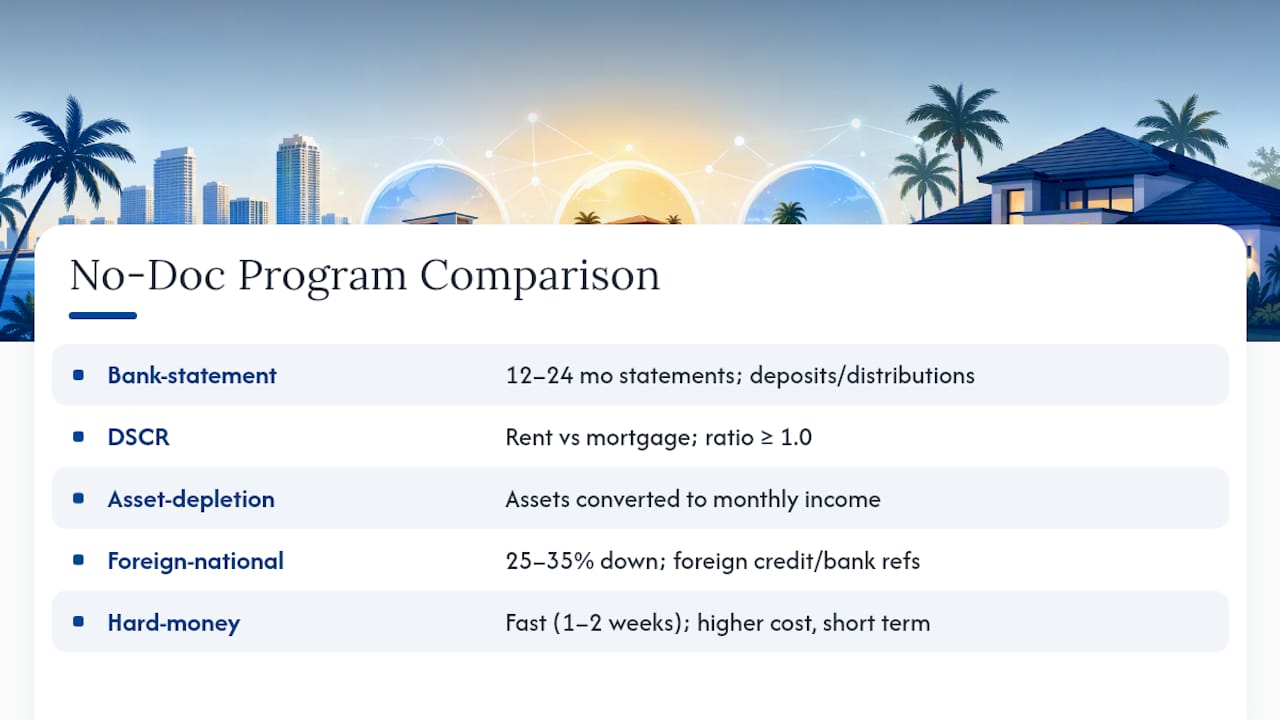
DSCR loans (debt service coverage ratio) ignore your personal income entirely and measure whether the property's rent covers its own mortgage payment. Lenders generally want a ratio of 1.0 or higher, meaning rental income at least matches the monthly obligation. This is the workhorse program for investors scaling a rental portfolio without dragging personal tax returns into every deal.
Asset-depletion loans convert liquid assets, brokerage accounts, retirement funds, into a monthly income figure using a set divisor formula. Retirees with $1.5 million in investments but modest Social Security income are the classic fit here.
Foreign-national programs commonly ask for 25% to 35% down and substitute foreign credit reports or bank references for a U.S. credit score.
Hard-money and bridge loans close fast, often in one to two weeks, but carry higher costs and short terms. They work best when paired with a clear refinance or sale plan.
Pro Tip: If you're self-employed and your accountant is proud of how low your taxable income looks, that's exactly why a bank-statement loan will likely qualify you for more than a conventional one will.
What Do No-Doc Loans Cost, and What Are the Limits?
Non-QM pricing runs higher than conventional lending because lenders take on more underwriting risk without the income-verification safety net that qualified mortgages require. Expect rates to sit meaningfully above conventional 30-year averages, with the exact spread depending on credit score, down payment, and program type.
Fees can include higher origination charges, appraisal costs, and sometimes a rate buy-down option.
Your credit score, down payment size, and whether the property is owner-occupied or an investment all move pricing directly.
Fast fact: Because non-QM loans fall outside the qualified-mortgage framework the CFPB oversees, pricing and terms vary more widely between lenders than they do in the conventional market, making broker comparison genuinely worth the effort.
How to Prepare and What to Ask a Broker
Getting ahead of the paperwork saves weeks. Most delays in non-QM lending come from borrowers scrambling for documents after they've already found a house.
- Gather 12 to 24 months of bank statements before you start shopping
- Pull recent asset and retirement account statements
- Have a government-issued ID and, for foreign buyers, a passport and visa ready
- Get a preliminary credit review to know where you stand
- Line up funds for reserves separate from your down payment
When you talk to a broker, ask directly: Which program fits my income situation? What reserve requirement applies to this loan? Is the condo or property type eligible? What's the realistic closing timeline? Can this loan refinance into a conventional product later? What are the total fees, not just the rate?
Timeline typically runs three to five weeks when your down payment is ready, title is clear, and the appraisal can be scheduled quickly. If you're buying through an LLC or trust for liability or estate reasons, mention it early. Titling affects underwriting requirements and sometimes the program itself.
Pro Tip: Ask your broker for a written breakdown of reserve requirements before you make an offer. Reserves often surprise buyers more than the down payment does.
For a full preparation walkthrough, our guide on steps to take before applying for a stated income loan covers the document order that speeds up approval.
Pros, Cons, and Warning Signs to Watch For
Non-QM lending opens doors that conventional underwriting slams shut, but it comes with real trade-offs worth weighing honestly.
- Pros: Access for self-employed and investor borrowers, faster approval timelines, flexible proof of income
- Cons: Higher rates and fees, larger reserve and down payment requirements, fewer built-in consumer protections than QM loans
- Red flags: Vague underwriting explanations, no clear path to refinance later, unusually low fees paired with aggressive prepayment penalties, or a lender you can't find on NMLS Consumer Access
If your income is steady and well-documented, conventional financing usually beats non-QM on cost. Non-QM earns its place when documentation, not affordability, is the real obstacle.
Why Work With a Florida Non-QM Specialist Broker?
Non-QM lending rewards local knowledge. A broker who closes bank-statement, DSCR, asset-depletion, foreign-national, and hard-money loans across Florida week after week understands which lenders actually approve condotels, which ones handle foreign credit reports smoothly, and which reserve requirements are negotiable.
Lending Bankers works across all of these program types for clients throughout Miami and the rest of Florida, pairing each borrower with the structure that fits their actual cash flow rather than forcing everyone into one box. That includes running the numbers upfront with a mortgage calculator so you know your payment before you commit to a program.
You'll also find practical breakdowns on product selection in our guide to choosing a mortgage product in Miami, which walks through how underwriting focus shifts between loan types. A no-obligation case review is the fastest way to find out which program actually fits your file before you spend money on an appraisal or apply anywhere else.
How Do No-Doc Mortgage Rates Compare to Conventional Rates in Florida?
Non-QM rates sit above conventional 30-year fixed rates, typically by a noticeable margin that widens or narrows depending on your credit profile and the specific program. The gap exists because conventional loans sold to Fannie Mae or Freddie Mac follow qualified-mortgage standards that spread risk across the secondary market. Non-QM loans don't get that backing, so the lender or private investor holding the loan prices in extra risk directly.
DSCR loans and bank-statement loans tend to land closer to conventional pricing than hard-money loans do, since they're underwritten with more borrower scrutiny even without tax returns. Hard-money and bridge loans carry the widest gap, often running several points above conventional rates, because they're priced for speed and short holding periods rather than long-term affordability.
Credit score moves the needle more in non-QM lending than in conventional lending. A borrower at 750 credit and a borrower at 640 credit can see a meaningful rate spread on the same DSCR loan, wider than you'd typically see on a conventional Fannie Mae loan with the same score difference. Down payment size works the same way: more equity buys a better rate almost dollar for dollar.
The practical takeaway for Florida borrowers: don't assume non-QM pricing is fixed. Rates vary significantly by lender, program, and file strength, which is exactly why comparing offers through a broker who works multiple non-QM lenders tends to save real money over accepting the first quote.
Legal and Regulatory Considerations Specific to Florida
Florida doesn't have a state law banning or specifically regulating "no-doc" mortgages by name. What governs these loans is the same federal framework that applies nationwide: non-QM loans sit outside the qualified-mortgage rules established by the CFPB, which means they don't carry the same built-in ability-to-repay presumptions that conventional QM loans do.
Florida does add a few state-specific layers worth knowing. The state's homestead exemption and creditor-protection laws affect how lenders and title companies structure certain investor deals, particularly when properties are held in an LLC or trust. If you're titling a purchase through an entity for liability reasons, Florida's documentary stamp tax and intangible tax apply at closing regardless of how the loan was underwritten, so budget for those separately from your mortgage costs.
Florida-licensed mortgage brokers and loan originators must hold active NMLS registration, and this is where verification becomes your responsibility as a borrower. Before signing anything or paying an application fee, confirm the company and the individual loan officer on NMLS Consumer Access. This single step catches unlicensed operators faster than any other check available to you.
Condotel and non-warrantable condo financing, common in Miami and along the coast, also carries Florida-specific complications tied to the state's condo association disclosure requirements following recent building-safety reforms. Non-QM lenders sometimes finance these properties when conventional lenders won't, but expect extra scrutiny on the condo association's financials and reserve funding.
How No-Doc Mortgages Affect Property Taxes and Insurance in Florida
Your loan program itself doesn't change your property tax bill. Florida calculates property taxes based on assessed value and millage rates set by the county, not on how you financed the purchase. But non-QM borrowing does interact with taxes and insurance in a few practical ways worth planning around.

Reserve requirements on non-QM loans, often six or more months of PITIA, mean your lender wants to see property taxes and insurance premiums fully covered in the bank before closing, not just budgeted. If you're buying in a flood zone or coastal county, and much of Florida qualifies, insurance premiums can run high enough to meaningfully affect your reserve math. A property that looks affordable on the mortgage payment alone can fail the reserve test once windstorm and flood coverage get added in.
Investment properties financed through DSCR loans face another wrinkle: your rental income projection has to absorb the full tax and insurance burden for the DSCR calculation to work. A property with a low mortgage payment but a high insurance premium, common along Florida's coastline, can post a weaker debt service coverage ratio than the mortgage amount alone would suggest.
Foreign-national buyers should also know that Florida doesn't impose extra property tax rates based on citizenship, but non-homestead properties, which most foreign-owned homes are, don't qualify for Florida's homestead exemption or its assessment cap. That means your taxable value can rise faster year over year than it would for an owner-occupant. Reviewing homeowners insurance versus mortgage insurance before closing helps clarify which coverage your reserve requirement is actually protecting.
Common Scams and Fraud Risks With No-Doc Loans in Florida
Florida's active non-QM market unfortunately attracts operators who exploit borrowers eager to skip paperwork. The fraud risks cluster around a few recognizable patterns.
Advance-fee scams ask for large upfront payments before any underwriting work happens, then stall or disappear. Legitimate lenders charge appraisal and application fees, but those should be disclosed clearly and tied to specific services, not paid as a vague "processing fee" before anything is underwritten.
Unlicensed lenders operate without NMLS registration, often marketing aggressively online with promises no legitimate lender would make, like guaranteed approval regardless of credit. Checking NMLS Consumer Access before sharing any personal or financial information is the single best defense against this.
Inflated asset or deposit documentation is a fraud risk that cuts the other way: some borrowers, or shady intermediaries advising them, get tempted to pad bank statements or asset accounts to qualify for a larger loan. This is mortgage fraud, plain and simple, and it carries federal criminal exposure regardless of how the loan is labeled.
Bait-and-switch terms show up when a verbal quote doesn't match the written loan estimate. Florida borrowers should insist on a written estimate early and compare it line by line against what was originally discussed.
Reviewing a lender's standing through Better Business Bureau listings alongside NMLS registration adds a second layer of verification, though neither replaces reading your closing documents carefully before you sign.
What Actually Matters More: The Program or the Broker?
The conventional advice on no-doc mortgages spends most of its energy explaining program mechanics, DSCR ratios, bank-statement math, asset-depletion formulas, as if picking the right label solves the problem. It doesn't. The real variable in this market is who's structuring your file, because two brokers working the same borrower through the same lender can produce meaningfully different terms depending on how the deposits are categorized, how reserves are documented, and which non-QM lender in their network actually wants your loan type that quarter.
What gets underweighted in most guides is timing risk. Non-QM rates and lender appetite shift faster than conventional pricing, and a program that made sense six months ago might carry a worse rate today, or a better one. That's not a reason to wait. It's a reason to work with someone actively quoting current programs rather than relying on generic percentages from an old article.
If you take one thing from this guide, let it be this: gather your bank statements and asset documentation before you shop for a house, not after you're under contract. Preparation, not program selection, is what actually controls your closing timeline and your rate.
— David
Ready to Find Your No-Doc Mortgage Option in Florida?
If you've read this far, you already know the programs exist, bank-statement, DSCR, asset-depletion, foreign-national, hard-money, but matching your specific income situation to the right one is where most borrowers get stuck. Lending Bankers works these loan types daily across Miami and the rest of Florida, which means you're talking to a broker who already knows which lenders approve your property type and credit profile instead of guessing alongside you.
Start by running your numbers through our mortgage calculator to see a realistic payment range, or if you're buying rental property, read how no-income investor loans work before your consultation, so you walk in with the right questions. A no-obligation case review with our team covers program fit, reserve requirements, and a realistic closing timeline based on your actual documents, not a generic estimate. Reach out today and get a straight answer on which non-QM program actually fits your file.