
Getting preapproved comes down to five document groups: government ID and Social Security verification, proof of income, bank and asset statements, a record of your current debts, and written authorization for a credit check. Preapproval means a lender has verified these documents and pulled your credit, unlike prequalification, which relies on numbers you self-report. If you're self-employed, a veteran, or receiving gift funds for your down payment, expect a few extra items on top of the standard list.
TL;DR:
- Most preapprovals require proof of income through recent pay stubs, tax returns, and account documentation, especially for self-employed or special cases.
- Having your documents organized in PDFs and submitted via a secure portal helps prevent delays caused by blurry images or unencrypted files.
- Preapproval is valid for a few months, but lenders often require updated statements if more than a month passes before making an offer.
- Additional paperwork is needed for applicants such as veterans, property owners, divorced individuals, or foreign nationals, depending on their specific circumstances.
- A preapproval letter proves your ability to close and carries more weight than prequalification, but final loan approval occurs only after full underwriting post-offer.
Table of Contents
- What Documents Do You Need for Mortgage Preapproval?
- How Long Does Preapproval Take and How Long Is It Valid?
- Extra Documents for Self-Employed, VA, and Other Special Cases
- How to Organize and Securely Share Your Paperwork
- What Do Lenders Actually Check in Your Documents?
- Turning Your Preapproval Letter Into an Accepted Offer
- Who Helps You Get This Right
- The Checklist Approach Isn't Overkill, It's the Whole Job
- Ready to Assemble Your Preapproval Packet?
- Where to Verify the Rules Yourself
- Sources
- FAQ
What Documents Do You Need for Mortgage Preapproval?
Lenders build your preapproval on a standard set of paperwork, and knowing the exact recency requirements ahead of time saves you from a stalled application. Here's what to gather, organized the way underwriters actually review it.
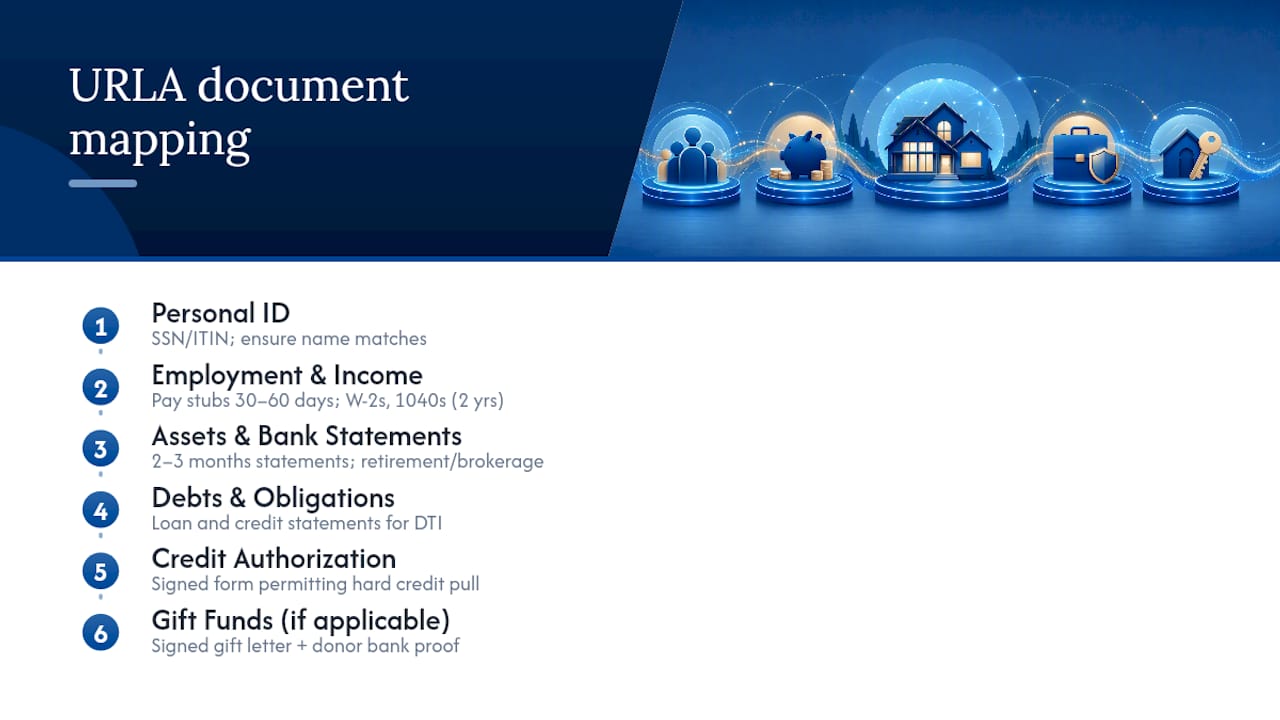
Personal identification and tax ID. You'll need a valid driver's license or passport plus your Social Security card, or an Individual Taxpayer Identification Number (ITIN) if you don't have an SSN. Lenders use this to confirm identity and pull your credit file, so make sure the name on your ID matches the name you'll use on the loan application.
Proof of income. This is the category that trips up the most applicants because the rules shift depending on how you earn. For salaried and hourly workers, lenders typically want pay stubs covering the last 30 to 60 days, W-2 forms for the past two years, and complete 1040 tax returns for the same two-year period. If you earn 1099 income, bring those forms alongside your tax returns. Bankrate's preapproval checklist confirms that this two-year, 30-to-60-day window is the industry norm, not a lender-specific quirk.
Assets and bank statements. Expect to provide two to three months of statements for every checking and savings account you plan to draw from, plus recent statements for retirement and brokerage accounts. If a large, unexplained deposit shows up in any of these statements, be ready to document where that money came from. Underwriters flag anything that doesn't match your regular deposit pattern.
Debts and monthly obligations. Pull together recent statements for auto loans, student loans, credit cards, and any other recurring debt. Lenders use these figures to calculate your debt-to-income ratio, one of the numbers that determines how much house you can afford.
Credit authorization. You'll sign a form giving the lender permission to run a hard credit pull. This differs from the soft pulls you might get from a free credit-monitoring app, and it will show up on your credit report. A single mortgage-related hard inquiry has a minor, short-lived effect on your score.
Gift letters, if applicable. If a family member is gifting part of your down payment, the lender needs a signed gift letter stating the amount, the relationship between you and the donor, and confirmation that the money is a gift, not a loan. The donor typically has to show a bank statement proving they had the funds available.
Underwriters map everything you submit onto the Uniform Residential Loan Application, also called Form 1003 or Freddie Mac's Form 65. This standardized form captures your personal information, employment history, income, and assets in the exact format every underwriter is trained to read, and it's the backbone of the entire process. Once your application moves forward, you'll also receive a Loan Estimate within three business days, a federally required disclosure that spells out estimated closing costs, which commonly range from low to moderate percentages depending on the source and loan type.
Pro Tip: Scan every document as a true PDF instead of a phone photo. Underwriters reject blurry images more often than you'd expect, and a rejected file can add days to your timeline.
How Long Does Preapproval Take and How Long Is It Valid?
Preapproval follows a predictable sequence: you submit your application and documents, the lender verifies each one, runs a hard credit pull, and issues a conditional preapproval letter. Most lenders complete this within a few business days once your file is complete.
The letter itself usually stays valid for a couple of months. If more than about a month passes before you make an offer, Freddie Mac's mortgage guide notes that lenders often ask for refreshed pay stubs and bank statements to confirm nothing about your financial picture has changed. This isn't a formality. Job changes, new debt, and shifting account balances all matter to an underwriter reviewing your file weeks after the fact.
Once you move into a formal application, expect the Loan Estimate to arrive within three business days, with closing costs commonly landing in the 3% to 7% range of your loan amount.
Extra Documents for Self-Employed, VA, and Other Special Cases
Standard employees have it relatively easy. If your income or situation falls outside that mold, plan on extra paperwork.
- Self-employed borrowers: Bring a year-to-date profit and loss statement, two years of business tax returns, and two to three months of business bank statements. If you invoice clients directly, recent invoices help fill in gaps between tax filings.
- VA loan applicants: You'll need a Certificate of Eligibility (COE) confirming your entitlement to VA loan benefits. You can request your COE through the VA directly, and many lenders can pull it on your behalf once you provide basic service information.
- Owners of rental property: Gather current leases, a rent roll if you own multiple units, and mortgage statements for each property you hold.
- Divorced borrowers or those paying or receiving support: A copy of your divorce decree and proof of consistent child support or alimony payments over time.
- Foreign nationals: Documentation requirements vary significantly by lender and visa status, so it's worth speaking directly with a broker who handles foreign national loans before assuming the standard checklist applies to you.
How to Organize and Securely Share Your Paperwork
A little organization up front saves real time later. Build a simple folder structure with subfolders for identification, income, assets, debts, and anything special to your situation. Save files as PDFs whenever you can rather than photographing paper documents.
- Name each file clearly, something like "Smith_PayStub_Jan2026," so nothing gets misfiled or overwritten.
- Keep a version history if a document gets updated. Replace, don't duplicate.
- Upload everything through your lender's secure portal instead of unencrypted email, especially anything showing your Social Security number.
- For gift funds, attach the signed gift letter alongside the donor's bank statement showing the money's source.
Pro Tip: If you're unsure whether a lender's upload system is encrypted, ask. A reputable loan officer will explain exactly how your documents are protected.
What Do Lenders Actually Check in Your Documents?
Every document you submit maps to a specific underwriting metric. Your credit report and score determine your interest rate tier, and that hard inquiry becomes part of your permanent credit history. Your pay stubs and bank statements feed your debt-to-income ratio, which lenders calculate by dividing your monthly debt payments by your gross monthly income. Many lenders also want to see reserves, meaning enough money left in your accounts after closing to cover a few months of payments. Consistent, verifiable income stability matters just as much as the amount you earn.
Turning Your Preapproval Letter Into an Accepted Offer
Sellers and their agents read a preapproval letter as proof you can actually close, which is why it carries far more weight than a prequalification estimate. The letter typically states your approved loan amount, loan type, and an expiration date.
If your letter is nearing that expiration or you've gone more than 30 days without an update, refresh your pay stubs and bank statements before submitting an offer. Once you have a ratified purchase contract, your file moves to full underwriting, where the lender re-verifies your documents and issues your official Loan Estimate within three business days.
Who Helps You Get This Right
David covers mortgage financing, drawing on experience with first-time buyers, investors, and foreign nationals across Miami and Florida. Lending Bankers routinely sees applicants submit outdated pay stubs or forget documentation for a large deposit. Both fixes are simple: refresh anything older than 30 to 60 days, and keep a paper trail for every deposit that doesn't match your regular paycheck.
The Checklist Approach Isn't Overkill, It's the Whole Job
Most advice on preapproval treats the document list as a formality, something to knock out quickly before the "real" work of house hunting begins. That framing gets it backward. The documents aren't paperwork standing between you and the process. They are the process. An underwriter's entire assessment of your creditworthiness comes from what's in that folder, and a thin or disorganized submission produces a weaker preapproval letter even when your finances are solid.
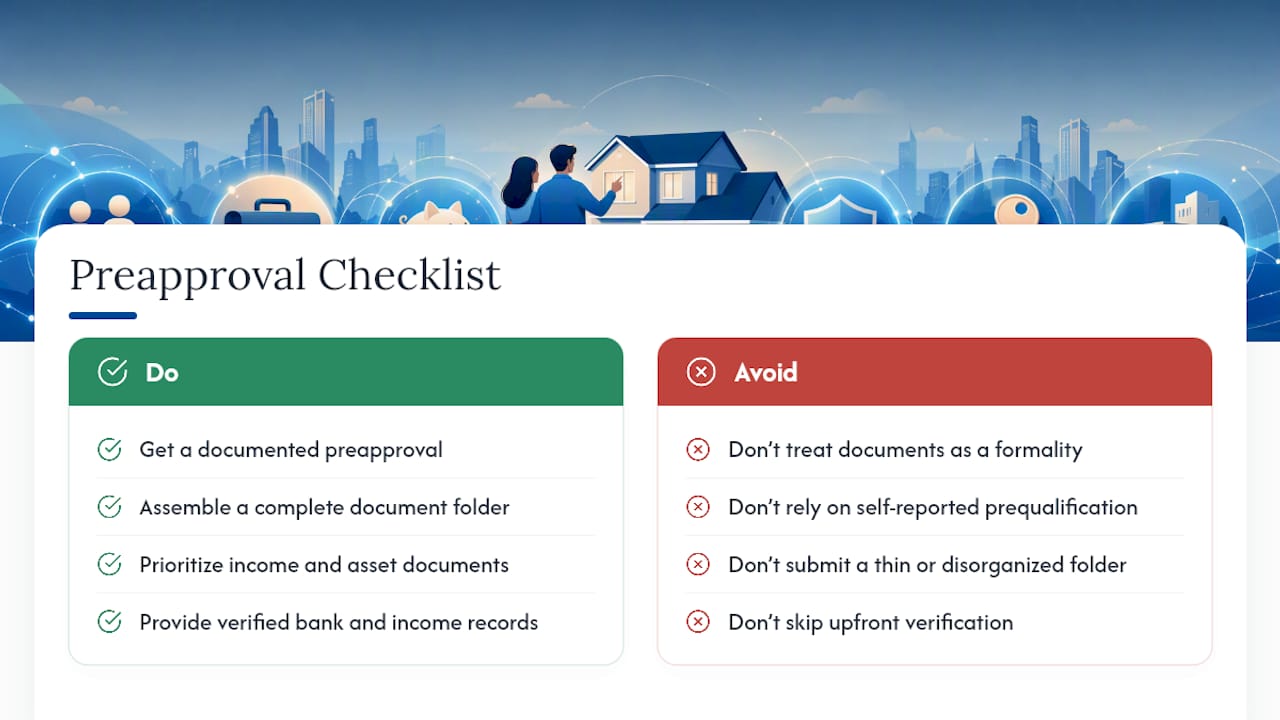
The bigger mistake I see is applicants treating preapproval and prequalification as interchangeable. The CFPB's own guidance makes the distinction explicit for a reason: a prequalification built on self-reported numbers can fall apart the moment an underwriter verifies your actual bank balance or income. If you're serious about making a competitive offer, skip the quick prequalification estimate and go straight for a documented preapproval. It takes a bit more effort up front, but it's the only version of "approved" a seller should trust, and the only version that protects you from a surprise later in underwriting.
Prioritize your income and asset documents first. Those two categories cause more delays than credit issues ever do.
— David
Ready to Assemble Your Preapproval Packet?
Gathering the right paperwork is easier with someone checking your file before it reaches underwriting, especially if your income comes from self-employment, rental properties, or overseas. Some mortgage brokers review preapproval packets for buyers across Miami and Florida, catching missing statements or gift-letter gaps before they slow down your timeline, and offer guidance for VA borrowers, foreign nationals, and investors who don't fit the standard W-2 mold.

Before you start collecting statements, run your numbers through the mortgage calculator to see what loan amount your income actually supports. When you're ready to move forward, visit Lending Bankers' mortgage services page to schedule a document review and get your preapproval packet moving toward a lender-ready submission.
Where to Verify the Rules Yourself
For the official application form, see Freddie Mac's step-by-step guide. For preapproval versus prequalification rules, check the CFPB. VA borrowers should start with the VA's COE instructions, and tax questions belong with IRS Topic 156.
This article is general information, not a substitute for advice from a qualified financial advisor. Consult a qualified financial professional about your own circumstances before acting on anything here.
Sources
- Freddie Mac: Step-by-step mortgage guide (URLA explanation)
- Documents Needed For Mortgage Preapproval | Bankrate
- VA: How to request a Certificate of Eligibility (COE)
- IRS Tax Topic 156
FAQ
What Six Items Are Required for a Mortgage Application?
The core six are government ID, Social Security number or ITIN, recent pay stubs, two years of W-2s or tax returns, two to three months of bank statements, and written authorization for a credit check.
How Much Income Do You Need to Qualify for a $400,000 Mortgage?
The exact figure depends on your interest rate, down payment, debt-to-income ratio, and property taxes, so it's best to run your specific numbers through a mortgage calculator rather than rely on a generic income figure.
How Do You Get Preapproved for a $200,000 Mortgage?
Submit the standard document set (ID, income proof, asset statements, debt records, and credit authorization) to a lender, who verifies your documents and runs a hard credit pull before issuing a preapproval letter, which usually takes a few business days for a complete file.
What Are the Five Steps to Getting a Mortgage Preapproval?
Submit your application and documents, let the lender verify your income and assets, authorize a hard credit pull, receive your conditional preapproval letter, and refresh your documents if more than 30 days pass before you make an offer.
Is a Preapproval Letter the Same as Final Loan Approval?
No. Preapproval is based on verified documents and a credit pull, but final approval happens only after you have a ratified purchase contract and the underwriter completes full verification, sometimes requesting an appraisal and updated statements.