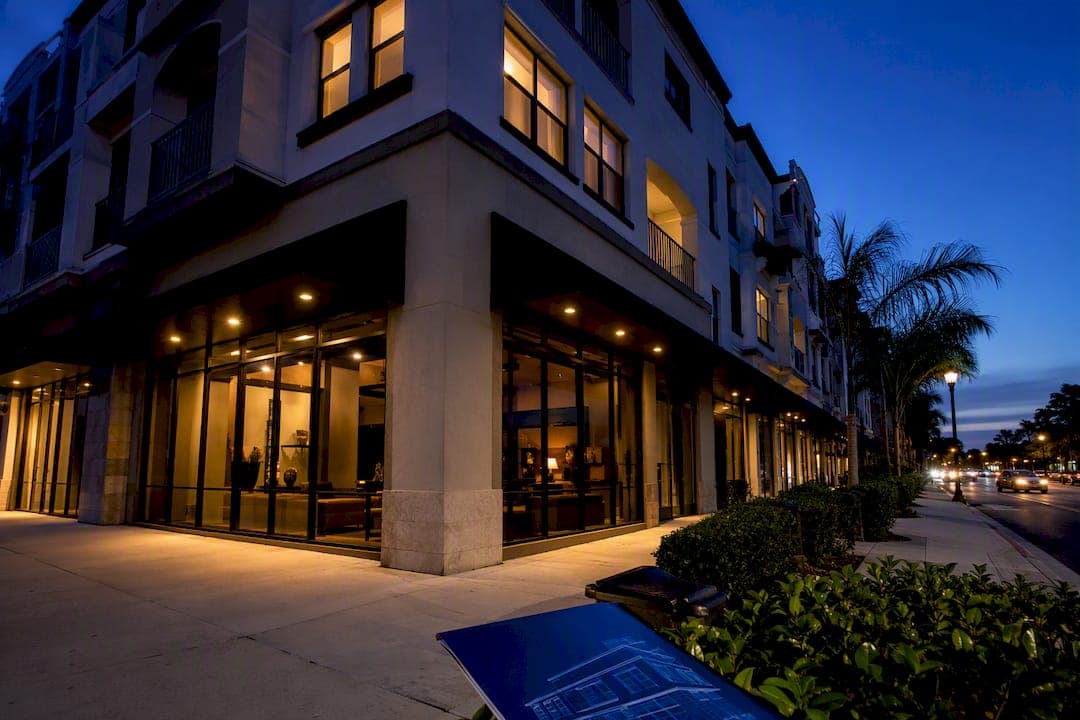
Yes, you can finance a mixed-use property, and the loan you qualify for depends almost entirely on the income mix between the residential and commercial space. Lenders sort these deals into conventional or commercial loans, DSCR loans, bridge loans, SBA programs, FHA financing, or hard money, depending on how much rent comes from tenants versus apartments. Before you call a lender, pull your rent rolls and current leases together. That single step determines which financing route you qualify for and how fast your file moves.
TL;DR:
- Most financing depends on the income mix, with higher residential income favoring conventional or agency loans, while commercial-heavy properties might require bridge or DSCR loans.
- Zoning compliance, lease quality, and accurate appraisals are critical factors that can slow underwriting or cause deal delays, especially if tenant estoppels and documentation are incomplete.
- Combining loan types, such as using a bridge loan for renovation followed by a permanent refinance, is common depending on the property's stabilization status and your exit strategy.
- Underwriters assess the blended debt service coverage ratio, tenant lease stability, property condition, and borrower reserves, which influences loan-to-value and pricing decisions.
- Prioritizing high-quality documentation and early tenant estoppel collection shortens close timelines, saving up to several weeks in the underwriting process.
Table of Contents
- What Is a Mixed-Use Property Loan and How It Differs From Standard Financing
- Common Loan Types for Mixed-Use Financing and When to Use Each
- How Lenders Underwrite Mixed-Use Deals
- How to Qualify and Prepare Your Documentation
- Matching Financing to Your Deal Type and Objective
- Weighing the Benefits Against the Real Risks
- What Lending Bankers Sees in Mixed-Use Loan Files
- Why the Conventional Advice on Mixed-Use Loans Falls Short
- Get a Preliminary Term Sheet for Your Mixed-Use Deal
- Sources
- FAQ
What Is a Mixed-Use Property Loan and How It Differs From Standard Financing
A mixed-use property combines two or more uses under one roof, most often retail with residential units above, office space paired with apartments, or live/work configurations where a shop and a home share a single lot. A mixed use property loan underwrites both income streams at once, which is why it behaves nothing like a standard residential mortgage or a straight commercial note.
Lenders treat these deals differently for a few concrete reasons:
- Two income streams mean two sets of risk. A vacant retail bay doesn't sink the whole property if the apartments above stay leased, but it still drags down the blended debt service coverage ratio.
- Zoning matters more here than on a single-use asset. A property zoned for commercial use with residential "as of right" gets appraised and financed differently than one with a legal nonconforming residential unit.
- Appraisals get more complicated. Appraisers have to value the commercial and residential components separately, then reconcile them, which slows the process compared with a single-family comparable sale.
Government-backed programs add another layer. FHA guidance allows mixed-use financing only when the residential portion clears a specific floor area threshold, and SBA programs apply mainly when a business will occupy part of the space itself. Both are worth checking early, since they narrow your options fast.
Common Loan Types for Mixed-Use Financing and When to Use Each
The loan type you target should match your exit strategy, not just your credit score. Here's how the main options break down:
- Conventional or agency commercial loans. These work best when residential net operating income dominates the property, often past the 51% to 75% threshold lenders use to treat the asset as residential-first for pricing purposes.
- Bridge loans. Use these for conversions, lease-up periods, or any deal where the property isn't stabilized yet. Bridge lenders typically underwrite each component's net operating income separately, then price the loan to line up with your eventual permanent exit.
- DSCR loans. These loans qualify the property on its cash flow rather than your personal income, which suits investors holding several mixed-use assets who don't want every deal tied to a W-2 or tax return.
- SBA 504 or 7(a) loans. These fit owner-occupied redevelopment, where your own business will operate out of part of the building. SBA certification requirements apply, and the process runs slower than conventional financing.
- FHA loans. Available only when the residential share of the building meets the FHA's floor area minimum. Confirm current limits directly, since FHA program thresholds get revisited annually.
- Hard money or private lending. Best for fast closings, distressed properties, or borrowers who need capital before a conventional lender could even finish an appraisal review.
Most investors end up combining two of these across a property's life cycle: a bridge loan during renovation, followed by a conventional or DSCR refinance once leases stabilize.
How Lenders Underwrite Mixed-Use Deals
Underwriters build their pricing and loan-to-value decisions around a specific checklist, and knowing it in advance saves you weeks. The core factors they weigh:
- Income mix and combined DSCR. A building with 70% residential income underwrites very differently than one carrying 70% retail income, even at identical loan amounts.
- Lease quality and rent rolls. Underwriters want current rent rolls, copies of every commercial lease, and tenant estoppels confirming the lease terms match what the landlord reported.
- Zoning and occupancy certificates. A mismatch between the certificate of occupancy and actual use is one of the fastest ways to stall a file.
- Property condition and required capex. Deferred maintenance on the commercial side (HVAC, storefront systems, ADA compliance) gets flagged separately from residential unit condition.
- Borrower credit, entity structure, and reserves. Lenders look for six to twelve months of reserves on mixed-use deals more often than on single-family investment loans, given the added income volatility.
- Diligence timeline. Appraisal, title work, and estoppel collection typically run 30 to 45 days on a straightforward deal, longer if commercial tenants are slow to sign estoppel certificates.
Pro Tip: Order tenant estoppels the same week you submit your loan application, not after the underwriter asks for them. Estoppel delays are the single most common reason mixed-use closings slip past their original date.
Reviewing what commercial lenders look for before you apply gives you a head start on assembling the file correctly the first time.
How to Qualify and Prepare Your Documentation
Getting your file lender-ready before you make a single call cuts weeks off the process. Work through these steps in order:
- Assemble your financial package. Gather rent rolls, all commercial and residential leases, two years of operating statements, and either personal tax returns or entity bank statements, depending on how you're structured.
- Run a preliminary DSCR and LTV screen. Calculate your combined debt service coverage ratio before you approach a lender, so you know roughly what loan-to-value range you're working with.
- Lock down tenant estoppels early. Send estoppel certificates to every commercial tenant as soon as you decide to refinance or acquire, since these confirm lease terms and rent amounts independently of the landlord's records.
- Match your exit to your lender. A lender who specializes in DSCR products for residential-dominant buildings may not be the right fit for a retail-heavy asset, so target lenders whose typical deals resemble yours.
- Confirm down payment and credit expectations. Mixed-use deals commonly require larger equity contributions than single-family investment properties, and credit score triggers can shift pricing tiers meaningfully.
Well-documented files with clean rent rolls and complete estoppels can close in as little as three weeks; complex conversions with incomplete lease documentation routinely stretch to six weeks or more. Avoiding the errors covered in common commercial loan mistakes is often the difference between the two timelines.
Matching Financing to Your Deal Type and Objective
Your financing route should follow your strategy, not the other way around.
- Stabilized acquisition. If the property already has leased space and steady income, a conventional or agency-style commercial loan usually offers the best rate, particularly when residential income carries the majority of the building's net operating income.
- Conversion or value-add plays. Buildings being repositioned, such as adding residential units above an existing retail strip, typically need a bridge or construction loan first, followed by a permanent refinance once occupancy stabilizes. Reviewing what's involved in applying for a construction loan helps set realistic expectations for draw schedules and inspection requirements.
- Short-term rehab or timing gaps. When you need to close before a conventional underwriter could finish a file, private lending or hard money fills that gap, even though the rate runs higher.
- Owner-occupied redevelopment. If your own business will occupy a portion of the finished building, SBA financing is worth exploring, though it comes with more certification steps than a standard commercial loan.
- Refinance and cash-out strategies. Once a property stabilizes, refinancing out of a bridge or hard money loan into permanent debt is standard practice, and lenders will re-underwrite the income mix at that point exactly as they did at acquisition.
Large-scale mixed-use construction sometimes uses structured tools beyond conventional debt entirely. Newmark reported a $172.5 million C-PACE construction financing package for the Shoma Bay mixed-use development in South Florida, an example of how large sponsors layer alternative capital into oversized projects.
Weighing the Benefits Against the Real Risks
Mixed-use properties reward investors who understand the trade-offs going in.
The upside is real. Diversified income streams mean a vacancy in one component doesn't necessarily sink the whole property. Yield potential often runs higher than single-use comparables in the same neighborhood, and adaptive-reuse opportunities, converting underused commercial square footage into apartments, can create meaningful forced appreciation.
The risks are equally real. Blended underwriting means a soft retail market can drag down your DSCR even if your apartments stay full. Zoning disputes surface more often on mixed-use parcels than on single-use ones. Retail and office demand has shifted meaningfully in recent years, and NAHB reporting on housing affordability pressures points to a market environment where underwriting assumptions need to stay conservative rather than optimistic.
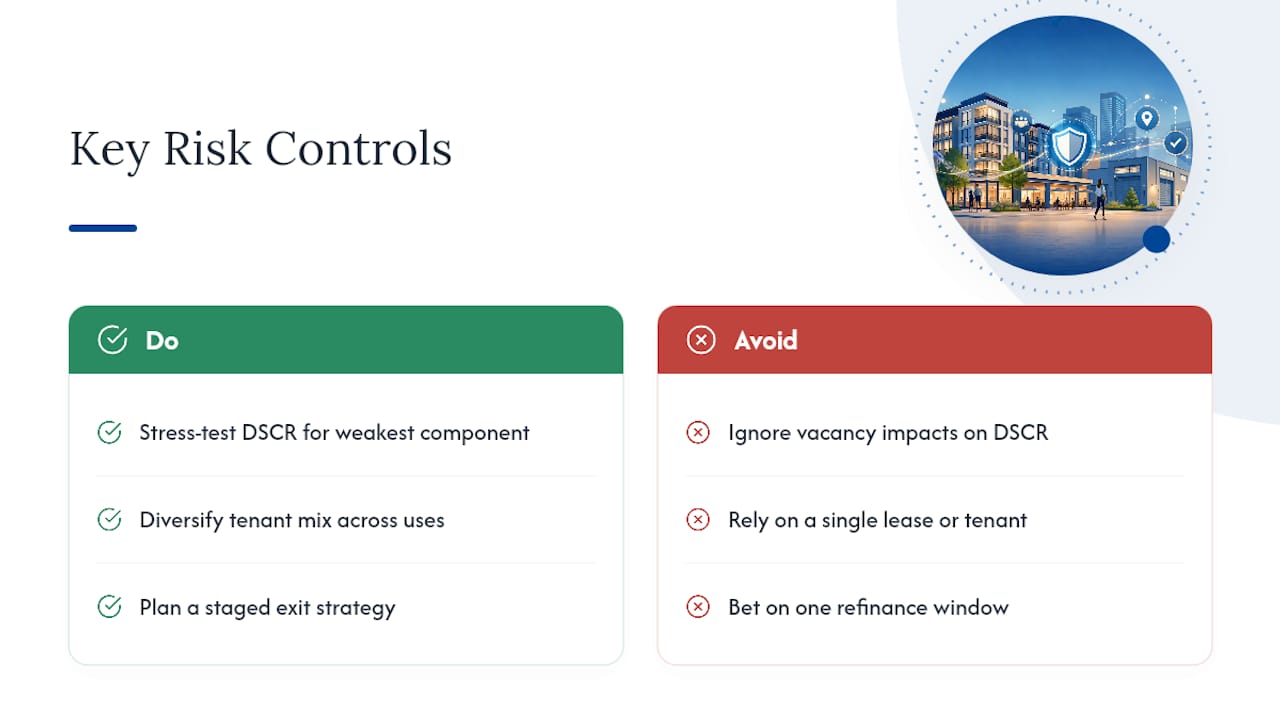
Mitigate these risks by stress-testing your DSCR against a vacancy scenario in your weakest income component, diversifying your tenant mix so no single lease carries the property, and planning a staged exit rather than betting on one refinance window.
What Lending Bankers Sees in Mixed-Use Loan Files
Lending Bankers works through mixed-use files by weighing income mix, lease quality, and borrower entity structure together, not in isolation, since a strong DSCR on paper can still fall apart if commercial leases are thin or about to expire. The most common fix Lending Bankers recommends is tightening up estoppels and rent documentation before submission, which routinely shortens underwriting by more than a week.
Pro Tip: If your commercial tenant's lease renews within twelve months of your target closing date, ask about renewal terms upfront. Underwriters weight short-term leases more conservatively, and knowing the renewal outlook in advance helps set realistic loan-to-value expectations.
Why the Conventional Advice on Mixed-Use Loans Falls Short
Most guides treat mixed-use financing as a single category, as if one loan type fits every building with a shop on the ground floor and apartments above. That framing misses the point. The income mix, not the property type, is what actually drives pricing and eligibility, and a 70/30 residential-to-commercial split behaves nothing like a 30/70 split at the underwriting table.
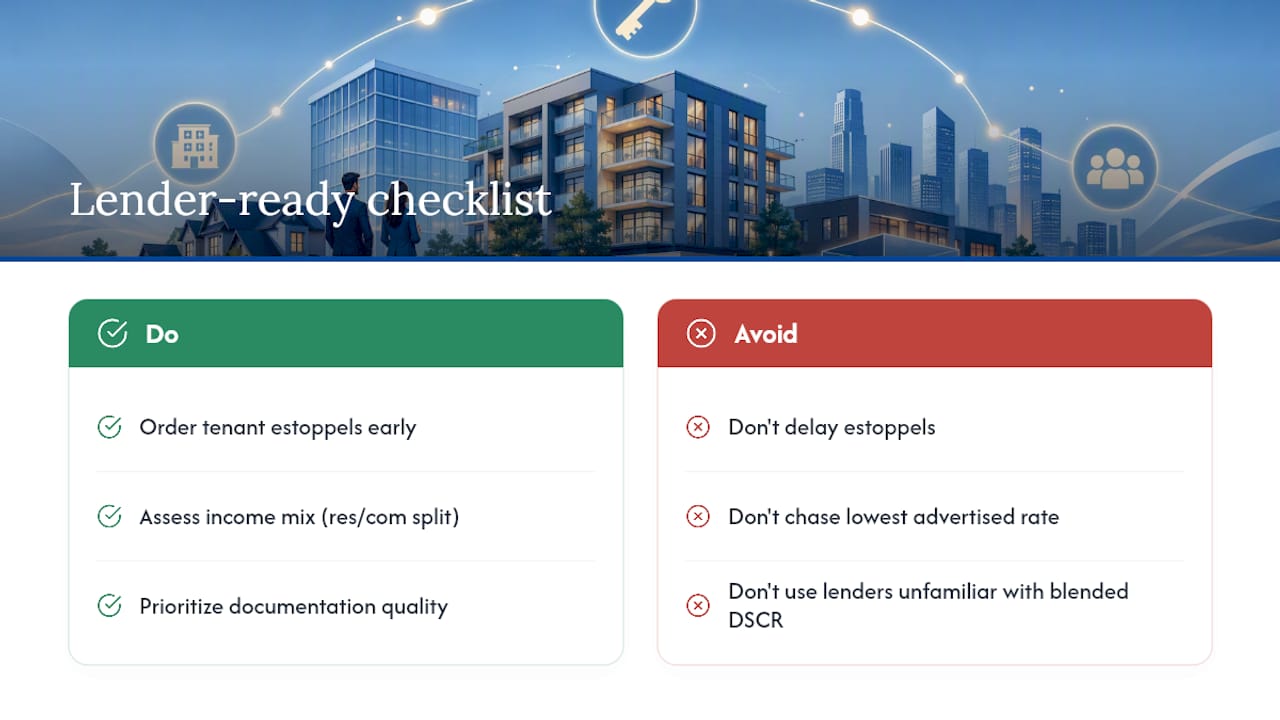
The advice that gets underweighted almost everywhere: order your tenant estoppels before you need them, not after an underwriter asks. Investors treat estoppels as paperwork to handle later, when in practice they're often the single biggest driver of whether a file closes in three weeks or six. Rent rolls tell a lender what you claim the income is. Estoppels tell them what's actually true, and that gap is where deals stall.
Prioritize documentation quality over chasing the lowest advertised rate. A slightly higher rate on a lender who understands blended DSCR underwriting will close faster and with fewer surprises than a marginally cheaper quote from a lender unfamiliar with mixed-use income structures.
— David
Get a Preliminary Term Sheet for Your Mixed-Use Deal
Lending Bankers is the alternative to shopping your mixed-use deal around to lenders unfamiliar with blended residential and commercial underwriting. Because the team works both sides of the transaction, residential loans and commercial financing, a single point of contact can help evaluate your income mix the first time instead of forcing your deal into a product that doesn't fit.
Whether your building leans residential, carries a heavier retail component, or needs a bridge loan to get through a conversion, Lending Bankers' commercial mortgage programs cover developer and investor financing, construction loans, and retail or office lending under one roof. Foreign national investors and borrowers considering hard money or private lending for a faster close have dedicated paths through the full range of loan options as well. Reach out through Lending Bankers to request a preliminary term sheet. Have your rent rolls and current leases ready when you do. It's the fastest way to find out which financing route actually fits your deal.
Sources
- Can commercial or mixed-use properties be financed with an FHA loan?
- U.S. Small Business Administration (SBA)
- Mixed-Use Bridge Loans 2026: Asset-Based 50% LTV, Property-Only | PeerSense
- Shoma Group secures $172.5M C‑PACE construction financing for Shoma Bay | Newmark
This article is general information, not a substitute for advice from a qualified financial advisor. Consult a qualified financial professional about your own circumstances before acting on anything here.
FAQ
What Qualifies as a Mixed-Use Property?
A mixed-use property combines residential and commercial space in one building or lot, such as retail on the ground floor with apartments above, or an office paired with residential units. Lenders classify these deals by income mix rather than by property type alone, which is why the FHA's residential floor-area threshold matters so much for eligibility.
Is Mixed-Use Property a Good Investment?
Mixed-use properties can offer stronger yield potential and income diversification than single-use assets, since a vacancy in one component doesn't necessarily sink the whole property's cash flow. The trade-off is more complex underwriting and appraisal work, along with retail and office demand risk that a purely residential building doesn't carry.
Can I Get a DSCR Loan for a Mixed-Use Property?
Yes, DSCR loans are available for mixed-use properties, and they qualify the deal based on the property's combined cash flow rather than the borrower's personal income. Lenders typically weigh residential and commercial net operating income separately before blending them into a single debt service coverage ratio, and Lending Bankers can walk you through which product fits your specific income split.
What Are the Risks of Mixed-Use Property?
The main risks include blended underwriting that lets a weak commercial component drag down an otherwise strong deal, zoning or occupancy certificate mismatches, and exit risk if the property doesn't cleanly fit agency or CMBS requirements at refinance. Conservative stress testing on your weakest income stream and diversifying your tenant base are the most effective ways to manage that exposure.