
Look at the interest rate to gauge your monthly payment, and look at the APR to compare the total cost of loan offers side by side. The interest rate is the base cost of borrowing your principal. The APR (annual percentage rate) folds in lender fees, so it's almost always the higher number, and federal law under the Truth in Lending Act requires both to be disclosed clearly.
Before you sign anything, check two things:
- Your Loan Estimate, where the interest rate sits on page 1 and the APR sits on page 3 under "Comparisons"
- Whether every offer you're comparing has the same loan term and structure, since APR only tells you something useful when you're comparing similar loans
Key Takeaways
The interest rate sets your monthly payment, while APR reveals the true annualized cost of a loan once fees are factored in, and comparing APRs only works across loans with matching terms.
| Point | Details |
|---|---|
| Match the number to your goal | Use the interest rate for monthly budgeting and APR to compare total loan cost. |
| Fees drive the APR gap | Origination fees and points push APR above the interest rate, sometimes by two points or more. |
| APR assumes full-term ownership | Selling or refinancing early makes APR a weaker comparison tool. |
| Compare like with like | Only stack APRs against loans with the same term and fee structure. |
| Check the Loan Estimate | Interest rate is on page 1; APR comparisons are on page 3. |
Table of Contents
- Interest Rate vs APR: What Drives Your Monthly Payment
- What Is APR and Which Fees Does It Include?
- When Should You Prioritize APR Over the Rate?
- How Is APR Actually Calculated?
- When APR Doesn't Tell the Whole Story
- How to Compare Loan Offers Without Getting Fooled
- How Lending Bankers Mortgage Helps You Compare Offers
- What This Comparison Gets Wrong in Most Advice Columns
- Sources
Interest Rate vs APR: What Drives Your Monthly Payment
Your interest rate is the annual cost charged on the principal balance you borrow, expressed as a percentage. It's the number that gets plugged directly into your monthly payment formula alongside your loan amount and term. Lenders offer either a fixed rate, which never changes, or a variable rate, which adjusts periodically based on a benchmark index.
Your monthly payment is a function of three things: principal, interest rate, and term length. Small rate shifts move the payment more than most borrowers expect.
- On a typical $350,000 loan with an interest rate in the mid single digits over 30 years, your principal and interest payment runs roughly around a couple thousand dollars a month.
- Increase that interest rate slightly and the payment rises by over a hundred dollars each month for the life of the loan.
What determines the rate a lender actually offers you? Mostly your credit score, your debt-to-income ratio, your down payment, and the loan term you choose. Borrowers with strong credit and lower DTI routinely see meaningfully better pricing. If you're financing a commercial property, the rate calculus gets more layered still, which is worth understanding through strategies for minimizing commercial mortgage rates before you shop lenders.
What Is APR and Which Fees Does It Include?
APR takes your interest rate and adds the upfront costs of getting the loan, then expresses the combined cost as a single annualized percentage. That's the core difference between APR and interest: one measures the cost of the money, the other measures the cost of the money plus what it took to obtain it.
Fees typically rolled into APR include:
- Loan origination fees
- Discount points paid to lower the rate
- Mortgage broker fees
- Certain mandatory closing costs and prepaid finance charges
Costs usually left out of APR include appraisal fees, title insurance, and recording fees, since those aren't classified as finance charges. Under the Truth in Lending Act, lenders must disclose the APR to you, and you'll find it printed clearly on your Loan Estimate and Closing Disclosure forms. A loan quoted at 6% interest with a 5% origination fee, for example, won't show an APR of 6%. It'll show something noticeably higher, because the fee gets spread across the annualized cost of borrowing.
When Should You Prioritize APR Over the Rate?
Use the interest rate when your main concern is cash flow. Use APR when you're deciding between multiple offers and want to know which one actually costs less over time.
- Comparing two fixed-rate 30-year mortgages? APR is your best tool, since fees get baked into an apples-to-apples number.
- Planning to sell or refinance in three years? The interest rate and your closing costs matter more than a 30-year APR calculation that assumes you'll never leave the loan.
- Deciding whether to buy discount points? Run the math on your break-even month, since points and rate tradeoffs only pay off if you keep the loan long enough to recoup the upfront cost.
Pro Tip: Never compare an APR on a 15-year loan against an APR on a 30-year loan and assume the lower number wins. Different terms spread fees differently, so the comparison isn't apples to apples.
How Is APR Actually Calculated?
APR calculations assume you keep the loan for its entire stated term and that upfront fees get spread across that full period. Change the term, and the same fee produces a different APR.
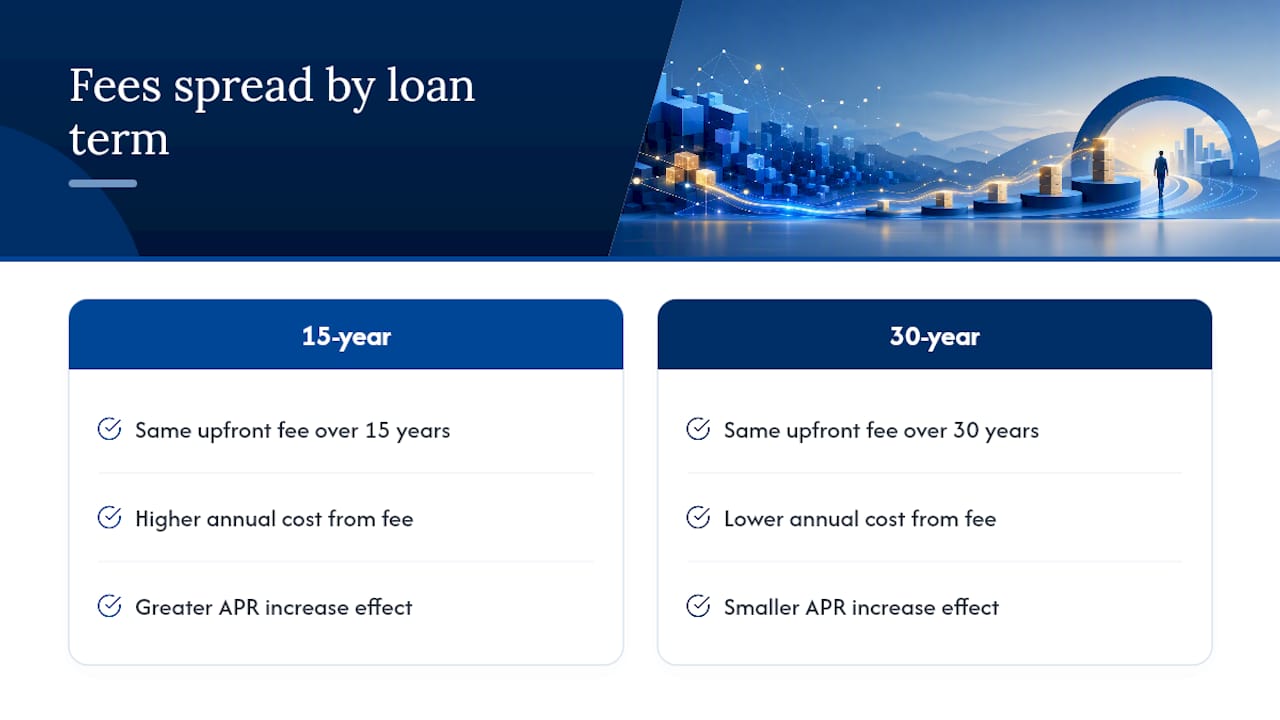
Here's a simplified version of the example Fidelity uses to illustrate the mechanics:
Stretch that same fee across a 30-year mortgage instead, and the annual impact shrinks considerably, since the upfront cost gets diluted over more years of payments.
When APR Doesn't Tell the Whole Story
APR works well for comparing fixed-rate loans of the same term. It gets shakier in a few specific situations.
- Adjustable-rate mortgages: APR can't reflect your maximum possible rate after the fixed period ends, so it understates long-term risk on an ARM.
- Short-term ownership plans: APR assumes you hold the loan to term, which distorts the comparison if you plan to sell or refinance in a few years.
- Credit cards and HELOCs: APR here usually equals the interest rate since there's no origination fee, but different transaction types (purchases, cash advances, balance transfers) can carry different APRs on the same card.
- Better fallback: Ask for projected payments under a few realistic rate scenarios instead of leaning on a single APR figure.
How to Compare Loan Offers Without Getting Fooled
A side-by-side comparison only works when you're checking the same things across every offer.
- Pull the interest rate from page 1 of each Loan Estimate under "Loan Terms."
- Pull the APR from page 3 under "Comparisons."
- Confirm the loan term, points, and fees match closely enough to compare fairly.
- Check for a prepayment penalty and total cash needed to close.
Ask your loan officer directly:
- "Which fees are baked into this APR figure?"
- "Are the points optional, and what's the break-even period?"
- "Can I lock this rate, and is there a cost to do it?"
Run the numbers yourself with a mortgage calculator before you commit, and save the direct lender questions for anything the calculator can't answer, like fee inclusion or lock terms. A buyer closing checklist can help you track what's due at each stage once you've settled on an offer.
How Lending Bankers Mortgage Helps You Compare Offers
Reading a Loan Estimate or Closing Disclosure line by line isn't something most borrowers do every day. Lending Bankers Mortgage works directly with Miami and Florida clients to walk through those forms, explain exactly where fees are landing, and match borrowers with loan structures suited to their timeline, whether that's a standard residential purchase, a refinance, or a foreign national mortgage.
- Use the mortgage calculator to model payment scenarios before you talk to a lender.
- Reach out through Lending Bankers for a personalized read on your Loan Estimate and rate lock options.
What This Comparison Gets Wrong in Most Advice Columns
Most articles treat APR as the objectively "correct" number and interest rate as the naive one. That's backward for a large share of borrowers. If you're not keeping a mortgage for its full term, and most people don't, APR's assumption of full-term amortization makes it a weaker signal than a straightforward comparison of your rate, your fees, and your expected timeline.

The conventional advice also glosses over adjustable-rate products almost entirely. APR on an ARM tells you almost nothing about your real exposure once the fixed period ends. A borrower comparing a 5/1 ARM against a 30-year fixed using APR alone is comparing two numbers that don't measure the same risk.
What should you actually prioritize first? Figure out your realistic ownership horizon before you look at either number. That single decision determines whether APR helps you or misleads you, and it's the step most rate-shopping guides skip entirely.
— David
This article is general information, not a substitute for advice from a qualified financial advisor. Consult a qualified financial professional about your own circumstances before acting on anything here.
Sources
- What is the difference between a loan interest rate and the APR? | CFPB
- APR and interest rate | Bankrate
- APR vs APY and APR vs interest rate explainers | Fidelity