
Yes, you can use gifted funds for a mortgage down payment or closing costs. Most conventional, FHA, VA, and USDA loans allow it when the money comes from an eligible donor and the transfer is properly documented. The single requirement that trips up more Florida buyers than any other: a signed gift letter stating the money is a true gift, with no expectation of repayment, backed by proof of where the funds came from and how they moved into your account.
TL;DR:
- Gift funds from non-family donors are allowed on most loan types, but require a signed gift letter confirming no repayment is expected.
- FHA loans permit a broader range of donors, including friends and organizations, while VA and USDA loans focus on excluding interested parties rather than listing donors.
- Underwriters scrutinize unseasoned gifts and demand full documentation, including donor bank statements, wire confirmations, and clear no-repayment language to prevent delays.
- Large or multiple gifts should be properly separated and documented, with each donor providing individual gift letters and proof of funds to avoid underwriting red flags.
- Gift tax rules are the donor's responsibility, typically requiring filing IRS Form 709 if the gift exceeds annual exclusion limits, though the recipient generally owes no income tax.
Table of Contents
- What Is a Gift Letter Mortgage Requirement, and Why Do Lenders Ask for One?
- Who Can Give Gift Funds? Rules by Loan Program
- What Goes Into a Gift Letter for a Down Payment
- Timing and Seasoning: Why When You Receive the Gift Matters as Much as How Much
- Lender Red Flags That Delay or Derail Gift Fund Approval
- Do Donors Owe Gift Tax? What to Know Before You Give or Receive
- Sample Gift Letter and Submission Checklist
- How Gift Funds Affect Your Credit Underwriting
- Are There Limits on How Much Gift Money You Can Use?
- Handling Gifts From Multiple Donors or Partial Gift Contributions
- Other Ways to Fund a Down Payment Besides a Gift
- The Florida Perspective: Local Closings and Why a Broker Matters
- Let Lending Bankers Help You Document Your Gift Funds Correctly
- Sources
- FAQ
What Is a Gift Letter Mortgage Requirement, and Why Do Lenders Ask for One?
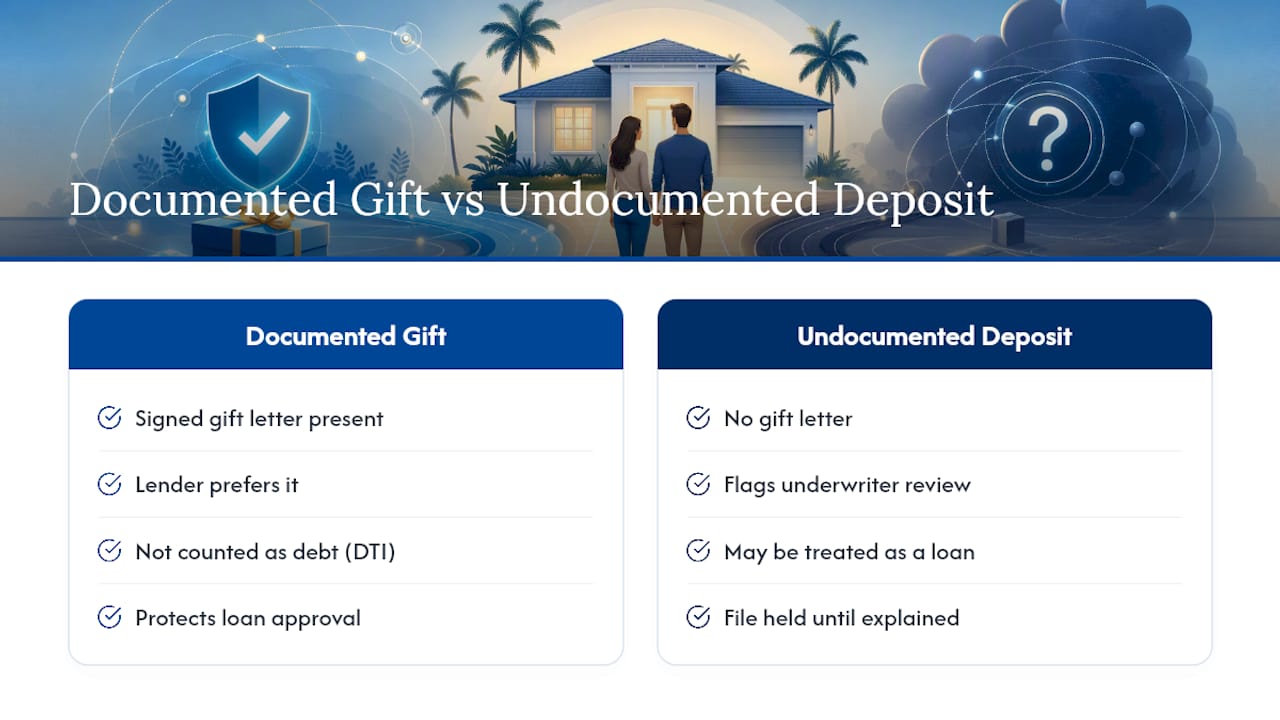
A mortgage gift letter is a short, signed statement from the person giving you money that confirms the funds are a gift, not a loan. Underwriters require it because a loan disguised as a gift changes your real financial picture. If your parents hand you $30,000 that you are quietly expected to pay back, your debt-to-income ratio is wrong, and the lender is underwriting a loan on false information.
That is the whole point of the letter. Lenders need to separate money you truly own free and clear from money that comes with strings attached. Once a payment obligation exists, even an informal one between family members, it has to be treated as debt and counted against your qualifying ratios. A gift letter draws a clean legal line: this money is yours, permanently, with nothing owed in return.
You will be asked for a gift letter whenever a deposit shows up in your bank account that does not match your documented income or your normal spending pattern. Underwriters review two or three months of bank statements during the loan process, and any large, unexplained deposit gets flagged automatically. If that deposit came from someone else, whether a parent, a sibling, or a close friend, the file gets held until you produce a signed letter and supporting paperwork.
The requirement applies across nearly every major loan program. Fannie Mae's guidance on personal gifts spells out exactly what the letter needs to contain and requires lenders to verify both the donor's ability to give the funds and the actual transfer. FHA, VA, and USDA loans carry similar expectations, though the fine print on who qualifies as an eligible donor differs by program, which matters a lot if you are trying to figure out who in your life can actually help.
Here is the part that catches people off guard: a properly documented gift protects your loan approval rather than complicating it. Buyers sometimes worry that disclosing a gift will hurt their application, so they try to move money quietly and hope no one asks. That almost always backfires. An undocumented deposit is a bigger red flag than a disclosed, well-papered gift. Lenders would rather see a clean gift letter than an unexplained $15,000 that shows up two weeks before closing.
The letter also protects your own qualifying numbers. Gift funds used for a down payment do not count as debt, so they do not touch your debt-to-income ratio the way a personal loan or a cash advance would. That is precisely why the paperwork matters so much: it is the only thing standing between "this is my down payment" and "this looks like undisclosed debt."
Who Can Give Gift Funds? Rules by Loan Program
Not every loan program treats donors the same way, and this is where a lot of Florida buyers get their plans wrong. Picking the right loan type can open up your list of eligible donors considerably.
Conventional loans (Fannie Mae and Freddie Mac). These programs restrict gifts largely to family members, along with a narrower set of non-family relationships such as a fiancé, fiancée, or domestic partner. Fannie Mae's rules also address a specific scenario worth knowing about: if the donor currently lives with you and will continue to after closing, the gift may be treated differently for purposes of certain borrower contribution requirements, so it is worth flagging that situation to your loan officer early rather than assuming standard rules apply.
FHA loans. This is the program with the widest donor pool. Beyond family, FHA allows gifts from close friends with a documented and verifiable relationship, employers, labor unions, and charitable organizations. That flexibility, combined with a minimum 3.5% down payment, is why FHA loans remain a common path for first-time buyers relying on gifted money, a pattern NerdWallet's gift letter guide also notes among borrowers using FHA financing. If you're weighing FHA against other programs, our breakdown of FHA loan benefits in Miami walks through the tradeoffs.
VA and USDA loans. Both programs take a different approach entirely. Instead of publishing a specific list of acceptable donors, they focus on excluding "interested parties" to the transaction, meaning the seller, the builder, the real estate agent, or anyone else with a financial stake in the sale closing. Family members and friends are generally fine as long as they have no financial interest in the transaction itself.
A few points apply no matter which program you choose:
- Every program prohibits gifts from anyone with a financial interest in the sale, including sellers, builders, and listing or selling agents.
- Gift funds can typically cover the down payment, closing costs, or both, depending on the specific program and loan-to-value ratio.
- Second homes generally follow rules similar to primary residences, though minimum borrower contribution requirements can shift.
- Investment properties are the strictest category. Many conventional programs require the borrower to contribute a minimum amount of their own funds, and gift money often cannot cover that portion at all.
If you are unsure which program fits your situation, that decision should happen before you accept a gift, not after. Comparing conventional and government-backed loan options up front can save you from picking a program that disqualifies your intended donor.
What Goes Into a Gift Letter for a Down Payment
A gift letter is short, usually a single page, but every field matters. Miss one, and the underwriter sends it back, which resets the clock on your file at exactly the wrong moment.
- Donor's full name, address, and phone number. The lender needs to be able to reach the donor directly to verify the gift if questions come up during underwriting.
- Relationship to the borrower. State it plainly: parent, sibling, grandparent, fiancé, employer. FHA and other flexible programs will also want a sentence explaining how a non-family donor knows you.
- The exact dollar amount of the gift. Round numbers are fine, but the figure in the letter must match the amount that actually gets transferred, to the penny.
- The property address, if you have already gone under contract, or a statement that the funds are intended for the purchase of a home if the address isn't finalized yet.
- A clear, unambiguous no-repayment statement. Something like: "This gift is not expected to be repaid in any form, whether by cash, services, or future consideration." Vague language here is one of the most common reasons letters get bounced back.
- Source of funds disclosure. The donor should identify the account the money is coming from (a checking or savings account, for example) without necessarily listing full account numbers in the letter itself. The lender will separately request donor bank statements to verify the funds were legitimately the donor's own money.
- Signatures and date, from both the donor and the borrower.
Most lenders provide their own gift letter template and prefer you use it rather than a generic version, since the exact wording sometimes needs to match their internal underwriting checklist. Bankrate's explainer on gift letters confirms this is standard practice across most mortgage lenders, and some also require notarization, though that varies by lender and loan type rather than being a universal rule.
Pro Tip: Ask your loan officer for their exact template before your donor writes anything. A gift letter with the right information in the wrong format still causes delays, and it is a five-minute fix to avoid if you ask up front.
Timing and Seasoning: Why When You Receive the Gift Matters as Much as How Much
"Seasoning" refers to how long gift funds have been sitting in your account before you apply for your mortgage. The general guidance is 60 days, and Wells Fargo's guidance on gifted funds confirms that seasoned money draws far less underwriting scrutiny than a fresh, unexplained deposit.
Here is why timing trips up so many buyers: underwriters typically review two to three months of bank statements. If a gift lands in the middle of that window, it stands out immediately, and the underwriter has to trace it back to its source no matter how legitimate it is. If the same money had arrived 60 days earlier and simply sat there through your statement history, it often would not raise a single question.
That does not mean unseasoned gifts are unusable. It means they require more paperwork, not less flexibility. A gift letter is still mandatory even when funds are fully seasoned. Seasoning reduces the scrutiny your file gets, but it never replaces the documentation itself, a point Bankrate makes clear.
A few practical habits keep this from becoming a problem:
- Ask for gift funds as early in your homebuying timeline as possible, ideally before you even start touring homes seriously.
- Avoid moving large sums between accounts in the weeks right before you submit your loan application.
- Use a wire transfer or cashier's check rather than cash or a personal check split across multiple deposits, since wires and cashier's checks create a clean, traceable paper trail.
- Keep the donor's bank statement showing the funds before the transfer, along with the wire confirmation or deposit slip on your end.
Pro Tip: If your closing date is tight and the gift can't be seasoned for 60 days, tell your loan officer immediately rather than waiting for the underwriter to flag it. Full documentation submitted up front, donor statement, wire confirmation, and your deposit record, often clears an unseasoned gift almost as fast as a seasoned one.
Lender Red Flags That Delay or Derail Gift Fund Approval
Underwriters have seen every version of a disguised loan dressed up as a gift, and certain patterns trigger automatic follow-up questions.
The most common red flags include:
- Money from an interested party. A "gift" from the seller, the builder, or the real estate agent is prohibited across nearly every loan program, since Fannie Mae's guidelines explicitly bar it, and Redfin's overview of gift fund rules flags it as one of underwriting's most scrutinized violations.
- Unseasoned, unexplained deposits. A large sum appearing with no documented source is treated as a potential undisclosed loan until proven otherwise.
- Inconsistent donor account history. If the donor's own bank statements show erratic deposits or the account itself looks recently funded, underwriters dig deeper into where that money originated.
- Vague or missing no-repayment language. A letter that hedges on repayment terms invites a phone call from the underwriter, at best, and a rejected letter at worst.
- Cash gifts with no paper trail. Physical cash handed over and then deposited is nearly impossible to verify and is one of the fastest ways to stall a file.
To keep your closing on schedule, submit a complete package the first time: the signed gift letter, the donor's bank statement showing the funds available before transfer, a wire confirmation or cancelled check documenting the transfer itself, and your own deposit record showing the funds landing in your account. If anything about your situation is unusual, a live-in donor, a friend rather than a relative, a gift split across two people, call your loan officer before you apply rather than after the underwriter flags it. Avoiding common approval obstacles starts with catching these issues before they become underwriting delays.
Do Donors Owe Gift Tax? What to Know Before You Give or Receive
Gift tax rules apply to the donor, not to you as the borrower. If your parents give you money for a down payment, you do not report it as income on your own tax return.
The donor, however, may need to think about federal gift tax reporting depending on the size of the gift. The IRS requires anyone giving away more than the annual exclusion amount to a single person in one year to file Form 709, a gift tax return. Filing Form 709 does not automatically mean the donor owes tax. Most people never pay actual gift tax because of the lifetime exemption, but the filing requirement itself kicks in once the annual exclusion is exceeded, and it is a separate obligation from any tax actually owed.
Quick facts for donors and borrowers:
- Recipients of a gift generally do not owe income tax on the money and do not report it as income.
- Donors giving above the annual exclusion to one recipient in a calendar year are generally required to file Form 709, even if no tax ends up being due.
- Married couples can often combine their individual exclusions to give a larger combined gift to one recipient without triggering a filing requirement, a strategy worth discussing with a tax professional rather than assuming it applies automatically.
- Multiple smaller gifts spread across a year still count toward the same annual total for that donor and recipient pair.
None of this is tax advice, and the exact thresholds and filing rules shift periodically. If your family is discussing a gift of any real size, especially anything approaching six figures, a conversation with a tax advisor or estate attorney before the money moves is worth far more than guessing based on what you read online.
Sample Gift Letter and Submission Checklist
Below is a plain-language template you can adapt. Treat it as a starting point, not a final document. Always confirm your specific lender's preferred format before your donor signs anything.
Sample Mortgage Gift Letter:
Date: [Date]
I, [Donor's Full Name], am giving a gift of $[Amount] to [Borrower's Full Name], who is my [relationship, e.g., daughter, son, fiancé]. This gift is intended to be used toward the purchase of the property located at [Property Address, or "a home currently under contract" if the address is not yet finalized].
This gift is not a loan. No repayment of any kind, whether monetary, in services, or otherwise, is expected or implied. These funds are coming from my personal account at [Bank Name], and I am providing a bank statement showing the availability of these funds prior to transfer.
Donor Signature: _______________________
Donor Printed Name: _______________________
Donor Address: _______________________
Donor Phone Number: _______________________
Borrower Signature: _______________________
Templates like this one, and the free editable version available through eForms, are a helpful starting draft, but your lender's own version may include additional required language.
Checklist to submit alongside your gift letter:
- Signed gift letter matching your lender's required format and fields.
- Donor's bank statement showing the funds available before the transfer occurred.
- Wire confirmation, cancelled check, or transfer receipt documenting how the money moved.
- Your own bank statement showing the deposit landing in your account.
- Proof of relationship if the donor is not an immediate family member, particularly for FHA loans allowing friend or employer gifts.
A practical way to keep this organized: gather every document into a single PDF in the order above and upload it as one package to your lender's portal. Submitting pieces separately, over several days, is one of the most common reasons gift documentation drags out longer than it needs to.
How Gift Funds Affect Your Credit Underwriting
Gift funds used correctly do not touch your credit score, and they do not appear on your credit report at all. The impact shows up elsewhere in your file, in how the underwriter reads your overall financial picture.
Because a properly documented gift is not debt, it does not affect your debt-to-income ratio, which is one of the most heavily weighted factors in loan approval. An underwriter calculates that ratio using your monthly obligations against your gross monthly income, and gift funds sitting in your account as an asset do not create a new monthly payment.
Where gift funds can indirectly affect underwriting is through the verification process itself. If the paperwork is incomplete or the donor's own financial history raises questions, the underwriter may pause your file while they resolve it, which can push back your closing date even though nothing about your own credit changed. That is a processing delay, not a credit issue, but it feels the same to a buyer waiting to close.
One more nuance worth knowing: some lenders will factor a large cash gift into their overall risk assessment of your file in a soft way, viewing a well-documented gift from a stable, verifiable source more favorably than a thin financial profile with no support behind it. It is not a credit factor in the technical sense, but it can influence how comfortable an underwriter feels signing off on marginal files.
Are There Limits on How Much Gift Money You Can Use?
Loan programs generally do not cap the dollar amount of a gift itself, but they do cap how much of your total down payment and closing costs can come from gift funds versus your own money, and that limit depends heavily on your loan-to-value ratio and property type.
Drop below that threshold, and some programs require you to contribute a minimum amount from your own funds, particularly on two-to-four unit properties or second homes, before gift money can cover the rest.
FHA loans are notably permissive here.
Investment properties are the tightest category across nearly every program. Many lenders require the borrower to fund the down payment on an investment property entirely from their own resources, with gift funds not permitted at all, or permitted only for closing costs rather than the down payment itself.
The practical takeaway: the size of the gift itself is rarely the limiting factor. The percentage of your total funds that gift money is allowed to represent, based on your specific loan program and property type, is what determines whether a large gift solves your entire down payment or only part of it. Confirming this ratio with your loan officer before you finalize how much to ask a donor for saves you from an awkward second conversation later.
Handling Gifts From Multiple Donors or Partial Gift Contributions
It is common for Florida buyers to combine gifts from more than one source, both parents, a parent and a grandparent, or a gift covering part of the down payment while the buyer covers the rest from savings. Lenders can absolutely work with this, but each donor needs their own separate paperwork.
If two people are contributing, you need two distinct gift letters, one from each donor, each listing that donor's specific contribution amount rather than one combined letter covering both. Each donor also needs to provide their own bank statement showing the funds were available in their account before the transfer, and each transfer needs its own wire confirmation or documentation trail.
When a gift only covers part of your down payment, with the rest coming from your own savings, the underwriter will still want to see both sources clearly documented and separated. Do not combine the gift and your personal savings into one deposit if you can avoid it. Keeping the gift as its own distinct, traceable transaction into your account makes it far easier for the underwriter to verify quickly, rather than trying to untangle which portion of a combined deposit came from where.
One more detail that catches people off guard: if a gift is being split between spouses or a couple purchasing together, but only one person is actually on the loan application, the donor relationship needs to be clearly tied to the borrower on the loan, not just to the household in general. When in doubt, have the donor address the letter specifically to the borrower named on the mortgage application.
Other Ways to Fund a Down Payment Besides a Gift
Gifted funds are not the only path to covering a down payment, and they are not always the best fit for every buyer's situation. Florida offers several state and local down payment assistance programs that provide grants or forgivable second mortgages to eligible first-time buyers, often layered on top of an FHA or conventional first mortgage.
Down payment assistance grants typically do not require repayment at all, provided you stay in the home for a minimum period, which makes them functionally different from a gift since there is no individual donor relationship for the lender to verify. Forgivable second mortgages work similarly but technically remain a lien on the property until the forgiveness period passes.
Employer assistance programs are another option some buyers overlook. A growing number of employers, particularly in competitive job markets, offer down payment assistance or matching programs as a recruitment benefit, and FHA loans specifically permit employer gifts as an eligible donor source.
Retirement account withdrawals are also worth understanding, since first-time buyers can often withdraw a limited amount from an IRA penalty-free for a home purchase, though the money is still taxable as ordinary income in most cases. This is a different mechanism entirely from a gift and carries its own tax considerations worth discussing with a financial advisor.
None of these alternatives are automatically better than a gift from family. Each comes with its own eligibility rules, repayment conditions, or tax consequences, and the right choice depends on your specific financial situation, your loan program, and how quickly you need to close.
The Florida Perspective: Local Closings and Why a Broker Matters
Florida closings have their own rhythm, and county recording schedules can compress your timeline more than out-of-state buyers expect. A gift that lands three or four days before closing, with documentation still trickling in, is exactly the kind of thing that pushes a Florida closing date when a title company is waiting on final underwriter sign-off.
This is where working with a mortgage broker familiar with the local market earns its keep. Coordinating donor verification with underwriter expectations before the file gets tight is important for timely processing, rather than handling it at the last minute. That means confirming your gift letter format matches your specific loan program, checking that your donor's paperwork is complete before you're two days from closing, and flagging any unusual donor relationships early enough to resolve them without a scramble.
Florida buyers juggling gift funds, tight closing windows, and sometimes multiple donors benefit from someone reviewing the file with fresh eyes before it reaches underwriting, not after a stipulation comes back.
— David
Let Lending Bankers Help You Document Your Gift Funds Correctly
A gift letter that gets bounced back by an underwriter costs you time you probably do not have if your closing date is already set. Lending Bankers reviews your gift documentation, donor bank statements, and loan program fit before submission, not after a stipulation delays your file.

Working with a Florida-based mortgage broker can provide expertise on acceptable donor relationships under FHA, treatment of live-in family member contributions by Fannie Mae, and typical Florida title company requirements for closing dates. A mortgage broker can coordinate verification directly with your loan officer, helping ensure that your gift letter, wire confirmation, and bank statements are submitted together as one package instead of arriving separately and triggering follow-up requests.
If you're still deciding which loan program fits your gift and your budget, comparing conventional and government-backed loan options is a good place to start before you finalize how a donor's contribution gets applied. When you're ready to move forward, visit Lending Bankers to speak with a loan advisor about your specific gift fund situation and get your documentation reviewed before you submit your application.
This article is general information, not a substitute for advice from a qualified financial advisor. Consult a qualified financial professional about your own circumstances before acting on anything here.
Sources
- Personal Gifts | Fannie Mae
- How to Buy a Home with Gifted Funds | Wells Fargo
- What Is A Gift Letter For A Mortgage? | Bankrate
- Gift Letters for Mortgages | NerdWallet
- Instructions for Form 709 (United States Internal Revenue Service)
FAQ
Is a Gift Letter Required for a Mortgage?
Yes, if any portion of your down payment or closing costs comes from someone other than yourself, your lender will require a signed gift letter along with proof of the transfer and the donor's source of funds.
Can My Parents Give Me $50,000 to Buy a House?
Yes, parents can gift funds toward a home purchase, but any large gift may require the donor to file IRS Form 709, and the borrower still needs a full gift letter and documentation trail for the lender.
What Does a Sample Mortgage Gift Letter Look Like?
A sample letter states the donor's name and relationship, the exact gift amount, the property address, an explicit statement that no repayment is expected, the source account, and signatures from both donor and borrower, similar to the editable template outlined earlier in this guide.
What Documentation Do I Need Along With the Gift Letter?
You need the donor's bank statement showing funds available before the transfer, a wire confirmation or cancelled check documenting the transfer itself, and your own deposit statement showing the funds arriving in your account.