
Yes, Florida offers real, usable help for first-time buyers, and you should start acting on it now. Check the Florida Housing Homebuyer Loan Program first, then look at FL Assist, the Florida Homeownership Loan Program (FL HLP), and the Florida Hometown Heroes program. Ask about the Mortgage Credit Certificate too, since it can lower your federal tax bill every year you own the home.
Before you apply anywhere, you need four things lined up:
- Preapproval from a participating program lender (not every lender participates)
- A HUD-approved homebuyer education certificate
- Confirmation of your county's purchase-price and income limits
- A credit score that meets the program minimum, commonly 640 for Florida Housing products
Here's the part most buyers miss: several of these programs run on limited funding that gets allocated first-come, first-served. Early applicants who get preapproved and complete their education course first have better access to funding. Your first move today should be calling a participating lender and enrolling in an approved course this week.
TL;DR:
- Meeting a credit score of at least 640 is essential for most Florida Housing programs, but lower scores may require additional credit work before qualifying.
- Applying early with preapproval from a participating lender and completing an approved homebuyer education course increases your chances of securing limited funding.
- Combining programs, like deferred second mortgages or tax credits, can significantly reduce upfront costs but requires confirming eligibility and lender participation upfront.
- Local county assistance programs vary widely in eligibility and funding availability; contacting county offices early is vital to avoid missing application windows.
- Partnering with a program-aware mortgage broker can improve timing and stacking of multiple assistance options, especially in competitive funding rounds.
Table of Contents
- Florida Housing Statewide Programs: What They Are and How They Differ
- How Do You Find County and City Assistance Programs?
- What Mortgage Types Work Best for First-Time Buyers in Florida?
- What Credit Score and Documents Do You Need to Qualify?
- How Much Down Payment Do You Actually Need in Florida?
- How Long Does the Application Process Take From Start to Finish?
- When Should You Work With a Mortgage Broker Instead of Going Direct?
- What This Means for Your Next Move
- Get Personalized Help Navigating Florida's First-Time Buyer Programs
- Key Takeaways
- Sources
Florida Housing Statewide Programs: What They Are and How They Differ
Florida Housing runs the state's primary first-time buyer infrastructure, and understanding how its programs stack matters more than memorizing their names. Each one pairs a 30-year fixed first mortgage with a different flavor of second-mortgage assistance, and the differences in repayment structure will affect your finances long after closing day.
The Florida Housing Homebuyer Loan Program is the foundation. It gives you a fixed-rate first mortgage and opens the door to the assistance programs layered on top of it. On its own, it does not hand you cash for a down payment. It qualifies you for the programs that do.
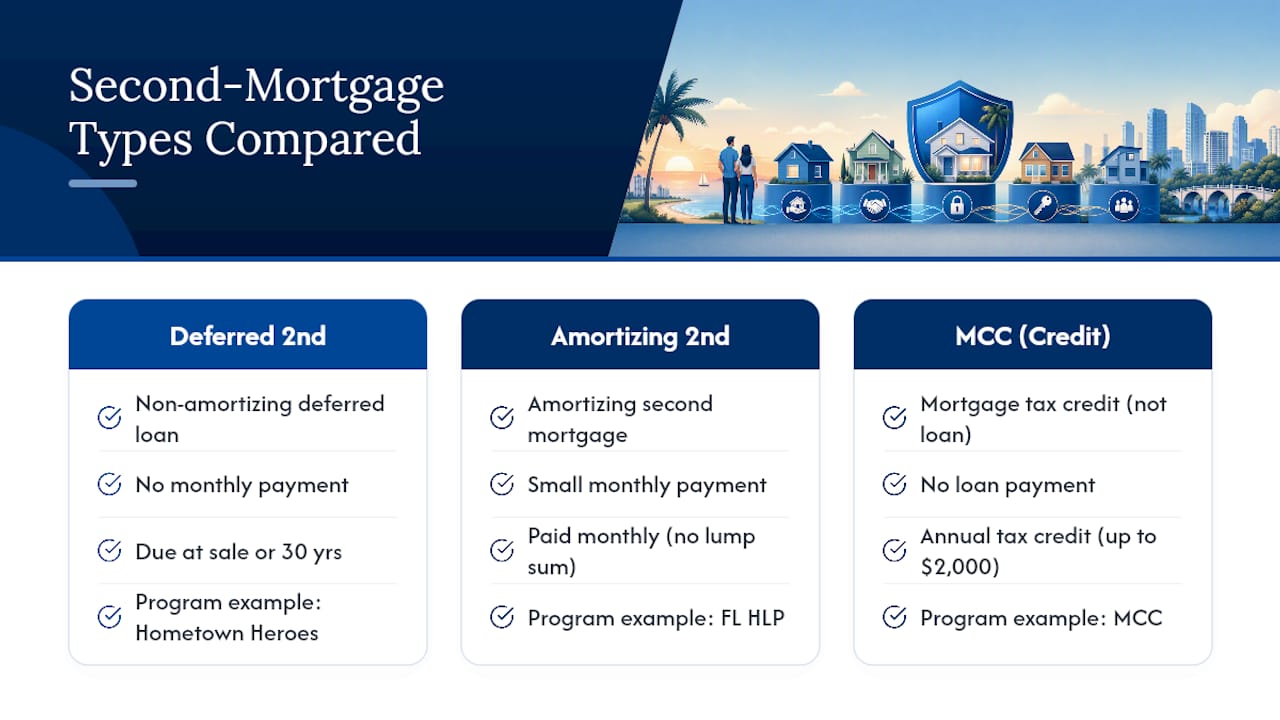
You are not making monthly payments on this second loan, but you are not walking away from it either. Sell the house in three years and you will owe that balance back at closing.
FL HLP works differently. It is an amortizing second mortgage, meaning you make a small monthly payment on it alongside your regular mortgage payment. That is real money out of your budget every month, but you avoid a lump-sum repayment surprise down the road.
Florida Hometown Heroes is the program getting the most attention right now, and for good reason. It offers down payment and closing cost assistance structured as a 0% non-amortizing, deferred second mortgage due in 30 years or at sale, refinance, or payoff, according to Florida Housing's program details. Eligibility ties to your occupation, covering teachers, healthcare workers, law enforcement, and dozens of other essential-service jobs. Funding rounds are limited and distributed first-come, first-served, so timing your application matters as much as qualifying for it.
The Mortgage Credit Certificate (MCC) works nothing like the others. It is not a loan. It is a federal tax credit that lets you claim a portion of your annual mortgage interest, often up to $2,000 per year, directly against your tax liability rather than as a deduction. That distinction matters: a credit reduces what you owe dollar for dollar, while a deduction only reduces taxable income. The catch is that MCCs carry pairing restrictions with some first-mortgage programs, so confirm with your lender whether you can combine it with the assistance you're already planning to use.
Statistic to remember: Florida Housing sets its baseline credit score requirement at 640 across its main programs, and that threshold shows up again and again as you compare county and city options.
Every one of these programs shares a few common threads. You must qualify as a first-time buyer (generally meaning you haven't owned a primary residence in the past three years), meet the county's income and purchase-price caps, complete approved homebuyer education, and work with a lender who participates in the specific program you're pursuing. County limits vary enough between, say, Miami-Dade and a rural Panhandle county that you cannot assume your neighbor's numbers apply to you.
How Do You Find County and City Assistance Programs?
Beyond the state-level offerings, dozens of Florida counties and cities run their own down payment assistance, often funded through HUD's HOME Investment Partnerships Program. These local programs can be more generous than state options in specific ways, but they are also more scattered and harder to research.
- Start with HUD's Florida county assistance listing, which catalogs contact information for housing counseling and assistance programs across the state.
- Visit your specific county's Housing and Economic Development (HED) page directly, since program details and funding status change more often than aggregator sites can track.
- Call the county HED office before you assume a program is open. Application windows close without much public notice once funds run out.
Palm Beach County offers a useful example of how these local programs typically operate. Its HOME First-Time Homebuyer Program provides deferred 0% loans that become forgivable after a set term, but it requires you to already have first-mortgage approval from a lender before you can even apply. Applications process on a first-qualified, first-served basis, which mirrors the funding pressure you'll see at the state level.
A few practical patterns show up across most county programs:
- Forgivable loan structures are common, meaning your debt shrinks over time if you stay in the home
- Income bands frequently differ from state program limits, sometimes more generous, sometimes tighter
- Lender preapproval is usually a prerequisite, not a formality you handle later
Local counseling agencies play a role here too. Organizations like Life Improvement for Tomorrow, Inc. (LIFT) offer financial literacy workshops that satisfy education requirements while connecting you to programs you might not find through a basic search. Treat your county HED office as your first phone call, not your last resort.
What Mortgage Types Work Best for First-Time Buyers in Florida?
The mortgage type you choose determines which down payment assistance programs you can pair with it, so this decision comes before you fall in love with a specific house.
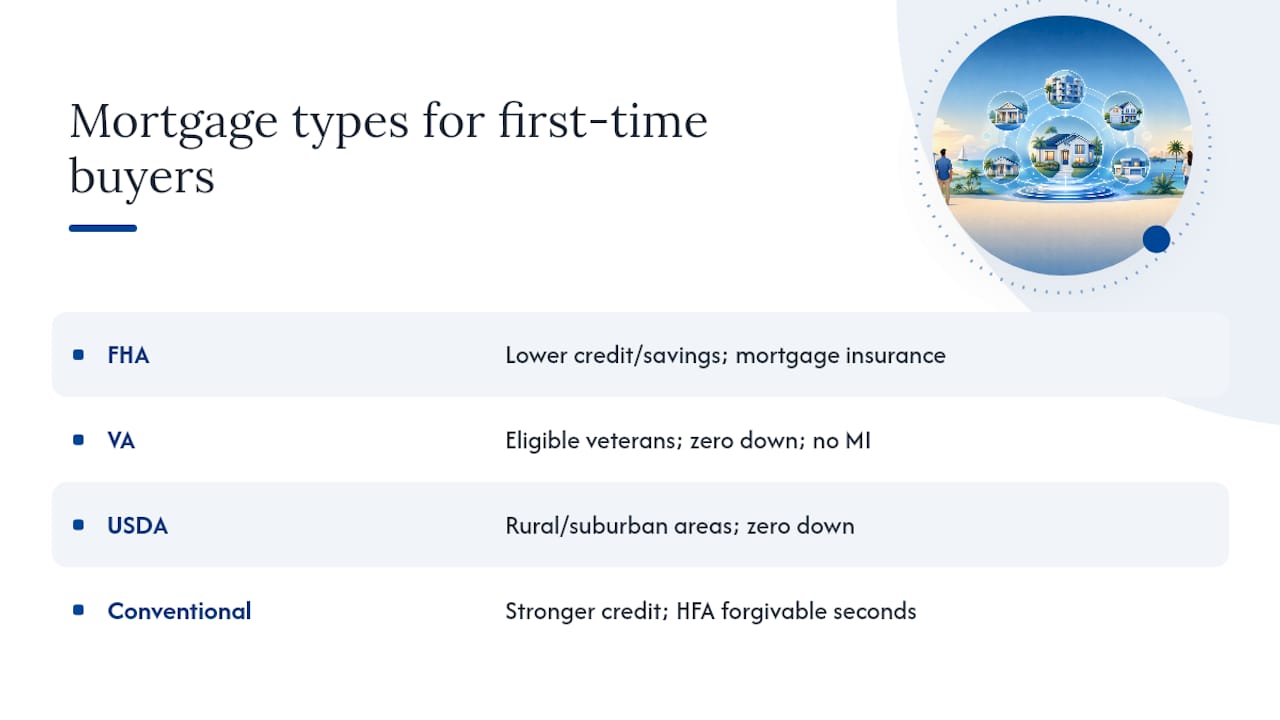
FHA loans remain the most common entry point for first-time buyers with less-than-perfect credit or limited savings. That insurance protects the lender, not you, and it adds up over the years you carry the loan.
VA loans offer a genuinely different path for eligible veterans, active-duty service members, and certain surviving spouses. According to the Department of Veterans Affairs, qualifying borrowers can buy with zero down and skip mortgage insurance entirely. DPA integration with VA loans is less standardized than with FHA, so confirm with your lender whether a specific program stacks cleanly with your VA benefit before you count on it.
USDA loans work similarly for eligible rural and some suburban Florida properties, offering zero-down financing for qualifying borrowers within income limits. Plenty of Florida still counts as USDA-eligible territory outside the dense urban corridors, so it's worth checking your target area's map status even if you assume you're in a city.
Conventional loans paired with HFA products, particularly HFA Advantage, use forgivable second mortgages rather than deferred or amortizing ones. That structure can mean lower long-term cost if you stay in the home long enough to hit the forgiveness milestone, but a conventional route typically demands a somewhat stronger credit profile than FHA. A 3% down conventional program combined with the right second mortgage can make sense for buyers with solid credit who want to avoid FHA's insurance costs altogether.
Comparing these paths side by side before you talk to a lender puts you in a much stronger negotiating position. Our comparison of Miami home loan options breaks down the tradeoffs in more detail if you want to go deeper on any single type.
What Credit Score and Documents Do You Need to Qualify?
Most Florida Housing programs set their credit floor at 640, and that single number determines whether several down payment programs are even available to you. Scoring below that threshold doesn't disqualify you from homeownership. It just means you'll likely need a few months of focused credit work before applying.
Pull your credit reports at Annualcreditreport and review them line by line. Dispute errors immediately, pay down revolving balances below 30% of their limits, and avoid opening new credit accounts while you're in the qualification window. Small, consistent changes over 60 to 90 days often move a borderline score enough to unlock a program you'd otherwise miss.
Your debt-to-income ratio matters just as much as your credit score. The Consumer Financial Protection Bureau defines DTI as your total monthly debt payments divided by your gross monthly income, and lenders use it to gauge how much mortgage payment you can realistically absorb. Most first-time buyer programs prefer to see a debt-to-income ratio below certain limits, which vary by program and lender.
Here's your document checklist before you sit down with a lender:
- Government-issued photo ID
- Social Security number or ITIN
- Two to three months of recent pay stubs
- Two years of W-2s and federal tax returns
- Two to three months of bank and asset statements
- Preapproval letter from a participating lender
- Homebuyer education completion certificate
Pro Tip: Gather every document before you schedule your first lender meeting, not after. Missing paperwork is the single most common reason program applications stall past a funding deadline, and by the time you track down a two-year-old tax return, the window may have already closed.
How Much Down Payment Do You Actually Need in Florida?
The math changes dramatically depending on which loan and assistance program you combine, and seeing real numbers side by side makes the decision far less abstract than reading program descriptions in isolation.
Take a $400,000 home financed with an FHA loan. Your required down payment is 3.5%, or $14,000. That's just over $20,000 in upfront costs before you even factor in closing costs. This is exactly where Hometown Heroes or FL Assist earns its keep: qualifying assistance can cover that $14,000 down payment and a meaningful chunk of closing costs, turning a five-figure cash requirement into something manageable.
Your down payment drops to $12,000 on the same $400,000 home, but FL HLP's second mortgage adds its own monthly payment on top of your primary mortgage. You're trading a smaller repayment obligation on the FHA side for an ongoing monthly cost on the conventional side.
| Scenario | Down Payment | Assistance Structure | Monthly Impact |
|---|---|---|---|
| FHA 3.5% down, $400k home | $14,000 | Hometown Heroes or FL Assist covers down payment (0% deferred second) | No added monthly payment from the second mortgage |
| Conventional 3% down, $400k home | $12,000 | FL HLP amortizing second mortgage | Adds a small monthly payment on top of the first mortgage |
One stacking rule catches buyers off guard more than any other: most Florida Housing down payment programs require your first mortgage to also come through Florida Housing's approved lender network. Local county programs are sometimes more flexible about which first mortgage they'll pair with, but you should never assume compatibility. Confirm stacking eligibility with your participating lender before you fall in love with a specific assistance program, because discovering an incompatibility during underwriting costs you weeks you don't have.
How Long Does the Application Process Take From Start to Finish?
A realistic timeline keeps you from missing funding windows that close without warning, and knowing the sequence in advance lets you front-load the slow steps.
- Get preapproved with a participating lender. This typically takes one to two weeks and should happen alongside your homebuyer education course, not after it. Completing both early means you're ready to apply the moment you identify your target program.
- Identify and apply to your target programs. Some state and local DPA applications require your lender preapproval already in hand, and many process funding on a first-come, first-served basis. Submitting a week late can mean missing an entire funding round.
- Move through underwriting to closing. This stage generally runs 30 to 60 days once your offer is accepted, assuming your documentation is complete and your assistance program approval is finalized.
The most common pitfall isn't a weak application. It's timing. Buyers who wait until they find a house to start their homebuyer education course, or who submit incomplete paperwork expecting to fill gaps later, frequently miss the funding cycle entirely.
Pro Tip: Complete your homebuyer education certificate before you start house hunting seriously. Programs process applications in the order they receive complete files, and a missing certificate is one of the easiest, most avoidable delays in the entire process.
When Should You Work With a Mortgage Broker Instead of Going Direct?
A broker's real value in this process is speed and access, not just rate shopping. Because Florida Housing, county programs, and Hometown Heroes each require you to work with specific participating lenders, a broker who already holds those relationships can move your application into a funding round faster than a buyer starting from scratch with a single bank.
Lending Bankers works with Florida first-time buyers on exactly this kind of program navigation, pairing local knowledge of county-level DPA rules with hands-on guidance through Florida Housing's statewide offerings. That combination matters most when you're trying to stack a first mortgage with a second-mortgage assistance program correctly the first time.
Program funding is often limited and distributed on a first-come, first-served basis. Working with a lender or broker who understands the timing of these rounds materially increases a buyer's chance of capturing available funds before they run out.
If you're evaluating brokers generally, ask about:
- Their track record with specific Florida Housing and county program approvals
- Whether they're currently an approved lender in the programs you want
- How they've handled stacking conflicts between first and second mortgages for past clients
What This Means for Your Next Move
The Florida first-time buyer landscape rewards preparation over hesitation, and that's the opposite of how most people approach it. Buyers tend to spend weeks house hunting before they've even confirmed their credit score meets the 640 threshold or finished a homebuyer education course, then discover the program they wanted has closed its funding round for the year.
Conventional advice tells you to "shop around" for the best rate. That's fine advice for a refinance. For a first-time buyer trying to access Hometown Heroes or FL Assist, the more urgent task is confirming lender participation and program stacking rules before you fall for a house. The mechanics matter more than most guides admit: a deferred second mortgage and an amortizing one produce wildly different long-term outcomes, and the Mortgage Credit Certificate's tax-credit structure gets overlooked constantly despite offering real annual savings.
If there's one thing to prioritize first, it's this: get your documents and education certificate ready before you start touring homes. Everything downstream, from preapproval to program stacking to closing, moves faster once that foundation is set.
— David
Get Personalized Help Navigating Florida's First-Time Buyer Programs
Lending Bankers gives Florida first-time buyers something a single-bank application can't: access to multiple participating lenders and direct experience stacking state and county assistance programs correctly the first time.
Where a generic bank branch might only offer its own in-house products, Lending Bankers works across the programs covered in this guide, Florida Housing, Hometown Heroes, FL Assist, FL HLP, and county HOME programs, matching you to the combination that fits your credit, income, and target purchase price. That matters most during limited funding rounds, when knowing exactly which paperwork a program needs, and having it ready, determines whether you get in before the money runs out.
If you're ready to see what your numbers actually look like, our mortgage calculator shows how different down payment and assistance combinations affect your monthly payment. From there, reach out to Lending Bankers to get preapproved and start the program-matching process while current funding rounds are still open.
Key Takeaways
Florida's first-time buyer programs work best when you secure lender preapproval and homebuyer education before house hunting, since limited funding rounds reward early, complete applications.
| Point | Details |
|---|---|
| Check statewide programs first | Start with Florida Housing's Homebuyer Loan Program, then layer in FL Assist, FL HLP, or Hometown Heroes. |
| Meet the 640 credit floor | Most Florida Housing products require a minimum 640 credit score before you qualify for assistance. |
| Confirm lender participation early | Down payment assistance typically requires your first mortgage through the same participating program lender. |
| Budget for real numbers | A $400,000 FHA purchase needs roughly $14,000 down plus upfront mortgage insurance, which DPA can offset. |
| Work with a program-savvy broker | Lending Bankers helps Florida buyers match credit, income, and county limits to the right stacked program. |
Sources
- Homebuyer
- HOME First-Time Homebuyer Program (Palm Beach County)
- What is a debt-to-income ratio?
- VA home loans