
If you already have an FHA loan and you've kept up with payments, an FHA Streamline refinance can often lower your monthly payment with far less paperwork than a traditional refi. The core requirements are straightforward: you need an existing FHA-insured mortgage, at least 210 days and six on-time payments since your last closing, and a refinance that delivers a genuine net tangible benefit under HUD's streamline guidance.
Before you call a lender, run through these checks:
- Your current loan is FHA-insured and you're current on payments, with a clean three-month history.
- You're at least 210 days past your last loan closing, with six payments made.
- You're not trying to pull cash out. Streamline refinances cap cash back at $500.
Meet all three, and you're likely a strong candidate. Lenders can still add their own overlays on top of these baseline rules, so your experience may vary by lender even when you qualify on paper.
Key Takeaways
An FHA Streamline refinance lowers payments for current FHA borrowers through reduced documentation, but seasoning rules, the net tangible benefit test, and lender overlays determine whether it truly pays off.
| Point | Details |
|---|---|
| Meet the seasoning window | You need a seasoning period after your last FHA loan closing accompanied by a history of timely payments. |
| Pass the benefit test | Most lenders require a meaningful rate drop or a switch from an adjustable-rate mortgage to a fixed-rate mortgage. |
| No cash-out allowed | Cash back at closing is capped at $500 under FHA rules. |
| Check the no-cost tradeoff | A higher rate on a no-cost refi can erase your monthly savings if you stay long-term. |
| Compare lenders through a broker | Lending Bankers shops overlays and no-cost structures across multiple lenders for FHA streamline clients. |
Table of Contents
- What Is an FHA Streamline Refinance and Why Does It Exist?
- Eligibility and Timing Rules You Must Meet
- Costs, "No-Cost" Options, and Who Pays Closing Costs
- Credit-Qualifying vs. Non-Credit-Qualifying Streamline Paths
- Step-by-Step: Preparing Your Streamline Application
- Red Flags and Pitfalls to Watch For
- How Lending Bankers Approaches FHA Streamline Clients
- An Editorial Take on Streamline Refinancing
- Lending Bankers Makes FHA Streamline Refinancing Simple
- Frequently Asked Questions
- Sources
What Is an FHA Streamline Refinance and Why Does It Exist?
The program exists to make refinancing easier for borrowers who already carry FHA-insured loans and just want a better rate or a more stable payment. It isn't a tool for tapping equity or overhauling your loan structure.
On the non-credit-qualifying path, lenders often skip the appraisal entirely and don't verify income or credit, according to trade coverage of FHA streamline mechanics. That's the "low-doc" reputation the program has earned, and it's a real advantage if your credit score has slipped since you took out your original loan.
The program is built around two outcomes:
- Lowering your principal and interest payment.
- Converting an adjustable-rate FHA loan into a fixed rate for stability.
Mortgage insurance still applies. You'll typically continue paying annual mortgage insurance premium (MIP), and depending on when your original loan closed, you may be eligible for a partial upfront mortgage insurance premium (UFMIP) refund applied to your new loan. In some cases, refinancing can also reduce your annual MIP cost depending on your original loan's timing, per that same trade reporting.
Eligibility and Timing Rules You Must Meet
FHA sets objective, checkable rules for streamline eligibility, and most of them come down to timing and payment history rather than income or assets.
- Existing FHA-insured mortgage. You must currently hold an FHA loan, and it must be current at the time of refinance. FHA won't streamline a conventional or VA loan into an FHA product.
- Seasoning period. You need at least 210 days since your last loan closing, a rule confirmed in both HUD's handbook and industry summaries of the program.
- Payment history. Six on-time payments are required, and lenders typically look closely at your most recent three months to confirm you haven't been late.
- Net tangible benefit test. This is the rule that trips people up most. FHA generally wants to see a meaningful improvement, and many lenders use roughly a 0.50% rate reduction as their internal benchmark, or documentation that you're moving from an adjustable rate to a fixed one. A refinance that only shaves a tenth of a point off your rate usually won't pass.
- No late payments in the qualifying window. Even one missed payment inside the required window can disqualify you, so pull your payment history before you apply.
These five checks are the backbone of FHA Streamline requirements, and they apply whether you're refinancing in Florida or anywhere else FHA loans are originated.
Costs, "No-Cost" Options, and Who Pays Closing Costs
Streamline doesn't mean free. FHA prohibits rolling closing costs into your new loan balance, so someone has to cover them, either you, out of pocket, or your lender, through a rate adjustment.
That's where "no-cost" refinances come in. The lender covers your closing costs in exchange for a slightly higher interest rate. It's a legitimate tradeoff, not a gimmick, but it only makes sense if you don't plan to stay in the home long enough to recoup costs through a lower rate.
Typical closing costs include:
- Title and recording fees
- Lender origination and underwriting fees
- Prepaid interest and escrow setup
Pro Tip: Divide your total closing costs by your monthly savings to get a rough breakeven month. If you plan to move or refinance again before that date, the lender-paid "no-cost" option is usually the smarter play.
Credit-Qualifying vs. Non-Credit-Qualifying Streamline Paths
FHA gives you two distinct streamline paths, and picking the right one depends on why you're refinancing and who's on the loan.
The non-credit-qualifying path is the faster, lighter-weight option. No appraisal, and often no income or credit verification, which makes it well-suited to homeowners whose credit score dropped or whose income changed since their original FHA loan closed, based on how trade publications describe the mechanics.
The credit-qualifying path comes into play when you're adding or removing a borrower from the loan, or when a lender needs to confirm you can still support the new payment. This path requires full income and credit documentation, and your debt-to-income ratio gets reviewed the way it would in a standard refinance.
Here's the catch: even when you qualify for the non-credit-qualifying path under FHA's baseline rules, individual lenders can still layer on their own overlays. Some pull credit anyway. Some request income documents "just in case." That's not FHA policy, it's lender risk management, and it's worth asking about upfront so you're not surprised mid-application.
Step-by-Step: Preparing Your Streamline Application
Getting your paperwork together before you contact a lender speeds everything up. Here's what to gather:
- Your current mortgage statement, showing at least six months of payment history.
- A payoff statement for your existing FHA loan. Lenders need this to satisfy the lien being refinanced, per HUD's handbook requirements.
- Two months of bank statements, especially if you're covering closing costs out of pocket rather than choosing a no-cost structure.
- Proof of occupancy, since FHA streamline refinances are limited to owner-occupied properties.
- Government-issued ID for identity verification.
Because appraisals and income verification are often skipped, streamline refinances frequently close faster than conventional refis, sometimes in a few weeks rather than a month or more.
Pro Tip: When you're comparing lender offers, don't just look at the interest rate. Compare APR, the length of your rate lock, and whether the lender is quietly adding overlay requirements that a competitor doesn't ask for. A tool like Lending Bankers's mortgage calculator can help you see how small rate differences play out over the life of the loan.
Red Flags and Pitfalls to Watch For
A few practices can quietly erase the savings a streamline refinance is supposed to deliver.
- A "no-cost" offer with an inflated rate. Some lenders use the no-cost label to justify a rate bump that wipes out your monthly savings entirely. Always compare the no-cost rate against a version where you pay costs upfront.
- Surprise appraisal or underwriting requests on what was pitched as a non-credit-qualifying streamline. This usually signals a lender overlay you weren't told about at the start.
- Mishandled UFMIP or MIP calculations. Ask specifically how your new mortgage insurance premium is being calculated and whether you're owed a partial UFMIP refund.
- Payoff statement discrepancies. If the payoff amount your new lender is using doesn't match your current servicer's statement, pause and get it resolved before closing.
If any of these show up, it's worth getting a second opinion from a broker who can pull multiple lender quotes and spot which overlays are negotiable, as described in this Miami refinance guide.
How Lending Bankers Approaches FHA Streamline Clients
Not every FHA borrower needs a streamline refinance, and part of the value a broker adds is telling you when a different path fits better, whether that's a rate-and-term refi, a cash-out option, or waiting a few more months to hit a seasoning deadline. When a streamline does make sense, brokers can shop lender overlays side by side and structure a no-cost refinance without guessing at the breakeven math. That comparison work, checking APR and lock terms across lenders rather than accepting the first quote, is where a broker's involvement tends to pay for itself.

An Editorial Take on Streamline Refinancing
That's incomplete. The net tangible benefit test matters, but it's the closing-cost structure that decides whether a streamline actually helps you, and most guides barely mention it.
A borrower who takes a "no-cost" refi without checking the resulting rate against a fee-paid alternative can end up worse off than before, even while technically passing FHA's benefit test on paper. The math FHA requires and the math that actually protects your wallet aren't always the same math.
My honest read: screen yourself against the seasoning and payment rules first, since those are binary and easy to check. But don't stop there. Before you sign anything, run the breakeven calculation yourself, or better, have a broker run it against several lenders' overlays at once. That's the step conventional advice skips, and it's the one that determines whether "streamline" actually saves you money.
Lending Bankers Makes FHA Streamline Refinancing Simple
Lending Bankers gives FHA borrowers something a single lender's application portal can't: a side-by-side comparison of overlays, rates, and no-cost structures across multiple lenders, so you're not stuck accepting the first offer that meets the bare minimum. If a streamline refinance doesn't quite fit your situation, our team can also walk you through alternative refinance options available to Miami homeowners.

Because closing costs can't be rolled into an FHA streamline loan, knowing exactly how a no-cost tradeoff affects your monthly payment matters before you commit. You can also review how mortgage insurance differs from homeowners insurance as part of your total cost picture, and for a broader decision framework on whether refinancing helps right now, this refinance decision guide is a useful outside reference. Ready to see your real numbers? Reach out to Lending Bankers for a lender comparison tailored to your existing FHA loan and current payment history.
Frequently Asked Questions
Does an FHA Streamline refinance require an appraisal? Often not. The non-credit-qualifying path typically skips the appraisal, though individual lenders can still require one as an overlay.
Can I get cash out with an FHA Streamline refinance? No. FHA caps cash back to the borrower at $500, so this isn't a cash-out refinance option.
How long does an FHA Streamline refinance take to close? Because appraisals and income verification are frequently skipped, streamline refinances often close faster than standard refis, sometimes within a few weeks.
What's the difference between credit-qualifying and non-credit-qualifying streamline refinances? Non-credit-qualifying skips income and credit checks; credit-qualifying requires full documentation, usually when adding or removing a borrower.
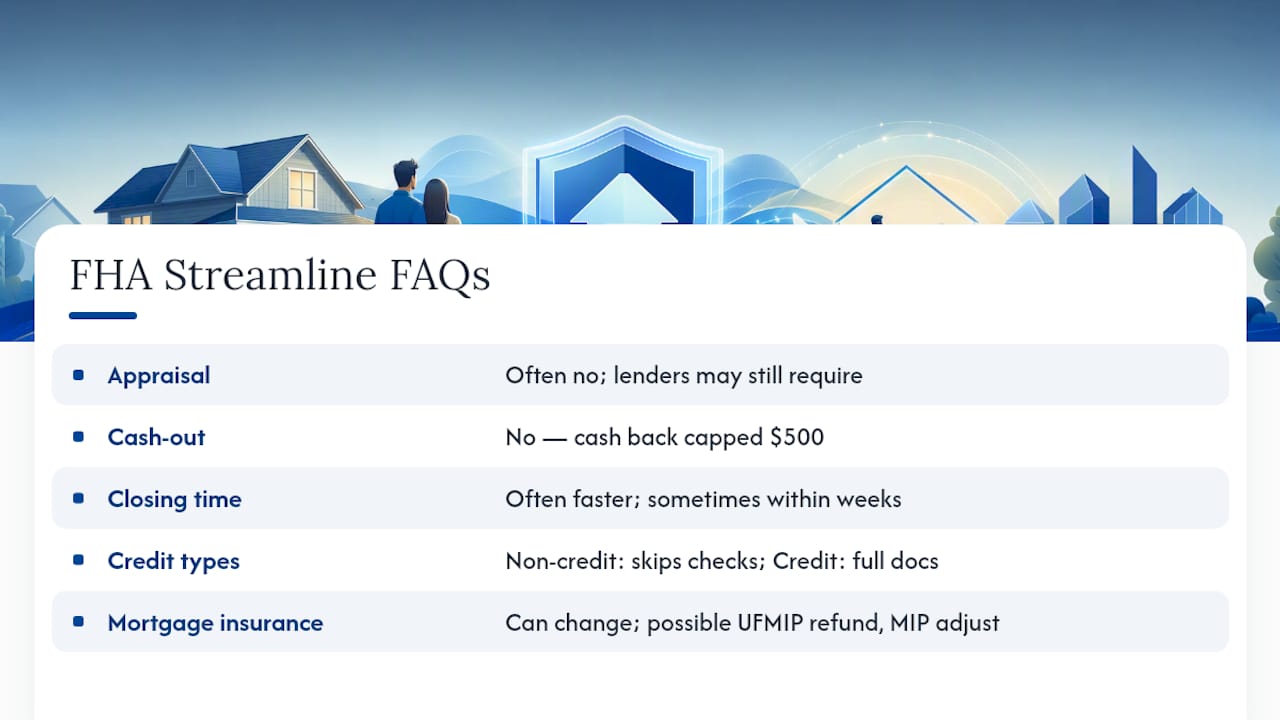
Will my mortgage insurance change after a streamline refinance? It can. You may be eligible for a partial UFMIP refund depending on your original loan's timing, and your annual MIP may adjust as well.