
Florida Housing Finance Corporation runs the state's core down payment help through FL Assist and Hometown Heroes, but you almost always need a Florida Housing first mortgage and an approved lender to unlock either one. County programs in places like Pinellas and Orange add another layer of money on top. Your first move: call an FHFC-participating lender or pull up your county's housing portal today, since funding windows close without warning.
TL;DR:
- Most Florida down payment assistance programs require buyers to partner with an approved lender and often depend on a qualifying first mortgage, making early lender coordination critical.
- County-run programs like Pinellas and Orange can offer significantly higher funds—up to $75,000 or more—based on income and household size, but funding availability varies by cycle.
- Applicants must meet specific criteria such as first-time buyer status, income caps based on exact location, credit scores around 640 or higher, and asset limits that may disqualify those with substantial savings.
- Funding for local and statewide programs is limited annually, so applying early and verifying property and income eligibility before house hunting is essential to secure assistance.
- Working with a mortgage broker familiar with Florida’s county portals ensures proper application submission and helps buyers understand how second mortgages or forgivable loans impact their monthly payments and long-term plans.
Table of Contents
- What Down Payment Assistance Florida Programs Cover
- Which County or City Programs Add Extra Help?
- Who Qualifies for Florida Down Payment Assistance?
- How Do You Actually Apply for DPA in Florida?
- When Should You Apply, and What Trips Buyers Up?
- How a Florida Mortgage Broker Fits Into Your DPA Search
- What Most Buyers Get Wrong About Florida DPA
- Get Help Finding the Right DPA Match in Florida
- Sources
What Down Payment Assistance Florida Programs Cover
Florida Housing offers several distinct paths to down payment help, and each one works differently once you get past the marketing language. Knowing the mechanics matters, because the wrong pairing can cost you thousands in unexpected repayment.
FL Assist provides up to $10,000 as a 0% interest, deferred second mortgage. You make no monthly payments on it while the home stays your primary residence, but it only comes bundled with a Florida Housing first mortgage. Sell, refinance, or move out, and the balance comes due immediately.
FL HLP works differently. That monthly obligation affects your debt-to-income ratio, so your lender needs to factor it into approval math from day one.
HFA Preferred and HFA Advantage PLUS pair conventional first mortgages with forgivable second mortgages, typically forgiven in increments over several years of occupancy. Stay put long enough, and the debt disappears entirely.
Florida Hometown Heroes targets frontline workers, veterans, and other community-service professions, with caps that can reach as high as $35,000 depending on the underlying program tier.
- FL Assist: up to $10,000, deferred, 0% interest
- FL HLP: 3% amortizing second mortgage with monthly payments
- HFA Preferred/Advantage PLUS: forgivable over time
- Hometown Heroes: assistance for eligible professions with varying caps
Amounts, terms, and availability shift as funding cycles and program forms change, so confirm current figures with a participating lender before you build a budget around any single number.
Which County or City Programs Add Extra Help?
Statewide money is only half the picture. Florida's counties and cities run their own layered assistance, often stacking on top of what FHFC provides. HUD's Florida county listing works as the master index for SHIP, HOME, and other local DPA labels, since terminology varies from one county to the next.
Pinellas County's program illustrates the scale some counties reach: deferred loans up to $75,000 for qualifying households, with income tiers for individuals and families described on the county portal. The Pinellas County portal requires lenders, not buyers, to submit applications directly.
Orange County structures its awards by income tier instead of a flat cap: very-low-income households can receive up to $70,000, low-income up to $40,000, and moderate-income up to $10,000, according to the Orange County program page.
- Pinellas: up to $75,000, deferred, income-tiered
- Orange County: $70,000 / $40,000 / $10,000 by income tier
- Miami-Dade: interest-free second mortgage, capped by program rules
Miami-Dade County publishes its own homebuyer down payment assistance page, and several cities within the county run separate programs with their own caps. Enter your exact property address into the county portal, or call the housing office directly, before assuming any figure applies to you.
Who Qualifies for Florida Down Payment Assistance?
Eligibility rules repeat across almost every program, so check these before you get attached to a specific number.
- First-time buyer status. Most programs require you haven't owned or occupied a home in the past three years, though a few exceptions exist for specific professions or disaster-affected buyers.
- Income and purchase price limits. Every county sets its own AMI-based income ceiling and maximum purchase price, and both vary by zip code, not just by county.
- Credit score minimums. FHFC programs commonly set the bar around 640, though individual lenders can layer on stricter requirements.
- Household income counting. Underwriters typically count income from every household member 18 and older who will live in the home, even if they're not on the loan.
- Asset limits. Programs often cap liquid assets, so a large savings cushion can disqualify you even with modest income.
- Repayment structure. Confirm whether your assistance is forgivable, deferred, or amortizing, since each carries different triggers for repayment on sale, refinance, or transfer.
How Do You Actually Apply for DPA in Florida?
You don't apply for down payment assistance directly. Your lender does, and that distinction shapes everything about the process.
- Get preapproved for a Florida Housing first mortgage with a participating lender.
- Complete FHFC-approved homebuyer education, usually a short online course with a certificate.
- Gather your documents: photo ID, recent pay stubs, two months of bank statements, and asset disclosures.
- Confirm your lender is registered in the specific county or FHFC portal your program requires.
- Let the lender submit the DPA application on your behalf, bundled with your first mortgage file.
Pro Tip: Ask your lender directly whether they're registered in your county's DPA portal before you fall in love with a house. A lender who isn't set up for Pinellas or Orange County's system can't submit your application there, no matter how strong your file is.
Underwriters review DPA files the same way they review your primary loan, checking income documentation, asset statements, and program-specific eligibility items. Waiting lists build quickly once popular county programs like Pinellas reopen, so timelines can stretch from a few weeks to several months depending on funding levels.
When Should You Apply, and What Trips Buyers Up?
Funding gets allocated annually, and popular programs can exhaust their pool well before the fiscal year ends. Apply early in the cycle rather than waiting until you've already found a house.
- Assuming DPA works standalone without a qualifying first mortgage.
- Skipping the address-specific eligibility check before making an offer.
- Working with a lender who isn't approved for your target program.
- Carrying liquid assets above the program's cap without realizing it.
Local and state DPA programs are subject to limited annual appropriations, and funds can run out late in the cycle even when a program technically remains "open." Verify address eligibility, secure lender preapproval, and finish your homebuyer education early. Clearing large non-exempt assets ahead of application, rather than after a denial, saves months of frustration.
How a Florida Mortgage Broker Fits Into Your DPA Search
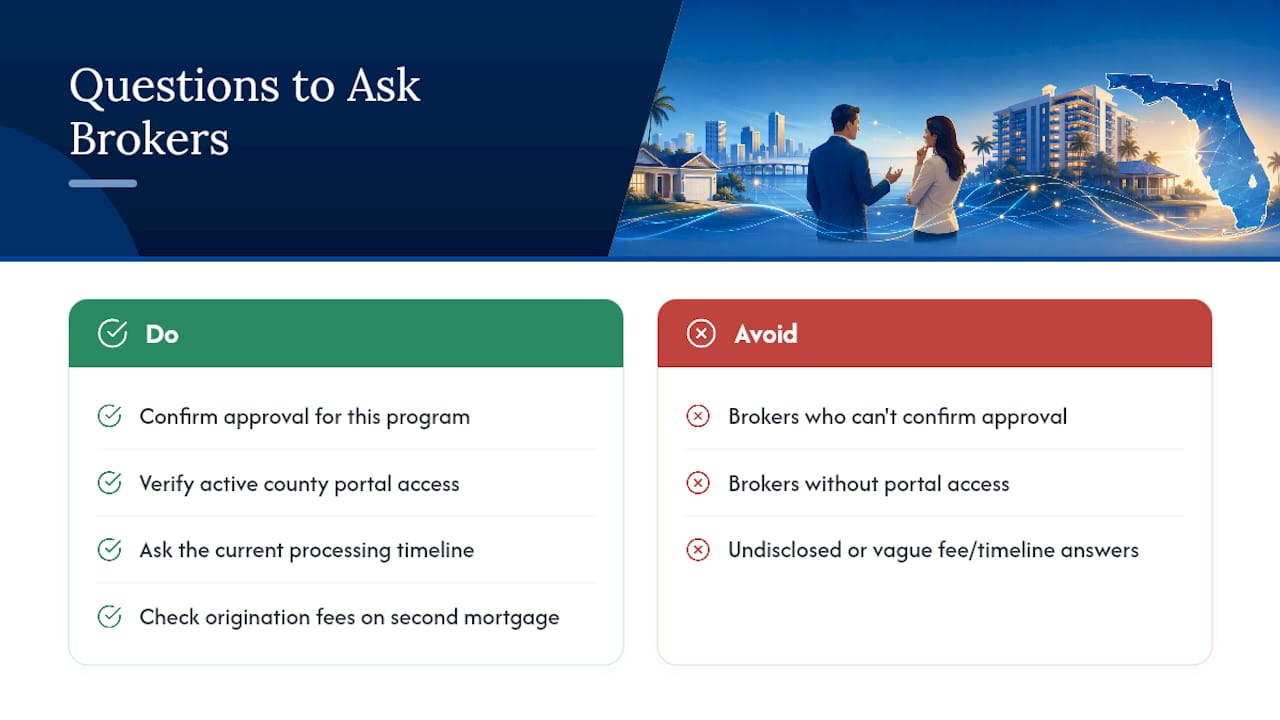
A broker's real value is knowing which lenders sit inside which county portals, then assembling a complete package the first time. Before committing, ask any broker or lender: Are you approved for this specific program? Do you have active portal access? What's the current timeline? Are there origination fees tied to the second mortgage? Straight answers to those four questions tell you more than any brochure.
What Most Buyers Get Wrong About Florida DPA
The conventional advice treats down payment assistance like a coupon you clip and redeem. It's closer to a second underwriting process running parallel to your first mortgage, with its own income math, its own asset ceilings, and its own repayment fine print. Buyers who treat FL Assist or a county program as free money often get blindsided when a refinance five years later triggers immediate repayment of a deferred second.
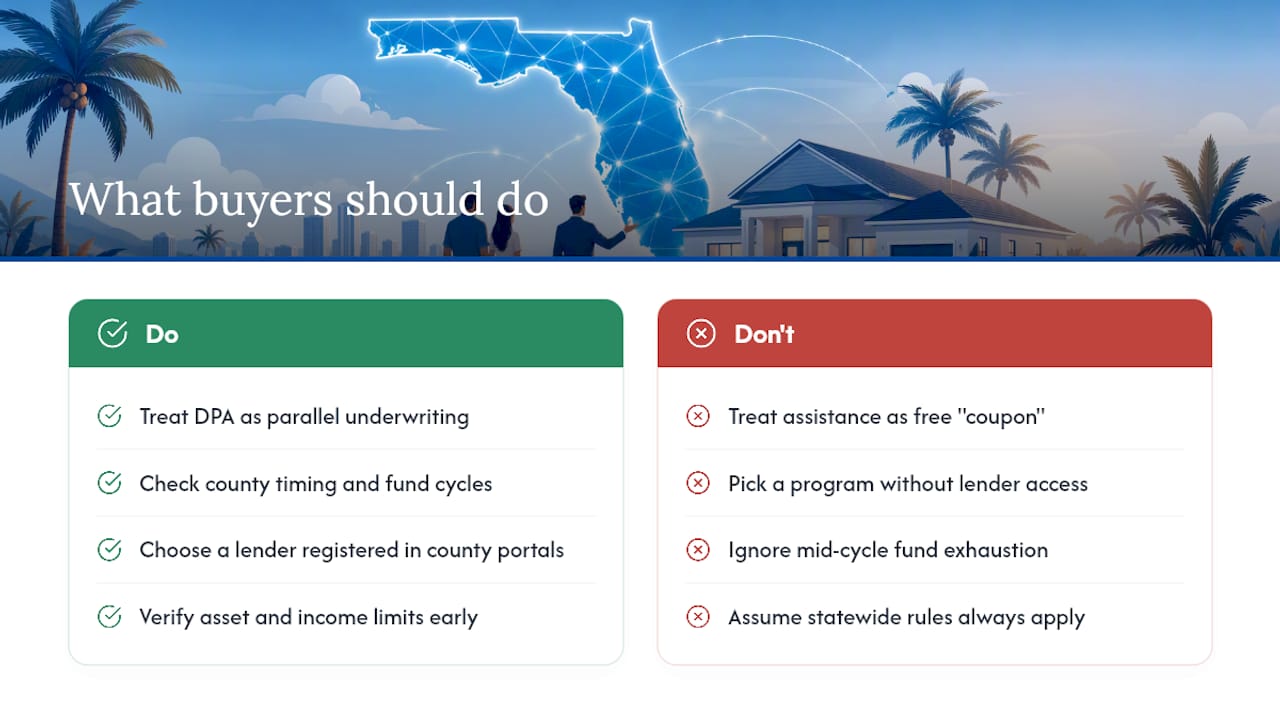
Where the standard guides fall short is timing. Most articles list program names and caps without stressing that Pinellas, Orange, and similar county funds run out mid-cycle in a way FHFC's statewide programs generally don't. If you're house hunting in a county with a popular local program, that clock matters more than the dollar amount you're chasing.
Prioritize lender fit before program fit. A buyer who locks in with a lender registered across multiple county portals has more paths to assistance than someone who finds the "best" program on paper but works with a lender who can't submit for it. Match yourself to the right participating lender first, and the program details tend to sort themselves out.
— David
Get Help Finding the Right DPA Match in Florida
Chasing down which county portal pairs with which lender, and which second mortgage structure won't blow up your debt-to-income ratio, requires careful coordination that expert mortgage brokers can provide for buyers in Miami and Florida.
Experienced mortgage brokers work directly with FHFC-participating lenders, assist in assembling the documentation county programs require, and explain how a deferred or forgivable second mortgage affects your monthly payments before you commit. If you're weighing how a second mortgage payment fits your budget, run the numbers through the mortgage calculator first, then reach out to talk through which Florida Housing or county program actually fits your address and income tier. Schedule a conversation with a qualified mortgage broker today to find out which program you should explore first.
This article is general information, not a substitute for advice from a qualified financial advisor. Consult a qualified financial professional about your own circumstances before acting on anything here.
Sources
- Homebuyer
- Down Payment Assistance - Pinellas County
- Homeownership Assistance in Florida, by County
- Homebuyer Down Payment Assistance
- Florida First-Time Home Buyer | Grants & Programs 2026