
A construction loan draw schedule is the lender-agreed plan that stages disbursements against documented construction progress. It tells you when you can request money, how much you'll receive at each stage, and what proof you must submit first. Before you close, negotiate and get the draw cadence, retainage percentage, and documentation requirements in writing. Lenders like Lending Bankers Mortgage work with borrowers on this up front, and standardized tools like the AIA G702/G703 forms make the process far less confusing once construction starts.
The single most important action you can take:
- Lock in your draw cadence, retainage rate, and required paperwork before you sign anything.
- Confirm who inspects the property and how fast they turn around approvals.
- Ask your lender for a written checklist so nothing gets rejected at the worst possible time.
Key Takeaways
Getting a construction loan draw schedule right requires locking in cadence, retainage, and documentation before closing, not after the first draw request stalls.
| Point | Details |
|---|---|
| Choose your format early | Confirm whether your project uses milestone-based or percentage-of-completion draws. |
| Budget for retainage | Plan for roughly 10% of each draw to be withheld until substantial completion. |
| Complete your draw package | Submit G702/G703 forms, updated SOV, lien waivers, COI, and dated photos together. |
| Model interest reserves accurately | Use draw-by-draw S-curve modeling instead of a flat 50% balance assumption. |
| Get lender support early | Lending Bankers Mortgage helps negotiate draw cadence and coordinate inspections before closing. |
Table of Contents
- How Construction Loan Draw Schedules Are Structured
- What Documents Do Lenders Require for Each Draw?
- Who Inspects Construction Loan Progress and How Long Does It Take?
- How Do Retainage and Interest Reserves Affect Your Cash Flow?
- How to Negotiate a Draw Schedule That Protects Your Cash Flow
- Building a Practical Draw Calendar You Can Actually Use
- An Insider's Notes on Where Draw Schedules Go Wrong
- How Lending Bankers Mortgage Helps You Set Up a Working Draw Schedule
- Frequently Asked Questions
- Sources
How Construction Loan Draw Schedules Are Structured
Draw schedules generally follow one of two formats. Milestone-based schedules release funds when specific construction phases finish, such as foundation, framing, or roofing. Percentage-of-completion schedules tie disbursements to the share of total work finished, verified against your budget rather than a fixed list of stages.
- Milestone-based draws typically fund foundation (10 to 15%), framing (20 to 25%), mechanicals and drywall (20%), and finishes (remaining balance).
- Percentage-of-completion draws release funds as inspectors confirm a rising share of total project value, often in smaller, more frequent increments.
- Residential projects usually run on roughly 30 day cadences with 4 to 6 total draws.
- Commercial projects tend to stretch to 30 to 45 days between draws, or follow milestone triggers instead of a fixed calendar, according to ProjUl's draw management guide.
Most residential borrowers can expect several draw requests over the life of the construction project. Larger commercial builds often shift to monthly draws regardless of milestone completion, simply to keep cash moving on both sides.
What Documents Do Lenders Require for Each Draw?
Every draw request rests on the Schedule of Values (SOV), the line-item budget breakdown that maps your total construction cost to specific tasks and materials. Your SOV becomes the reference point every inspector and underwriter uses to check whether the work performed matches the dollars requested. A mismatched SOV is one of the most frequent causes of draw reductions or holds, according to Procore's construction documentation guidance.
Most lenders use the AIA G702/G703 forms, the standardized Application and Certificate for Payment. The G702 summarizes the total contract sum, amount requested, and retainage held. The G703 breaks that summary down by line item, matching your SOV.
A complete draw package usually includes a certificate of insurance (COI) confirming active coverage:
- Signed G702/G703 forms or your lender's equivalent draw request form
- Updated Schedule of Values reflecting current progress
- Lien waivers from your general contractor and major subcontractors
- Certificate of insurance (COI) confirming active coverage
- Dated, timestamped progress photos of completed work
Incomplete submissions can add weeks to your funding timeline, which is exactly the kind of delay that stalls subcontractor payments and damages trust on site.
Pro Tip: Keep a running folder of lien waivers as you go instead of chasing them down the week a draw is due. Subcontractors are far more responsive to a signature request right after they're paid than three weeks later when you need it fast.
Who Inspects Construction Loan Progress and How Long Does It Take?
A third-party construction loan inspector acts as your lender's independent verification arm. Their job is straightforward: confirm that what you're claiming on paper actually exists on the ground. Inspectors check physical progress against your draw request, comparing framing, mechanical rough-ins, or finish work against the percentage you're claiming complete.
Inspectors typically look for:
- Structural progress matching the claimed completion percentage
- Materials on site (for stored-materials draws) matched to invoices
- Code compliance issues that could stall future draws
- Photo documentation consistent with the SOV update
Common inspection cadences run 30 to 45 days, tracking closely with the draw calendar itself. That said, the industry has moved fast on turnaround speed. Modern inspection networks using geolocation-verified photos and prequalified local inspectors have cut average turnaround to as little as 1.25 days in some markets, compared to the week-plus delays common with traditional scheduling.
To avoid inspection-related holdups, request inspections the moment a milestone finishes rather than waiting for your draw due date, and keep your own dated photo log as a backup if the assigned inspector has a scheduling gap.
How Do Retainage and Interest Reserves Affect Your Cash Flow?
Retainage is the percentage of each draw your lender withholds until substantial completion, commonly set at around 10%. If you request a $50,000 draw, expect roughly $45,000 to actually hit the account, with the remaining $5,000 released once the project passes final inspection. That gap matters. Contractors and subcontractors still expect full payment on their invoices, so you need cash on hand to cover retainage until closeout.
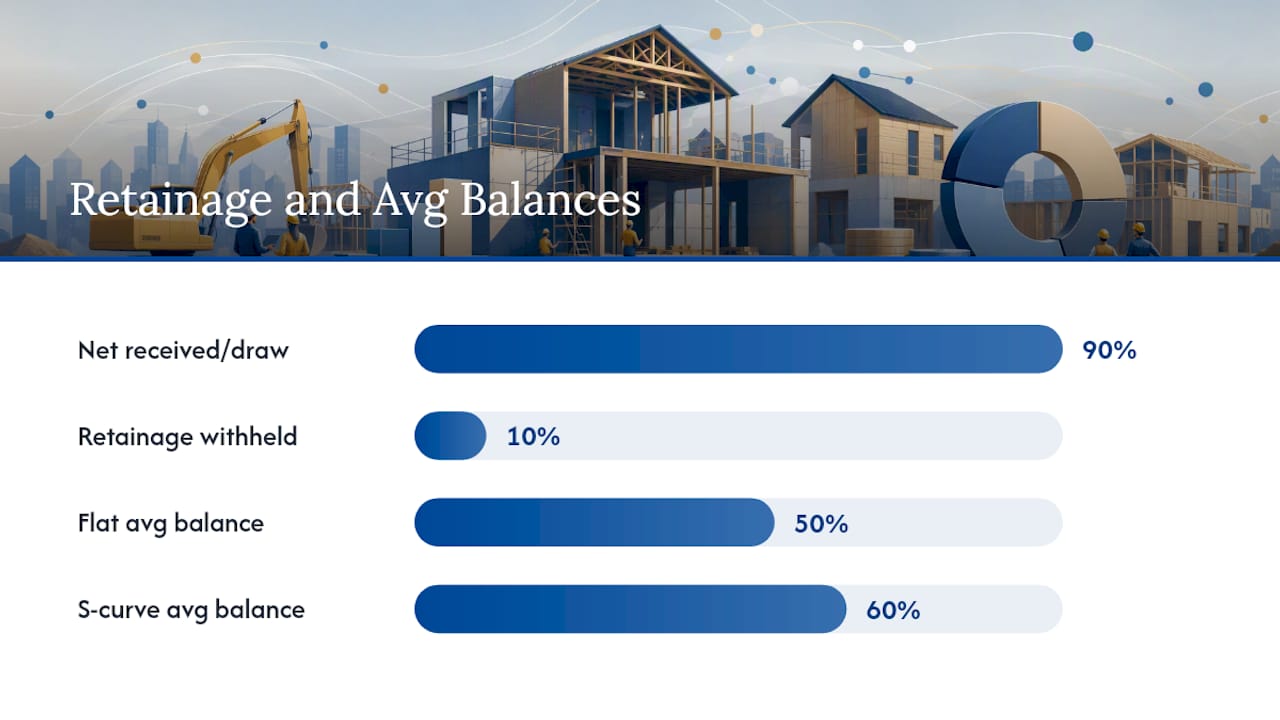
Interest reserves compound this. Many borrowers assume their average outstanding loan balance sits near 50% of the total loan through construction, but the draw curve, called an S-curve because disbursements accelerate through the middle of the project, typically pushes the real average balance to 55 to 65% for vertical construction. A flat 50% assumption tends to underestimate the interest reserve required.
| Assumption | Average Outstanding Balance | Risk |
|---|---|---|
| Flat 50% shortcut | 50% of loan amount | Understates interest reserve needs |
| S-curve reality (vertical construction) | 55–65% of loan amount | More accurate but requires draw-by-draw modeling |
Budgeting steps that help:
- Build a cash buffer covering at least two draw cycles of retainage
- Ask your lender to model interest reserve draw-by-draw rather than using a flat percentage
- Keep a contingency line of 5 to 10% for change orders that shift your SOV
How to Negotiate a Draw Schedule That Protects Your Cash Flow
The lack of a clear, agreed draw process is the single most common cause of funding stalls. Fix this before closing, not after your first draw gets rejected.
- Negotiate your draw cadence, retainage rate, stored-materials rules, and inspection turnaround expectations in writing before you sign your loan documents.
- Request your lender's full draw documentation checklist in advance and share it with your general contractor so everyone works from the same list.
- Align your contractor's payment terms with the lender's draw calendar. When that's not possible, plan for short-term bridge funding or front-load early draws to cover stored materials.
- Review change-order clauses carefully. Reallocating budget between SOV line items without lender approval is a common trigger for inspection holds.
Pro Tip: Ask specifically whether your lender allows draws against stored materials that haven't been installed yet. Some lenders won't fund lumber or fixtures sitting in a garage, which can create a real cash gap on projects with long material lead times.
Building a Practical Draw Calendar You Can Actually Use
Before closing, assemble your SOV, documentation checklist, agreed cadence, inspection trigger points, and retainage percentage into one reference document you and your contractor both use.
Submit each draw request as soon as a milestone completes rather than waiting for vendor invoices to come due. Track weekly progress photos, update your SOV after every milestone, and collect lien waivers continuously so your draw package never sits waiting on paperwork.
An Insider's Notes on Where Draw Schedules Go Wrong
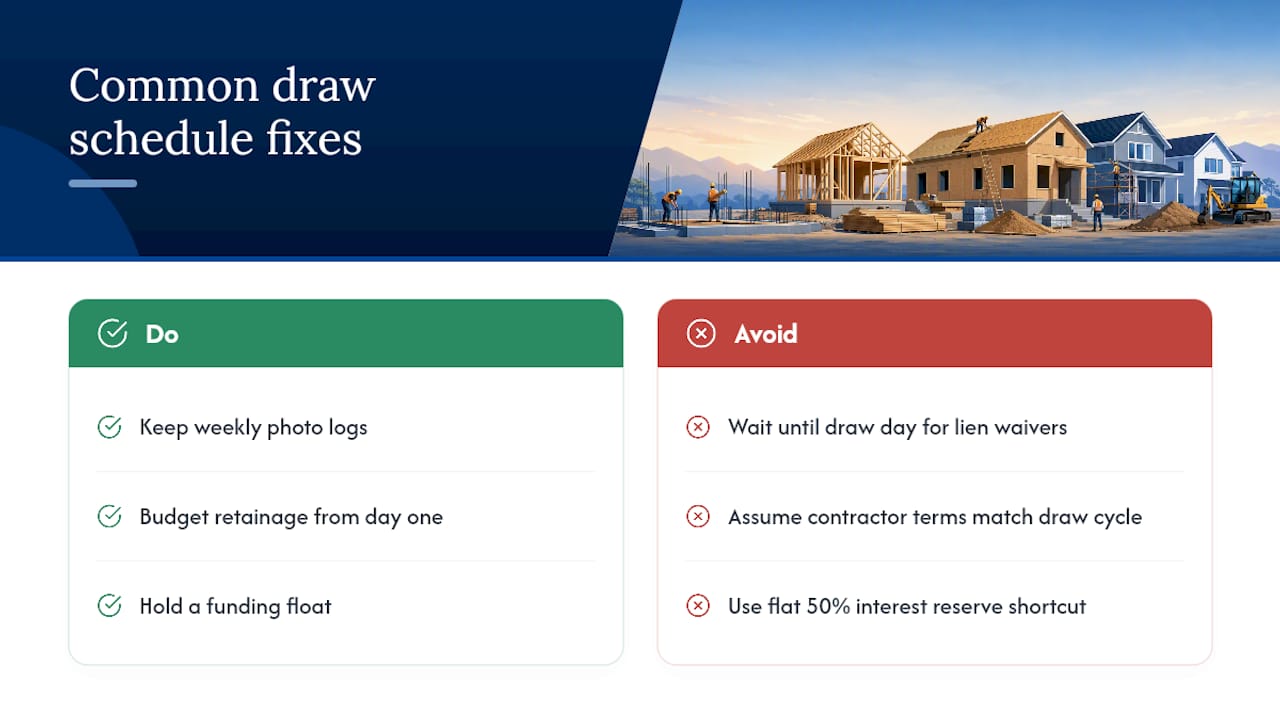
Most funding delays trace back to the same handful of mistakes, not bad luck. Late lien waivers are the top offender. Borrowers wait until draw day to chase subcontractor signatures, and that single missing document can push a funding date back a full week.
Misaligned contractor payment terms come next. A contractor expecting net-15 payment on a lender operating a 30 to 45-day draw cycle creates a cash gap someone has to bridge, usually the borrower. Underestimated interest reserves round out the pattern. Borrowers who use the flat 50% shortcut, rather than modeling draw-by-draw accrual against the S-curve, routinely run short late in the project.
The borrowers who avoid these problems keep weekly photo logs, budget for retainage from day one, and hold a funding float rather than assuming every draw lands on schedule.
How Lending Bankers Mortgage Helps You Set Up a Working Draw Schedule
If you'd rather not build your interest-reserve math and draw documentation checklist from scratch, Lending Bankers Mortgage works directly with Florida borrowers to structure a draw schedule before you ever sign closing documents.

That includes negotiating your draw cadence and retainage terms with the lender, modeling interest reserves against your actual S-curve rather than a flat percentage guess, and coordinating inspection timing so your contractor never waits on paperwork that should have been in motion weeks earlier. The process starts with a review of your project budget and SOV, followed by a documentation checklist built around your specific lender's requirements, then direct coordination between you, your builder, and the lending institution through funding. If you're still comparing loan structures before you get that far, our construction loan overview walks through what to establish before closing. When you're ready to see how the numbers work for your project, run your figures through our mortgage calculator or reach out directly to start your draw schedule review.
Frequently Asked Questions
What is a typical construction loan draw schedule? Most residential projects use a milestone-based schedule with four to six draws, released roughly every 30 days as construction phases complete.
How much retainage do lenders typically hold back? Lenders commonly withhold around 10% of each draw until the project reaches substantial completion.
What documents do I need for each draw request? You'll typically need G702/G703 forms, an updated Schedule of Values, lien waivers, proof of insurance, and dated progress photos.
How long does a draw inspection take? Standard cadences run 30 to 45 days, though modern inspection networks using remote photo verification have cut turnaround to as little as 1.25 days in some markets.
Should I use a flat 50% assumption for interest reserve budgeting? No. The draw S-curve typically pushes average outstanding balance to 55 to 65%, so a flat 50% estimate understates the interest reserve you'll actually need.
Sources
- How Do Third-Party Construction Loan Inspectors Operate? | KOWBC
- Draw Inspections: How Lenders Cut Turnaround to 1.25 Days | Built
- Construction Loan Draw Schedule & Interest Reserves | Apers
- Construction loan draw management guide | ProjUl