
Title insurance, statewide transfer taxes, and county custom around who pays for the owner's policy can shift the final number by thousands of dollars, and that piece is often negotiable.
TL;DR:
- County custom significantly influences who pays for the owner's title insurance policy, with most counties assigning this cost to sellers, except Miami-Dade and Broward.
- Fluctuations in transfer taxes and title premiums can add thousands of dollars to closing costs, depending on home price and county-specific rates.
- Buyers should carefully review their Loan Estimate and Closing Disclosure to identify discrepancies and understand how taxes, title, and insurance impact their cash to close.
- Negotiating seller credits or lender credits can reduce upfront cash needs, but statutory taxes and mandated rates are typically non-negotiable.
- Estimating accurate closing costs requires early calculation of statutory taxes, title insurance premiums, and local customs, facilitated by mortgage calculators and direct lender questions.
Table of Contents
- Closing Costs Florida Buyers and Sellers Should Expect
- Buyer Closing Costs: A Line-Item Breakdown
- Seller Closing Costs: Commissions, Deed Tax, and Prorations
- Florida's Statutory Tax Rates and Title Insurance Formula
- County Customs That Change Who Pays for Title Insurance
- How to Estimate Your Cash to Close
- Ways to Lower or Reassign Your Closing Costs
- Your Closing Day Checklist
- A Florida Lending Perspective on Closing Costs
- Let Lending Bankers Help You Plan Your Cash to Close
- Sources
Closing Costs Florida Buyers and Sellers Should Expect
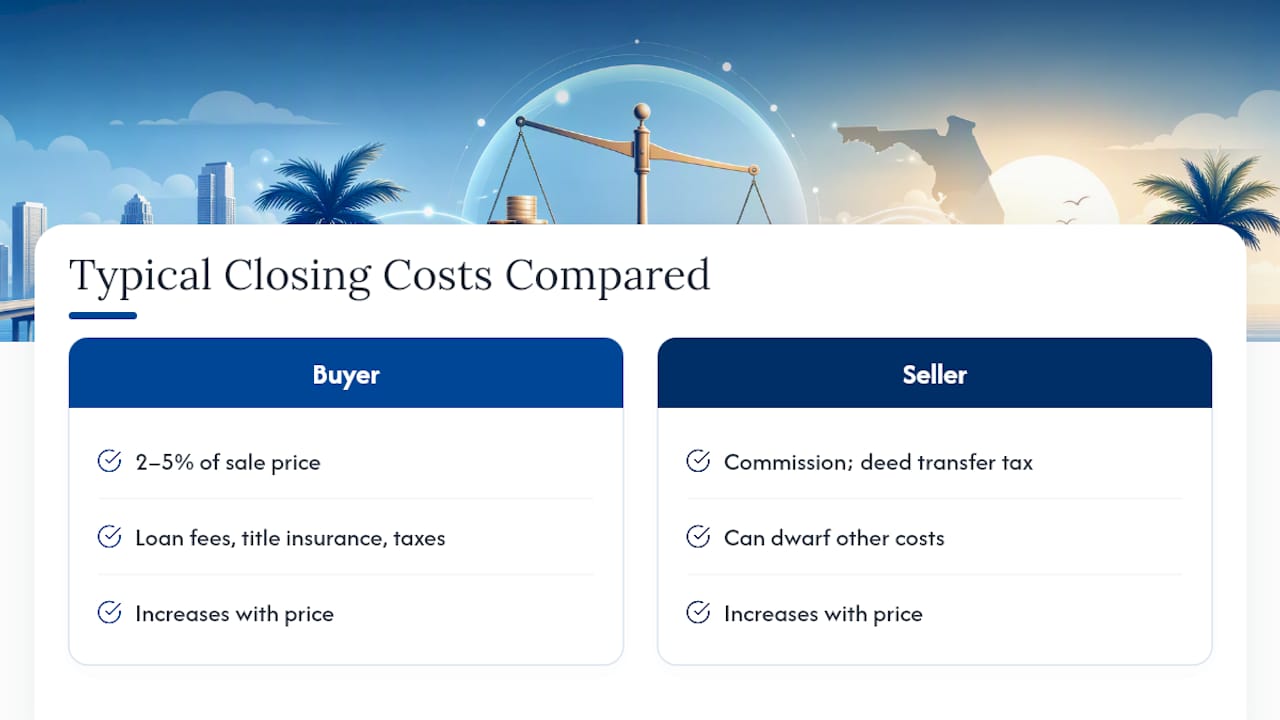
That 2% to 5% rule of thumb for buyers holds up across most Florida markets, but the dollar swing between those two endpoints is significant once you're working with a real purchase price. Sellers face a different math problem entirely: their biggest cost isn't loan-related fees, it's commission and the deed transfer tax, which together can dwarf everything else on their settlement sheet.
Here's how that plays out at different price points:
Typical buyer and seller closing costs vary with home price, generally increasing as price rises; exact amounts depend on loan fees, taxes, and title insurance premiums.
The main drivers behind these ranges are lender fees, title insurance premiums, and Florida's documentary stamp and intangible taxes, all of which we'll break down by line item next.
Buyer Closing Costs: A Line-Item Breakdown
Your Loan Estimate groups buyer costs into sections, and each one represents a real service or a state-mandated charge. Understanding what each line actually pays for helps you spot errors before they show up again on your Closing Disclosure.
- Lender fees. Origination, underwriting, and processing charges generally amount to a small percentage of the loan, with appraisal fees varying by property type.
- Lender's title insurance policy. This protects the bank, not you, and its cost depends on the loan amount rather than the sale price.
- State taxes on the mortgage. Florida charges $0.35 per $100 of the loan amount for documentary stamp tax on the note, plus $2 per $1,000 for intangible tax, both set under Florida statute.
- Recording fees, surveys, and inspections. Recording the deed and mortgage runs $10 to $20 for the first page plus a per-page fee; a home inspection typically costs $300 to $500.
- Prepaid escrow items. Lenders often collect several months of property tax and homeowners insurance upfront to seed your escrow account.
For a mid-range loan amount, documentary stamp and intangible taxes can add several hundred to over a thousand dollars before lender fees.
Seller Closing Costs: Commissions, Deed Tax, and Prorations
Real estate commission is usually the largest cost for sellers, commonly calculated as a percentage of the sale price and shared between listing and buyer's agents.
Beyond commission, sellers should expect:
- Documentary stamp tax on the deed, charged at $0.70 per $100 of the sale price in most counties under Fla. Stat. §201.02. Miami-Dade County uses a different rate structure, including a surtax on non-single-family transactions.
- Mortgage payoff costs, including any prepayment penalties or per-diem interest owed through the closing date.
- Prorated property taxes, calculated based on how much of the tax year the seller owned the home.
- Title search and closing agent fees, often shared with or absorbed entirely by the seller depending on local practice.
Sellers who need to make a deal work sometimes offer a credit toward buyer closing costs rather than dropping the price outright. A credit reduces the buyer's cash needed at the table without touching the loan-to-value calculation lenders use to set terms.
Florida's Statutory Tax Rates and Title Insurance Formula
Three state-level charges show up in nearly every Florida transaction, and all three are set by statute rather than negotiated. The documentary stamp tax on a deed is $0.70 per $100 of consideration in most counties, per Fla. Stat. §201.02, with Miami-Dade applying its own rate and an added surtax on certain property types. On the loan side, the documentary stamp tax on the note is $0.35 per $100 of the loan amount, and the intangible tax adds $2 per $1,000, both governed by Fla. Stat. §201.08 and Fla. Stat. §199.135.
Title insurance follows a different formula entirely. Florida's Office of Insurance Regulation promulgates the same premium rate for every licensed title agent in the state, so shopping around won't get you a cheaper policy for identical coverage:
| Loan or sale amount | Rate applied |
|---|---|
| First $100,000 | $0.70 per $100 |
| Amount above $100,000 | $0.70 per $100 |
On a $400,000 home, that formula produces an owner's title premium of roughly $2,075, calculated as $575 on the first $100,000 plus $1,500 on the remaining $300,000.
County Customs That Change Who Pays for Title Insurance
In most of Florida, sellers pay for the buyer's owner's title policy as a matter of custom. Four counties flip that expectation, and it can catch buyers off guard if nobody flags it early:
- Miami-Dade County: buyers typically pay for their own owner's title policy.
- Broward County: same buyer-pays custom applies in most transactions.
- Sarasota County: buyers commonly cover the owner's policy here as well.
- Collier County: buyers should expect the same responsibility.
Depending on county custom, the responsibility for the owner's title insurance premium can shift significantly between buyer and seller. None of this is set in stone. Florida's standard FAR/BAR contract addresses this allocation in Paragraph 9, and the parties can negotiate it either direction regardless of local custom.
Pro Tip: Ask your agent or closing attorney which way your county leans before you write an offer, not after you're under contract. A last-minute surprise on a five-figure line item is a rough way to start negotiating.
How to Estimate Your Cash to Close
Cash to close is the actual amount you need to bring to the settlement table, and it's different from your closing costs alone. The Consumer Financial Protection Bureau defines it with a simple formula: down payment plus closing costs plus prepaid items plus initial escrow deposits, minus any seller or lender credits.
- Review your Loan Estimate first. You'll receive this within three business days of applying, and it gives you an early snapshot of projected costs.
- Compare it against your Closing Disclosure. You get this at least three business days before closing, and it should closely match the Loan Estimate unless something material changed.
- Flag any discrepancy immediately. Ask your loan officer to explain any line item that moved by more than a small margin between the two documents.
Lenders are required to keep most fees within a tight tolerance between these two documents, which is exactly why comparing them line by line matters.
Ways to Lower or Reassign Your Closing Costs
You have more room to negotiate than most buyers realize, even though Florida's statutory taxes and promulgated title rates aren't up for debate.
- Ask for a seller credit instead of a price reduction if you need help with upfront cash rather than a lower monthly payment.
- Request lender credits in exchange for a slightly higher interest rate, which trades a bit more cost over time for less cash due at closing.
- Roll eligible costs into the loan on certain programs, spreading the expense across your mortgage term instead of paying it all upfront.
- Negotiate who pays for services like the owner's title policy or closing agent fees, since these aren't fixed by statute the way transfer taxes are.
Pro Tip: Seller credits are usually more flexible than price cuts because they don't affect the appraisal or the loan-to-value ratio lenders rely on to approve your financing.
Your Closing Day Checklist
Closing day moves fast, so confirm the essentials before you walk in.
- Bring certified funds or a wire transfer, since personal checks are rarely accepted for the amount due at closing.
- Carry a government-issued photo ID and any documents your lender flagged during underwriting.
- Review your Closing Disclosure line by line one final time, checking the loan amount, interest rate, and total cash to close.
- Speak up immediately if any number differs from what you approved, before you sign anything.
Pro Tip: Request your final Closing Disclosure numbers by email the day before closing so you can wire funds with confidence and skip any last-minute scramble.
A Florida Lending Perspective on Closing Costs
Every Florida closing has its own personality, and Miami-area transactions carry a few recurring patterns worth naming outright. Buyers frequently underestimate the intangible tax and title premium because neither shows up in the sticker price of a home, and sellers often assume commission is negotiable when the bigger surprise is usually the county-specific title custom.
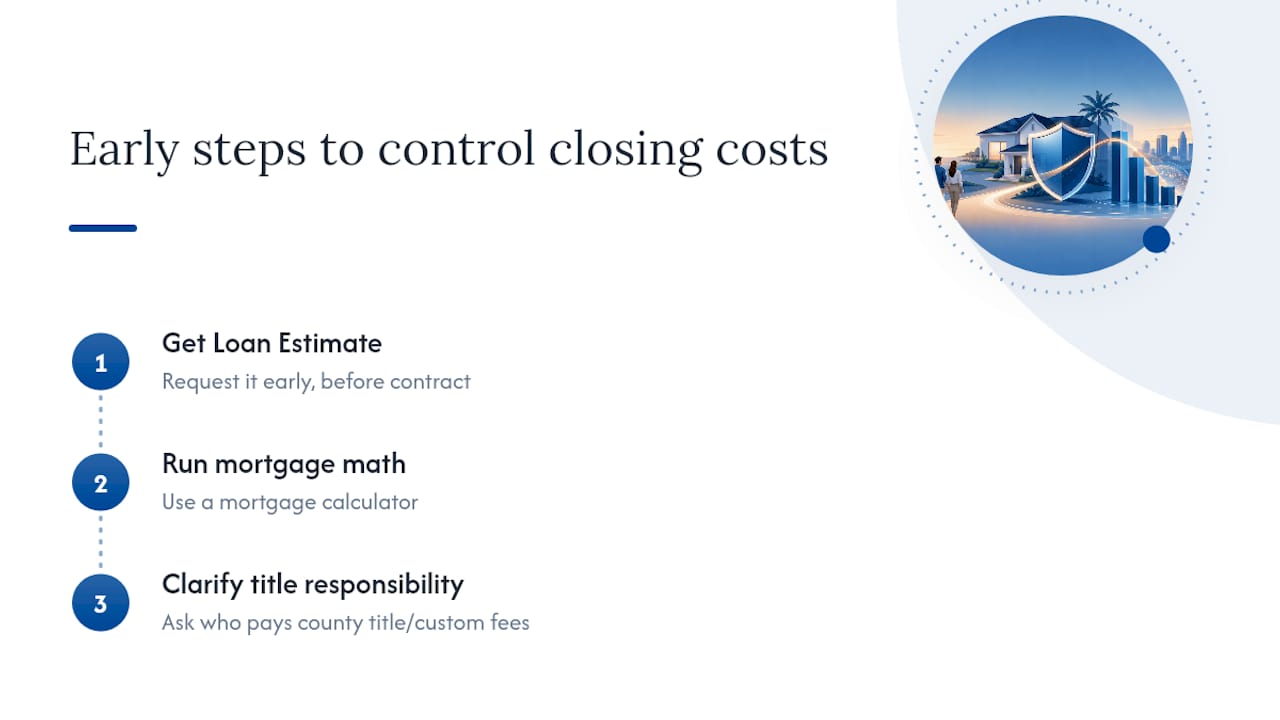
The fix isn't complicated. Pull a Loan Estimate early, run your own numbers through a mortgage calculator, and ask direct questions about title responsibility before you're locked into a contract.
— David
Let Lending Bankers Help You Plan Your Cash to Close
A Loan Estimate built around your actual loan program, your actual price point, and Florida's actual statutory rates can provide more accurate information than a generic national average calculator that ignores doc stamps and intangible tax entirely.
Whether you're comparing an FHA loan against a conventional one, weighing a lender credit against a slightly higher rate, or trying to figure out how title custom in your county affects your bottom line, We walk you through the math before you're locked into a contract. Start by running your numbers through the mortgage calculator to see how different loan amounts affect your total cash to close, then explore loan program options suited to your situation. If you're also weighing how homeowners insurance factors into your monthly payment, this breakdown of homeowners insurance versus mortgage insurance is worth a look too. Reach out to get a real, itemized Loan Estimate started today.
Sources
- Closing disclosure | Consumer Financial Protection Bureau
- Fla. Stat. §201.08
- Florida Closing Costs by the Numbers (2026): Rates, Taxes & Fees | Barnes Walker