
Yes, you can cash out an investment property by replacing your current mortgage with a larger one and pocketing the difference in equity. Whether you should depends on three things: how much equity you actually have, how far Fannie Mae, Freddie Mac, or your lender will let you push the loan-to-value ratio, and whether the return on what you do with that cash beats the cost of carrying a bigger loan.
TL;DR:
- The maximum loan-to-value ratio for investment property cash-out refis is generally lower than owner-occupied loans and varies by property type and lender overlay.
- Rolling closing costs into the new loan increases upfront liquidity but reduces net cash to borrower and raises total interest paid over the loan term.
- The process involves appraisal, payoff calculation, applying LTV caps, deducting costs, and disbursing cash within a few days, with stricter requirements for investment properties.
- A break-even point depends on the monthly benefit of the cash out; widely varying returns can make or break the deal within 13 to 45 months.
- Alternatives like HELOCs or hard-money loans may be faster or cheaper but carry higher rates and shorter terms, suitable for specific projects or quick flips.
Table of Contents
- What Is a Cash-Out Refinance on an Investment Property?
- How Does a Cash-Out Refinance Work, and What's the Breakeven Point?
- Who Qualifies, and What Do Underwriters Want to See?
- What Costs Should You Budget for a Cash-Out Refinance?
- When Does a Cash-Out Refinance Make Sense for Investors?
- HELOC, Bridge Loan, or Something Else? Weighing Your Alternatives
- What Should You Prepare Before Applying?
- What Investors Get Wrong About Cash-Out Refinancing
- Ready to Access Your Equity? Here's How Lending Bankers Helps
- Sources
What Is a Cash-Out Refinance on an Investment Property?
A cash-out refinance on an investment property replaces your existing mortgage with a new, larger loan and sends you the difference in cash after your old balance and closing costs are paid off. It differs from a rate-and-term refinance, which only adjusts your interest rate or loan length without pulling out equity, and from a HELOC, which stacks a second lien on top of your current mortgage instead of replacing it.
Investors typically choose this route for one of three reasons. Some use the proceeds as a down payment on another rental, effectively recycling equity from a stabilized property into new inventory. Others fund a rehab or value-add project, betting that the improvements raise rent and property value enough to justify the new debt. A third group uses it to consolidate higher-cost debt, like a hard money loan or a credit line used during a purchase, into one lower-rate, longer-term payment.
Common uses among Lending Bankers clients include:
- Funding a down payment on a second or third rental property
- Paying for renovations that boost rent or resale value
- Paying off a hard money or bridge loan used to close quickly
- Consolidating multiple debts into a single monthly payment
- Building a cash reserve for future acquisitions or emergencies
Each use case comes with a different risk profile, and the math only works if the new payment still leaves room for positive cash flow. That's the part worth slowing down for.
How Does a Cash-Out Refinance Work, and What's the Breakeven Point?
The mechanics follow a predictable sequence, even though the numbers change property to property. Here's the order lenders actually work through:
- Appraisal. A licensed appraiser establishes current market value, which sets the ceiling for your new loan amount.
- Payoff calculation. Your existing mortgage balance, plus any liens, gets paid off from the new loan proceeds.
- Maximum loan amount. The lender applies its loan-to-value (LTV) cap for investment properties to the appraised value.
- Subtract costs and payoffs. Closing costs, prepaid items, and the old loan balance come out of the new loan amount.
- Cash to borrower. What's left is wired to you at closing, typically within a few business days.
LTV caps matter more here than they do on a primary residence. Investment property cash-out refinances usually top out lower than owner-occupied loans, and Freddie Mac's cash-out refinance guidelines confirm that program terms, including maximum LTV, vary by property type and generally run more conservative for non-owner-occupied homes. You'll also see the term CLTV (combined loan-to-value) if there's a second lien involved, and HTLTV (high-cost-area LTV) in jurisdictions with elevated loan limits.
Statistic Callout: Freddie Mac notes that closing costs and prepaid items can often be rolled into the new loan balance rather than paid out of pocket, which increases upfront liquidity but reduces the net cash you walk away with and adds to the interest you'll pay over the life of the loan.
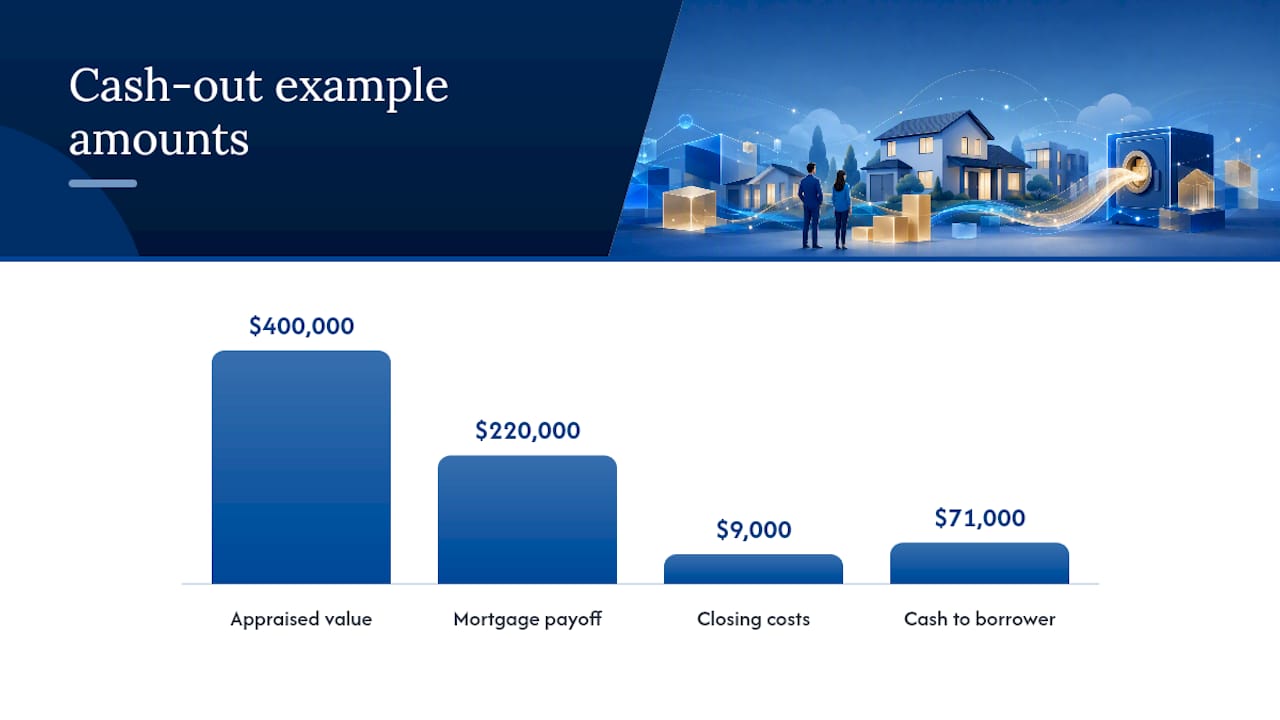
Here's a simplified worked example. Say your rental property appraises at $400,000, and your current mortgage balance is $220,000. Subtract the $220,000 payoff and roughly $9,000 in closing costs, and you're left with about $71,000 in cash to borrower. If your old payment was $1,400 a month and your new loan at a higher balance runs $1,950, you've added $550 a month in debt service, or $6,600 a year.
To find your breakeven, divide your total costs (the $9,000 in fees, if paid out of pocket) by the monthly benefit you expect from deploying that $71,000, whether that's rental income from a new property or savings from paying off a higher-rate loan. If the cash generates $700 a month in net benefit, you break even on fees in under 13 months. If it only generates $200 a month, you're looking at 45 months, which changes how attractive the deal really is.
Who Qualifies, and What Do Underwriters Want to See?
Agency rules set the floor, and most lenders build their own overlays on top of them. Under Fannie Mae's cash-out refinance guidelines, the mortgage you're paying off generally needs to be at least 12 months old, and at least one borrower must have been on title for a minimum of six months before the new loan disburses. There's a notable exception: delayed financing lets you cash out within six months of purchase if you bought the property with cash and can document the source of those funds, which matters if you closed on a rental using savings or a private loan and want to redeploy capital quickly.
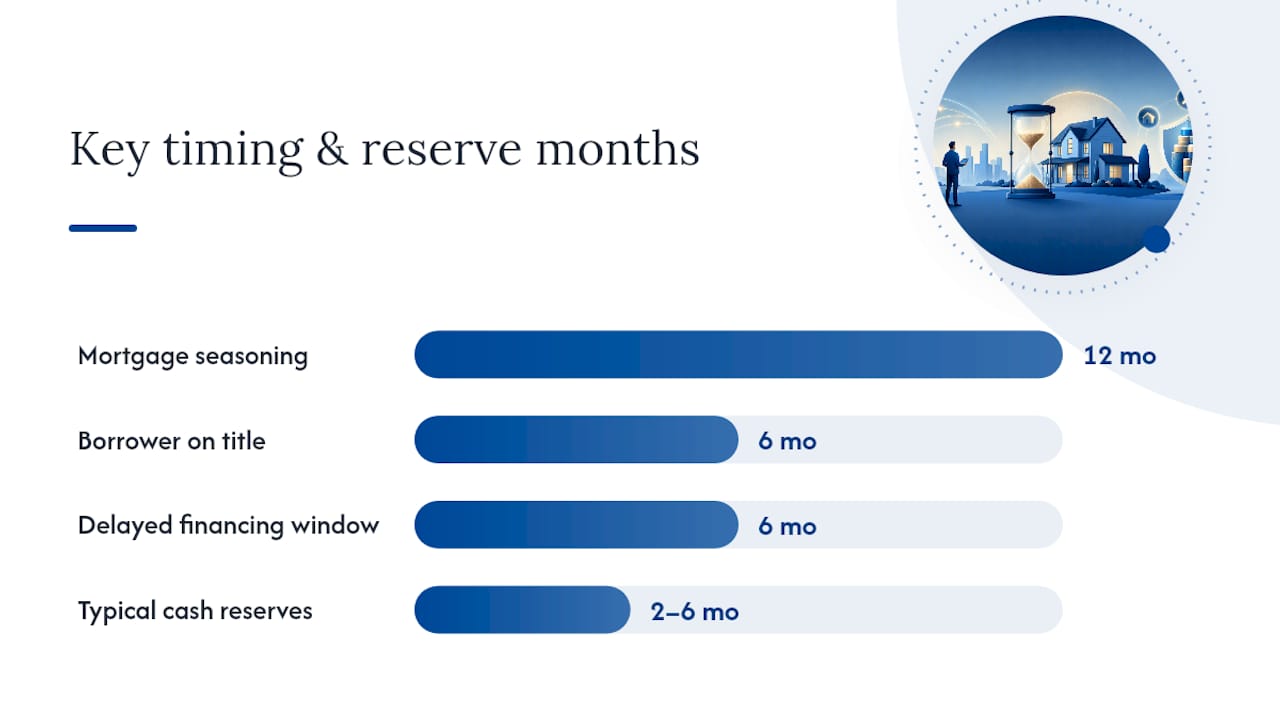
Beyond agency minimums, lenders often layer on their own requirements for investment properties, including larger cash reserves (commonly two to six months of payments on all financed properties), rental income verification through leases or a Debt Service Coverage Ratio (DSCR) calculation, and sometimes a lower maximum LTV than the agency allows on paper.
Expect underwriters to request:
- Two years of tax returns or, for DSCR loans, current lease agreements
- Recent bank and asset statements showing reserves
- A payoff statement from your current mortgage servicer
- Title report confirming ownership and any existing liens
- Government-issued ID and entity documents if the property is held in an LLC
- The appraisal report once ordered
Pro Tip: Pull your lender's NMLS record before you sign anything. The NMLS Consumer Access database shows licensing status and complaint history, and a five-minute check can save you from a lender who overpromises on LTV and underdelivers at closing.
What Costs Should You Budget for a Cash-Out Refinance?
Closing costs on an investment property cash-out refinance typically run 2% to 5% of the loan amount, and they add up faster than most first-time investors expect. Line items usually include:
- Appraisal fee, often $500 to $800 for a single-family rental
- Title insurance and search fees
- Lender origination or underwriting fees
- Recording fees and transfer taxes, where applicable
- Prepaid interest and escrow deposits for taxes and insurance
Statistic Callout: Freddie Mac points out that many of these closing costs and prepaid items can be rolled into the new loan balance instead of paid at the table, which is convenient if cash is tight but comes at a real cost: rolling fees into the loan reduces your net proceeds and means you're paying interest on those fees for the full term of the loan.
Term choice matters just as much as the fees themselves. A 30-year term keeps monthly payments lower and preserves cash flow, but you'll pay considerably more in total interest over time. A 15 or 20-year term raises the monthly payment but shrinks total interest paid and builds equity faster, which can matter if your strategy depends on refinancing again in a few years. Run both scenarios before you pick a term, not after.
When Does a Cash-Out Refinance Make Sense for Investors?
The case for cash-out refinancing is strongest when the money has a clear job to do. Pulling equity to fund a down payment on another rental, finance a renovation that raises rent, or boost rental income through targeted upgrades all put the new debt to work generating returns. Consolidating a hard money loan or high-interest debt into a longer, lower-rate mortgage can also improve monthly cash flow immediately.
The risk side is just as real. A larger loan balance means a higher monthly payment, and if rents don't cover the new debt service, you've turned a cash-flowing property into a break-even or negative one. Higher leverage also means less cushion if the market softens or a unit sits vacant longer than planned, and pulling cash out can affect your insurance requirements and how the IRS treats interest deductibility depending on how proceeds are used.
A simple decision rule helps here: if the projected return on the cash you deploy exceeds the after-tax cost of the new debt, and you can still maintain an adequate reserve across your portfolio, a cash-out refinance income requirements is usually worth pursuing. If either condition fails, it's worth waiting or considering a smaller draw.
- Pros: liquidity for new acquisitions, funding for rehab, consolidation of costly debt, potential to lock in a longer amortization schedule
- Cons: higher monthly payment, reduced cash flow margin, increased exposure if rents or values drop, possible tax and insurance changes
HELOC, Bridge Loan, or Something Else? Weighing Your Alternatives
A cash-out refinance isn't always the fastest or cheapest path to equity. A HELOC gives you a revolving line against your equity, often with lower upfront costs and a variable rate, which works well for rehab projects where you draw funds in stages rather than all at once.
Second mortgages and bridge or hard-money loans move faster than a full refinance and don't disturb your existing first mortgage, but they typically carry higher rates and shorter terms, making them better suited to flips or bridging a seasoning gap before you qualify for permanent financing. Selling, bringing in a partner, or executing a 1031 exchange are worth considering too, particularly when a property has appreciated significantly and redeploying the full sale proceeds makes more sense than borrowing against it.
What Should You Prepare Before Applying?
Getting organized before you apply shortens underwriting and often improves the terms you're offered. Here's the sequence that works:
- Gather payoff statements, current leases, tax returns or DSCR documentation, recent bank statements, ID, and title information.
- Document any recent repairs or upgrades with receipts and before-and-after photos to support a stronger appraisal outcome.
- Pull comparable rental and sale data for your market so you can discuss value with your lender before the appraisal comes back.
Pro Tip: Ask any lender you're considering three questions upfront: what LTV cap applies to this specific property type, whether seasoning or ownership exceptions apply to your situation, and what the all-in closing costs look like once prepaids are included. The answers vary more than most investors expect.
What Investors Get Wrong About Cash-Out Refinancing
The biggest mistake isn't leverage itself, it's underestimating reserves and overestimating how fast a rehab or new acquisition will cash flow. Investors often budget the down payment on the next property but forget the six months of reserves most lenders will require across every financed property they own. That gap kills deals at the underwriting stage more often than credit or income does.
Lender overlays are the other blind spot. Two lenders working from the same Fannie Mae guidelines can land on very different LTV caps and reserve requirements for the same borrower. Working with a broker who shops multiple programs, including DSCR and portfolio options, tends to surface exceptions that a single retail lender won't offer. That's a large part of how Lending Bankers Mortgage helps investor clients move faster and negotiate better terms.
— David
Ready to Access Your Equity? Here's How Lending Bankers Helps
Lending Bankers gives Florida investors something a single retail lender can't: access to multiple loan programs, including conventional cash-out refinancing, DSCR loans, hard-money exit strategies, and foreign national financing, all evaluated side by side to find the best LTV and rate for your specific property.
If you're weighing a cash-out refinance against a HELOC or bridge loan, or you're not sure how much equity you can actually pull, start by running the numbers on the mortgage calculator to see how a new loan balance affects your monthly payment before you commit to anything. From there, a quick consultation lets Lending Bankers review your current mortgage payoff, target property value, and intended use of funds to map out realistic LTV options. Have your most recent mortgage statement, a rent roll or lease copies, and a rough renovation budget ready, and the conversation moves a lot faster.
This article is general information, not a substitute for advice from a qualified financial advisor. Consult a qualified financial professional about your own circumstances before acting on anything here.
Sources
- B2-1.3-03, Cash-Out Refinance Transactions (Fannie Mae)
- Cash-out refinance (Freddie Mac)
- NMLS Consumer Access - Company record