
If you need a few months to sell your current home before closing on the next one, a bridge loan is usually the right tool. If you're buying a distressed property, racing an auction deadline, or funding a rehab that a bank won't touch, a hard money loan almost always fits better. Either way, compare full term sheets, not product labels, and model your exit before you sign anything.
TL;DR:
- The true cost of a short-term loan depends heavily on your actual exit timeline, with delays increasing total payments significantly.
- Both bridge and hard money loans can have similar structures, but their key differences lie in purpose, underwriting focus, and flexibility regarding construction or sale risks.
- Before signing, borrowers should obtain written extension and fee schedules, then run stress-tested calculations assuming their exit takes 50 percent longer than expected.
- Hard money loans are asset-based, making them suitable for fix-and-flip projects or distressed properties, but they carry higher rates and shorter terms.
- Borrowers should compare full term sheets, not just advertised rates, to select the option that minimizes total cost under realistic scenario delays.
Table of Contents
- Bridge Loan vs Hard Money: What a Bridge Loan Actually Is
- What Is a Hard Money Loan?
- Bridge Loan vs Hard Money: The Term Sheet Comparison
- When to Choose Each: Scenario-Based Rules
- Underwriting and Exit Checks Every Borrower Must Demand
- Pre-Application Checklist: Get Your Paperwork Ready
- How Lending Bankers Helps You Choose and Close
- The Real Question Behind Bridge Loan vs Hard Money
- Ready to Compare Your Bridge Loan and Hard Money Options?
- Sources
- FAQ
Bridge Loan vs Hard Money: What a Bridge Loan Actually Is
A bridge loan is short-term financing designed to cover a gap. Homeowners use it to buy a new house before their current one sells. Commercial borrowers use it to stabilize a property, lease it up, and refinance into permanent financing once income normalizes. The OCC's Comptroller's Handbook notes that commercial bridge loans are typically written for terms up to three years, which is longer than most homeowners expect.
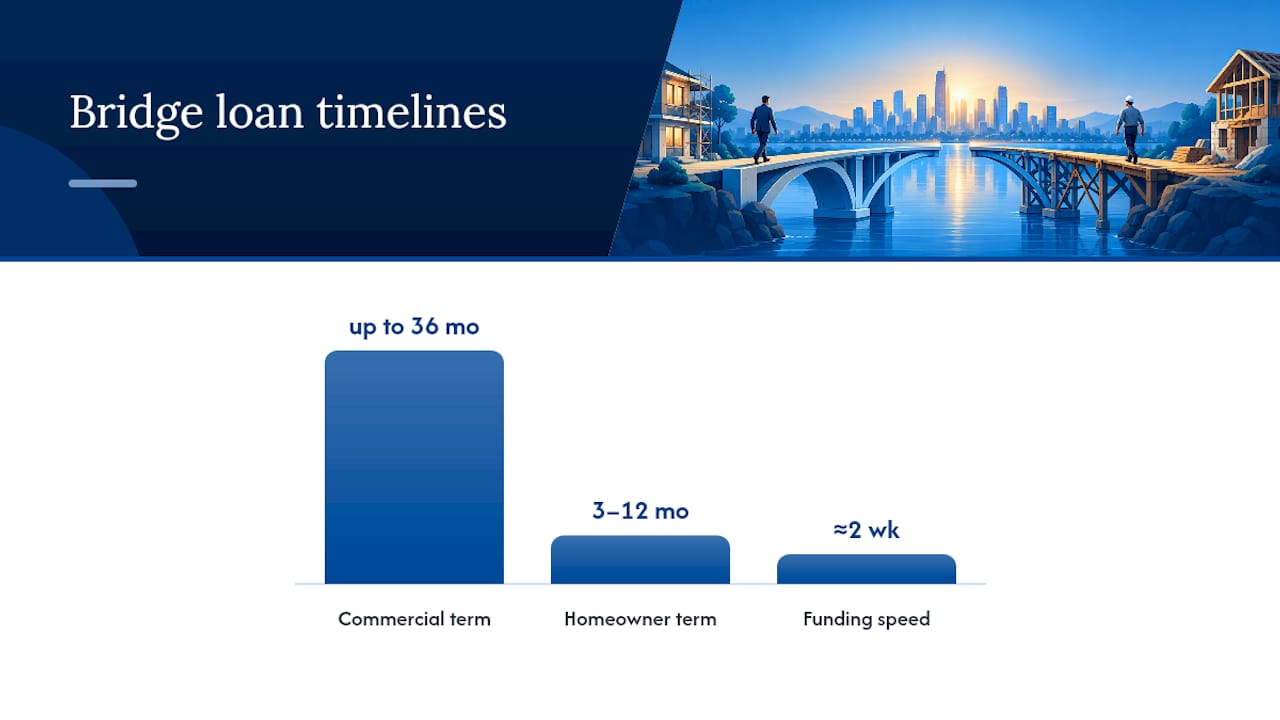
On the residential side, terms run much shorter. Bankrate reports that homeowner bridge loans commonly last 3 to 12 months, carry higher rates than a standard mortgage, and can fund in as little as two weeks once the paperwork is in order.
Typical bridge loan features include:
- Interest-only monthly payments with a balloon payment due at maturity or sale
- Collateral tied to the property being sold, the property being purchased, or both
- Underwriting that leans on the borrower's equity position and a credible sale or refinance plan
- Availability through banks, credit unions, and private lenders, though banks tend to move slower than private capital
The main risk is a stalled exit. If your current home doesn't sell on schedule, you're carrying two properties on one balance sheet. Lenders mitigate this by requiring strong equity cushions and, in commercial deals, documented leasing or stabilization plans before they'll fund.
What Is a Hard Money Loan?
A hard money loan is asset-based financing where the property, not your income or credit score, drives the approval. Investopedia's definition emphasizes that hard money underwriting weighs collateral value, the borrower's business plan, and the exit strategy, often more heavily than tax returns or credit documentation.
This makes hard money the default choice for fix-and-flip investors, auction buyers, and anyone acquiring a property a conventional lender would reject outright, whether due to condition, title issues, or timeline pressure.
Common structural features include:
- Rates and points that run higher than bridge financing, reflecting the added collateral and execution risk
- Draw-controlled funding for rehab work, where money releases in stages tied to completed construction milestones
- Terms typically running 6 to 24 months, built around a flip, refinance, or stabilization timeline
- Underwriting focused on scope of work, contractor budgets, and a lender's own assessment of after-repair value
The risk cuts the other way from a bridge loan. If your renovation runs long or the market softens before you sell or refinance, carrying costs on a hard money loan add up fast. Draw schedules exist partly to protect the lender: they release funds only as work is verified, which also keeps a borrower from overspending before a project is finished.
Bridge Loan vs Hard Money: The Term Sheet Comparison
Product names get marketed loosely. One lender's "bridge loan" might function exactly like another's "hard money" product. The only reliable comparison happens at the term sheet level, across a consistent set of axes.
- Purpose and fit. Ask what the loan is designed to solve: a timing gap on a stabilized asset, or an acquisition plus rehab scenario with construction risk.
- Underwriting emphasis. Does the lender weigh your income and credit, or primarily the collateral and your exit plan?
- Term length and extension options. Get the base term in writing, along with what an extension costs and how many extensions are available.
- Funding speed. Some lenders close in days; others take weeks. Ask for their average timeline on deals like yours, not their advertised best case.
- All-in cost. Add interest, origination points, underwriting fees, draw fees, extension fees, and unused-commitment fees. The quoted rate alone tells you little.
- Collateral and recourse. Confirm whether the loan is secured by one property or cross-collateralized, and whether you're personally guaranteeing the debt.
- Draw rules and inspections. For any rehab component, ask exactly how draws are requested, inspected, and released.
- Prepayment and default terms. Some products penalize early payoff; others penalize late payoff aggressively. The CFPB's guidance on prepayment penalties is a useful baseline for what to check.
Pro Tip: Calculate the total dollars you'll pay by your expected payoff date, not the interest rate in isolation. A lower headline rate with steep extension fees can cost more than a higher rate with no hidden charges, especially if your exit slips by even a month or two.
Run the math twice: once on your expected timeline, and once assuming a slower sale, a higher refinance rate, or a construction delay. That second number is usually the one that matters.
When to Choose Each: Scenario-Based Rules
- Buying before selling. You've found your next home but haven't closed on your current one. A bridge loan against your existing equity covers the gap without forcing a rushed sale.
- Rehab and resale (fix-and-flip). You're buying a property that needs work before it can be financed conventionally. Hard money's draw-controlled funding matches the construction timeline.
- Auction or off-market acquisition. Speed matters more than rate. Hard money lenders who underwrite the asset, not your tax returns, can often close faster.
- Commercial lease-up. You've acquired a property that needs tenants before it qualifies for permanent financing. A commercial bridge loan, structured around stabilization, is the standard tool here.
- Uncertain exit timeline. If you can't confidently project when you'll sell or refinance, that's a red flag regardless of product. Both loan types punish a delayed exit; only the size of the penalty differs.
Before signing anything, run through this checklist: how much equity are you bringing in, how large is the rehab scope, how fast do you actually need to close, and how likely is your refinance or sale to happen on schedule? Weak answers to any of those questions should slow you down, not speed you up.
Underwriting and Exit Checks Every Borrower Must Demand
Lenders evaluate short-term real estate loans against a specific checklist, and you should ask to see how you measure up against each item before you commit.
- Exit credibility under stress. Can your sale, lease-up, or refinance plan survive a slower market or a higher rate environment?
- Loan-to-value (LTV) and loan sizing. How much of the property's value does the loan represent, and what's the cushion if values soften?
- Appraisal and valuation support. Is the after-repair value or stabilized value backed by comparable sales, not just optimism?
- Borrower equity contribution. How much of your own capital is at risk alongside the lender's?
- Debt service coverage ratio (DSCR), where relevant, for income-producing commercial properties.
- Contractor budget and scope of work, for any deal involving rehab or construction.
- Environmental and legal review, standard for commercial transactions.
Federal Reserve interagency guidance recommends that lenders stress-test exits and document their income and value assumptions for short-term commercial loans, specifically to avoid concentration risk when too many deals depend on the same optimistic assumptions.
Ask for these in writing before closing: extension options and their fees, unused-commitment fees, the default interest rate, and the exact inspection schedule tied to draw releases. Reviewing what commercial lenders actually look for can help you anticipate these questions before a lender asks them.
Pre-Application Checklist: Get Your Paperwork Ready
Before you contact a lender, assemble the documents that let an underwriter move quickly. Missing paperwork is the single biggest reason quotes come back slower or higher than expected.
- Gather your deal documents. Purchase contract, current mortgage payoff statement, rent rolls, operating statements, and contractor bids if rehab is involved.
- Prepare your financial documents. Bank statements, entity formation documents (for LLCs or corporations), and any permits or insurance already in place.
- Estimate your payoff timeline. Be realistic about how long a sale, lease-up, or refinance will actually take, not how long you hope it takes.
- Compute total cost to that date. Add interest, points, origination, and any draw or extension fees you expect to incur.
- Stress-test the numbers. Rerun the calculation assuming a slower sale, a higher refinance rate, or a construction overrun, then compare that worst-case cost across the offers you're considering.
Pro Tip: Before you close, get the lender to put their extension fee and unused-commitment fee schedule in writing. Verbal assurances about "we'll work with you" mean nothing once you're three months into an extension you didn't budget for.
How Lending Bankers Helps You Choose and Close
A mortgage brokerage works with homeowners and investors on both bridge and hard money financing, alongside residential and commercial mortgages. Because loans can be placed across both categories, clients can get a comparison grounded in actual numbers, not a pitch for whichever product happens to be on the shelf that week.
Borrowers may get support with speed-to-close coordination, draw schedule management on rehab deals, and refinance planning once a bridge or hard money loan reaches maturity. That combination, personalized guidance plus access to foreign national and specialty loan programs, is part of what can set a firm apart in a market where many brokers only handle one loan type well.
The Real Question Behind Bridge Loan vs Hard Money
The debate over bridge loan versus hard money gets treated like a product choice. It isn't. It's an exit-planning exercise wearing a financing decision as a disguise.
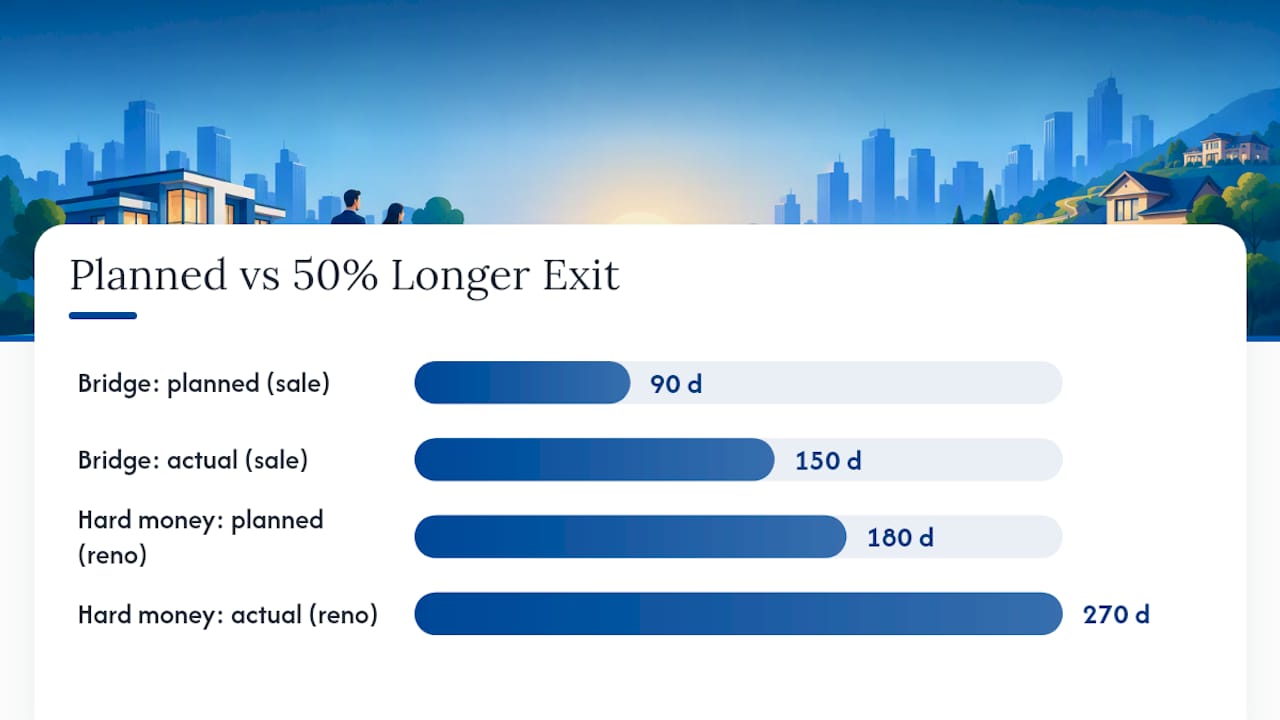
Most borrowers who get burned didn't pick the wrong product category. They picked the right category and then underestimated how long their exit would actually take. A homeowner bridge loan structured around a 90-day sale becomes expensive fast when the house sits for 150 days. A hard money rehab loan penciled around a six-month renovation gets brutal when permitting delays push it to nine.
Conventional advice tells you to compare rates. That's incomplete. The number that actually predicts your outcome is the stress-tested payoff cost, run against a slower timeline than you expect, not your best-case scenario.
If you take one thing from this comparison, take this: ask every lender for their extension fee schedule in writing before you sign, and run your own numbers assuming your exit takes 50 percent longer than planned. Borrowers who do that rarely get surprised. Borrowers who skip it usually learn the hard way.
— David
Ready to Compare Your Bridge Loan and Hard Money Options?
This brokerage is an alternative to shopping rate quotes in isolation: instead of guessing which product fits, clients may work with a broker who places both bridge and hard money loans and can show the real total cost of each against a specific timeline. This matters most for borrowers juggling a home sale, a rehab project, or a fast-closing acquisition where the wrong structure costs thousands in avoidable fees.

Start by gathering your purchase contract, payoff statement, and, if rehab is involved, your contractor bids. From there, Lending Bankers can walk you through hard money loan pros and cons and how to pick the right hard money lender before you commit to a term sheet. Visit the Lending Bankers homepage to start a conversation about your specific deal and get a clear picture of your options before you sign anything.
Sources
- Hard money loan definition — Investopedia
- Commercial real estate lending — OCC Comptroller's handbook
- Interagency guidance on concentrations in commercial real estate lending — Federal Reserve
- What is a bridge loan? — Bankrate
FAQ
What Is the Downside of a Bridge Loan?
The biggest downside is carrying cost if your exit stalls. You're often paying interest on two properties or extending a short-term loan, and homeowner bridge loans typically carry higher rates than a standard mortgage, so a delayed sale gets expensive quickly.
What Does Dave Ramsey Say About Bridge Loans?
Dave Ramsey generally advises against bridge loans, favoring a sell-first approach to avoid carrying two mortgages and taking on short-term debt risk. That view fits a debt-averse philosophy, but it doesn't account for time-sensitive markets where waiting to sell first means losing the next home.
What Is a Better Alternative to a Bridge Loan?
For some borrowers, a home equity line of credit (HELOC) on the current property can cover a down payment gap at a lower rate than a bridge loan, provided there's enough time to set it up before closing. A cash-out refinance or a contingent purchase offer are other paths worth discussing with a lender before defaulting to a bridge loan.
How Much Would a $350,000 Bridging Loan Cost?
Total cost depends on the rate, points, and how long you carry the loan before payoff. Rather than quoting a single figure, calculate your specific interest, origination points, and any extension or draw fees against your expected payoff date, then stress-test that number against a slower timeline.
Can Lending Bankers Help With Both Bridge and Hard Money Loans?
Yes. Lending Bankers places both bridge and hard money financing for homeowners and investors in Miami and across Florida, alongside residential and commercial mortgage options. Current terms and pricing are available directly through Lending Bankers.