
Yes — self-employed Florida borrowers can typically qualify for a mortgage using 12 to 24 months of bank statements instead of tax returns. You'll trade some flexibility in documentation for a higher interest rate and a larger down payment than a conventional loan requires. The next move is straightforward: gather clean, consolidated bank statements for the past one to two years and talk to a broker who works with Florida non-QM programs regularly.
TL;DR:
- Borrowers should prepare 12 to 24 months of consolidated bank statements, with 24 months offering a more stable average for seasonal businesses.
- Qualifying generally requires a credit score above 600, a down payment between 10% and 20%, and documented reserves covering several months of payments.
- Large unexplained deposits or inconsistent deposit patterns can trigger manual reviews and delay loan approval.
- Property considerations include potential high costs for flood or wind insurance, especially in coastal areas, and the need to verify rental income for investment properties.
- Working with a broker who shops across multiple non-QM lenders can secure better terms for complex income or property situations.
Table of Contents
- What Is a Bank Statement Loan and When Does It Make Sense?
- Who Typically Qualifies for a Bank Statement Loan in Florida?
- What Documentation and Numbers Should You Expect?
- How Do Lenders Turn Deposits Into Qualifying Income?
- What Florida Property Issues Should You Plan For?
- How Do You Prepare and Submit a Clean Application?
- How Long Does Closing Take and What Slows It Down?
- How Lending Bankers Approaches Bank Statement Loans in Florida
- Ready to Explore Your Bank Statement Loan Options?
- Sources
What Is a Bank Statement Loan and When Does It Make Sense?
A bank statement loan is a non-QM mortgage that qualifies you using 12 to 24 months of personal or business bank deposits instead of W-2s and tax returns. Underwriters look at what actually lands in your account, not what your accountant reported to the IRS after deductions. That distinction matters because the IRS Self-Employed Individuals Tax Center outlines write-offs that legitimately shrink taxable income even when cash flow stays strong.
This program fits a specific group of borrowers:
- Self-employed business owners with 1099 income or Schedule C filings
- Contractors and consultants whose deductions make tax returns look thinner than reality
- Gig workers and freelancers without a traditional employer verification letter
Common uses include home purchases, rate-and-term refinances, cash-out refinances, and investment property purchases. If your tax returns undersell your income, this is likely the more accurate way to shop for a mortgage.
Who Typically Qualifies for a Bank Statement Loan in Florida?
Florida has one of the largest concentrations of small business owners and self-employed workers in the country, according to the SBA Office of Advocacy's 2025 Florida profile. That population is exactly who these loans were built for, and it explains why so many lenders in Miami, Tampa, and Orlando actively compete for this business.
Lenders generally look for:
- At least two years of self-employment or steady 1099 work, though some programs allow one year with strong compensating factors
- A credit score in the mid-600s or higher, with the best pricing reserved for scores above 700
- Consistent monthly deposits that reflect real business activity, not sporadic lump sums
Most programs accept primary residences, second homes, and investment properties, which gives Florida investors real flexibility when they want to add a rental property without touching a traditional loan file.
What Documentation and Numbers Should You Expect?
Lenders build their bank statement loan requirements around a few core numbers. Knowing them ahead of time keeps you from getting blindsided mid-application.
- Months of statements. Twelve months is the minimum most lenders accept. Twenty-four months often produces a stronger, more stable average, which helps if your business has seasonal swings, common in Florida's tourism and construction sectors.
- Down payment. Expect a starting point in the 10% to 20% range depending on occupancy, credit score, and property type. Investment properties usually sit at the higher end.
- Credit score and reserves. Lenders commonly want documented reserves covering several months of mortgage payments, with the exact number tied to your score and loan size.
- Debt-to-income ratio. Your calculated income from deposits gets weighed against existing debt the same way it would on a conventional file, just with a different income calculation feeding into it.
Pro Tip: Ask your loan officer for both a 12-month and a 24-month income calculation before you commit to a statement window. Sometimes the shorter period actually qualifies you for more, especially if your last year outperformed the one before it.
How Do Lenders Turn Deposits Into Qualifying Income?
Underwriters don't take your total deposits at face value. They average your monthly deposits over the statement period, then strip out anything that isn't real revenue, transfers between your own accounts, loan proceeds, or one-time gifts, so what's left reflects actual business income.
From there, most lenders apply an expense factor, a percentage deducted from gross deposits to account for the cost of running your business, since not every dollar that comes in is profit. The exact percentage varies by lender and by whether you can document your actual expense ratio.
A few things strengthen your file during this process:
- A profit-and-loss statement, even an unaudited one, gives underwriters context beyond raw deposits
- A CPA letter confirming your business structure and ownership percentage speeds up manual review
- Clear notes explaining any large or unusual deposits before an underwriter has to ask
Large unexplained deposits, frequent inter-account transfers, and inconsistent monthly totals are the most common triggers for a manual underwriting review, so tackling them proactively pays off. Reviewing how lenders assess what commercial lenders look for in cash flow can also clarify how deposit patterns get judged.
What Florida Property Issues Should You Plan For?
Property type shapes your loan almost as much as your income does, and Florida adds a few wrinkles you won't find in every market.
- Non-warrantable condos are common in South Florida buildings with high investor concentration or pending litigation, and they usually require a non-QM approach rather than a conventional one
- Wind, flood, and hurricane insurance premiums can be substantial in coastal counties, and lenders factor those costs into your qualifying ratios and reserve requirements
- Short-term rentals and investment purchases sometimes get underwritten using projected rental income rather than your personal deposit history alone, which is worth exploring if you're financing a rental property
Planning for these costs before you shop for a rate keeps your budget realistic — try this HELOC Monthly Payment Calculator to estimate your monthly payments accurately. A mortgage calculator that lets you adjust for insurance and property taxes gives you a clearer monthly payment picture than a generic estimate.
How Do You Prepare and Submit a Clean Application?
Getting through underwriting without delays comes down to preparation. Here's the sequence that keeps a bank statement loan application moving:
- Gather your statements. Pull 12 to 24 months of consolidated bank statements, personal or business, depending on your program, along with a government photo ID and recent asset statements.
- Add supporting documentation. Include a business license, a profit-and-loss statement if you have one, and a brief cover letter explaining any owner draws or irregular deposits.
- Annotate anything unusual. Flag large deposits, transfers between accounts, or gaps in deposit activity with a short written explanation before your underwriter has to ask.
- Choose your lending partner carefully. A broker who works across multiple non-QM programs, rather than a single direct lender, can usually shop your file to find better pricing for your specific income pattern.
- Ask the right questions upfront. Before signing anything, ask your loan officer how they calculate your expense factor, what reserves they'll require, and whether your property qualifies if it's a non-warrantable condo.
You can confirm any loan officer's license status through NMLS Consumer Access before committing to work with them, a five-minute step that protects you from unlicensed operators.
How Long Does Closing Take and What Slows It Down?
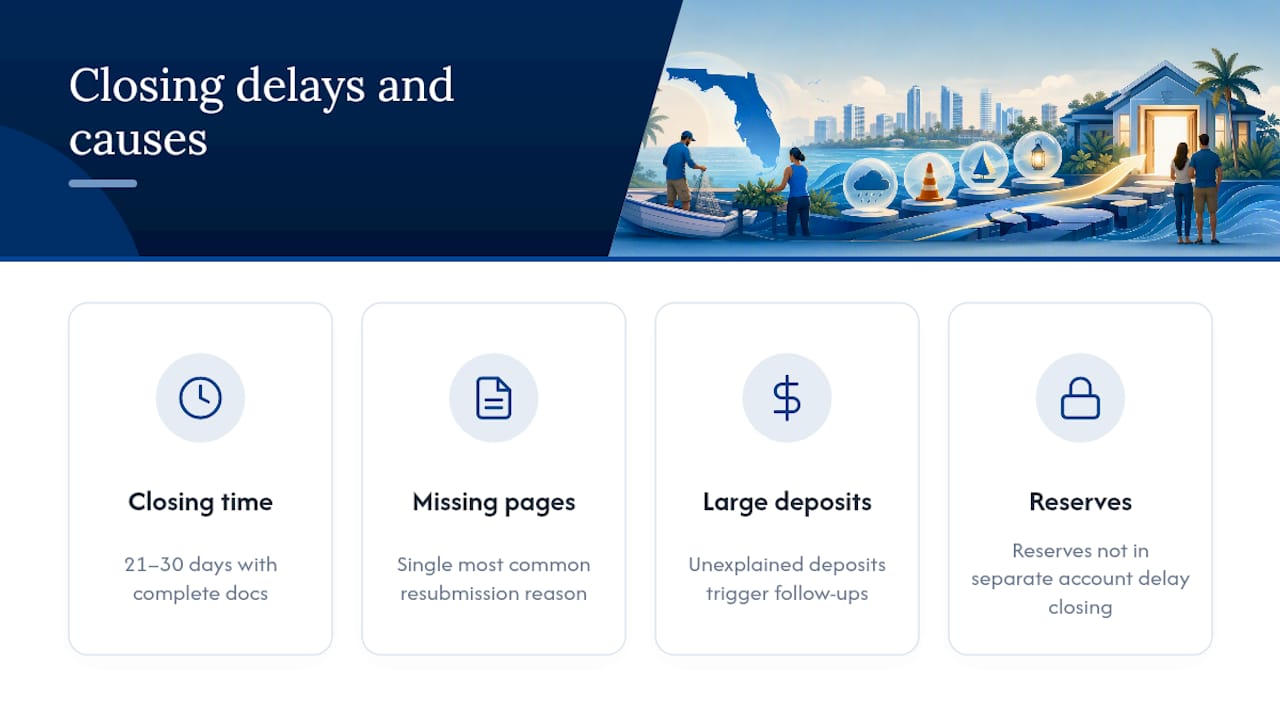
When your documents are complete and consistent, closing on a bank statement loan commonly takes 21 to 30 days, similar to many conventional timelines. The delays that stretch this window almost always trace back to the same handful of issues.
Incomplete or missing statement pages top the list, followed by unexplained large deposits and reserves that aren't clearly documented in a separate account. Each one triggers a follow-up request from underwriting, and each follow-up adds days to your closing date.
Pro Tip: Before you submit anything, reconcile your own statements page by page and make sure the running balances match from one statement to the next. A missing page is the single most common reason files bounce back for resubmission.
Reviewing how borrowers commonly stumble in Miami loan approvals can help you spot your own file's weak points before an underwriter does.
How Lending Bankers Approaches Bank Statement Loans in Florida
Lending Bankers Mortgage works with self-employed borrowers, business owners, and investors across Miami and the rest of Florida, and bank statement lending sits squarely in that wheelhouse alongside foreign national loans, hard money financing, and condotel programs. Non-QM files are rarely one-size-fits-all, which is where a broker's ability to shop multiple lenders starts to matter.
Some situations call for a direct conversation rather than a generic checklist. A non-warrantable condo in a building with litigation history, a jumbo loan amount that needs a specific investor match, or a closing timeline that's tighter than usual are all cases where the right lender match saves real money and real stress. If your income looks strong on paper but doesn't fit a conventional box, that's usually the moment to get a second set of eyes on your file.
— David
Ready to Explore Your Bank Statement Loan Options?
If your tax returns don't tell the full story of your income, a knowledgeable broker can review your bank statements and walk you through which Florida programs actually fit your situation, whether that's a primary home purchase, a cash-out refinance, or an investment property in a non-warrantable condo building.
Unlike shopping rate quotes site by site, working with a broker means one point of contact comparing several non-QM lenders on your behalf, so you're not the one calling around explaining your deposit history five separate times. Before you apply anywhere, it's also worth understanding how homeowners insurance differs from mortgage insurance, since both affect your monthly payment and your reserve requirements in Florida's insurance market.
Reach out to Lending Bankers to schedule a consultation and find out which bank statement loan program fits your income, your property, and your timeline.
Sources
- Florida 2025 State Profile — SBA Office of Advocacy
- Self‑Employed Individuals Tax Center — IRS
- NMLS Consumer Access