
An asset depletion mortgage lets you qualify for a home loan by converting eligible liquid assets into a monthly income figure using specialized property/mortgage resources and IDX tools to support loan sizing and local property considerations. Instead of pay stubs, you show a lender bank statements, brokerage accounts, and retirement funds, and an underwriter runs the numbers through a formula to produce qualifying income.
This approach exists for asset‑rich, income‑light borrowers. Three groups benefit most:
- Retirees living on portfolio value rather than a paycheck
- Business founders between exits, sitting on cash from a sale
- Investors and high‑net‑worth individuals whose tax returns understate their real financial position
The tradeoff is real. You'll typically pay a rate premium over a conventional loan, and you'll need to keep meaningful reserves in place after closing rather than spending down everything you own.
Key Takeaways
Asset depletion mortgages convert liquid assets into qualifying income using a lender's divisor, and the choice between a short non‑QM divisor and a long agency divisor determines both your loan size and your rate.
| Point | Details |
|---|---|
| Formula drives everything | Eligible assets minus reserves and down payment, divided by the program's divisor, sets your qualifying income. |
| Divisor length is the biggest lever | Non‑QM programs using 60 to 120 months produce far higher income than Fannie Mae's 360‑month standard. |
| Not every asset counts equally | Cash counts near 100%, brokerage accounts 70% to 100%, and retirement accounts less until penalty‑free age. |
| Expect a rate premium | Pricing typically runs 0.5 to 2.0 percentage points above conventional loans, narrowing with strong credit and reserves. |
| Lending Bankers runs multiple formulas | The team tests agency and non‑QM divisors side by side to find the strongest qualifying result for each client. |
Table of Contents
- How Asset Depletion Underwriting Turns Savings Into Qualifying Income
- A Worked Example: $2 Million in Assets Under Two Divisors
- Which Assets Count, and Which Ones Lenders Discount
- Credit, Down Payment, Reserves, and What Drives the Rate You'll Pay
- Agency Rules vs. Non-QM: Picking the Right Path
- Documents, Timeline, and How to Avoid Underwriting Delays
- Who Actually Benefits From Asset Depletion Financing
- How Lending Bankers Handles Asset Depletion Files
- How the Depletion Method Affects Your Loan Size and Terms
- Tax Considerations Behind the Asset Depletion Number
- A Practical Take on Asset Depletion Lending
- Ready to Run Your Numbers? Here's How to Start
- Where to Verify the Rules Yourself
- Sources
How Asset Depletion Underwriting Turns Savings Into Qualifying Income
Every asset depletion mortgage runs on the same basic idea: take a pool of liquid assets, subtract what you'll need for the down payment and closing costs, and spread the remainder over a set number of months to produce a monthly income figure. The OCC describes this process as converting assets into a hypothetical annuity stream that gets added to any other income you report.
The formula plays out in three steps:
- Total eligible assets, minus early‑withdrawal penalties, minus the funds earmarked for down payment, closing costs, and required post‑close reserves.
- Apply asset‑specific haircuts. Cash counts at full value; brokerage and retirement accounts get discounted based on volatility and access rules.
- Divide by the depletion period. This divisor, set by the loan program, ranges from 60 months on aggressive non‑QM programs to 360 months on Fannie Mae's standard method.
That divisor is the single biggest lever in the whole calculation. A shorter divisor spreads the same asset pool over fewer months, which produces dramatically higher qualifying income, though usually at a higher rate. Lenders also expect the reserve portion of your assets to stay untouched after closing, since OCC guidance treats reserve strength as a core part of prudent asset dissipation underwriting.
A Worked Example: $2 Million in Assets Under Two Divisors
Numbers make this concrete faster than formulas do. Say a borrower has $2,000,000 in eligible post‑close assets after down payment, closing costs, and reserves are carved out.
| Divisor | Monthly Qualifying Income | Approximate Supported Loan Amount* |
|---|---|---|
| 60 months (non‑QM) | $16,667 | Significantly higher, subject to DTI and rate |
| 360 months (Fannie Mae) | $5,556 | Notably lower for the same asset pool |
*Actual loan size depends on the borrower's rate, debt‑to‑income ratio, and other qualifying income, not the asset‑derived figure alone.
The gap between those two rows is the whole story of asset depletion lending:
- The same $2 million produces roughly six times more monthly income under a 60‑month divisor than a 360‑month one.
- Non‑QM lenders can offer that flexibility because their portfolio programs price for the added risk with tighter reserve and down payment rules.
- A borrower chasing a larger loan amount will often lean toward a shorter‑divisor program, even at a premium rate, if the qualifying income gap is what stands between them and the property they want.
Which Assets Count, and Which Ones Lenders Discount
Not every dollar you own carries the same weight in an asset depletion calculation. Lenders generally sort assets into three tiers.
- Cash and bank accounts typically count at or near 100% of value.
- Brokerage and investment accounts usually count at 70% to 100%, depending on the mix of stocks, bonds, and cash inside them.
- Retirement accounts (401(k), IRA) get a reduced percentage tied to your age and any early‑withdrawal penalty, though many lenders raise that percentage once you reach penalty‑free withdrawal age.
Common exclusions include business operating accounts, restricted or unvested stock, non‑vested compensation, and most home equity. Fannie Mae's guidance treats illiquid holdings as either excluded or heavily discounted, since a lender needs assets it can verify and access quickly if the loan ever goes into default.
Large or recently deposited funds usually trigger a seasoning requirement, meaning the money needs to sit in the account for a set period, along with a paper trail showing where it came from.

Pro Tip: Move any large deposits into your primary accounts at least two to three months before you apply. A sudden $200,000 wire the week before underwriting almost always triggers extra documentation requests that can delay closing by weeks.
Credit, Down Payment, Reserves, and What Drives the Rate You'll Pay
Asset depletion programs still run through standard underwriting gates. Credit score bands matter as much here as with a conventional mortgage, and a stronger score typically unlocks both easier approval and better pricing.
- Down payment minimums commonly range from a moderate to a high percentage, depending on the lender and loan size.
- Post‑close reserve requirements often cover several months of the new mortgage payment, sometimes more for jumbo balances.
- Reserves and down payment funds get carved out of your asset pool before the depletion formula runs, so a larger down payment can shrink your qualifying income even as it lowers your loan amount.
On pricing, expect a premium over a comparable conventional rate, commonly running about 0.5 to 2.0 percentage points higher. That gap narrows for borrowers with strong credit, a larger down payment, and reserves well beyond the minimum. If your debt‑to‑income ratio is already tight even after the asset‑derived income gets added in, it's worth reviewing how DTI calculations affect qualification before you lock into one specific program.
Agency Rules vs. Non-QM: Picking the Right Path
Fannie Mae and Freddie Mac both allow asset‑based qualifying income, but their formulas are conservative by design. Freddie Mac typically uses a 240‑month divisor, and Fannie Mae generally applies 360 months, with an important exception: Fannie's age‑62 LTV carveout allows higher loan‑to‑value ratios for older borrowers relying on asset income, recognizing that retirees often have strong net worth but modest cash flow.
Non‑QM and portfolio lenders take a different approach, using divisors as short as 60 to 120 months. That flexibility often comes bundled with interest‑only options and larger jumbo loan sizes, which suits borrowers who need maximum qualifying income from a fixed asset pool.
- Choose an agency path if you want the lowest possible rate and your assets already produce enough qualifying income under a 240 or 360 divisor.
- Choose non‑QM if the agency math falls short of your target loan amount and you can accept a rate premium in exchange for a shorter divisor.
Documents, Timeline, and How to Avoid Underwriting Delays
A clean asset depletion file comes down to preparation. Here's the typical runbook:
- Gather two to three months of statements for every account you want counted, including all pages, even blank ones.
- Document any large deposits with a clear paper trail: sale proceeds, inheritance records, or business distribution statements.
- Confirm penalty‑free access to retirement funds where age matters, since that documentation changes your haircut percentage.
- Submit early and avoid moving money. Lenders re‑verify balances late in the process, and shifting funds before closing can undo the qualifying math entirely.
Most files move from pre‑approval to closing in four to six weeks, though non‑QM portfolio loans sometimes run longer due to manual underwriting. Before signing with any broker or lender, it's worth a quick check on NMLS Consumer Access to confirm licensing, a step that also matters for avoiding approval pitfalls on larger Florida transactions.
Pro Tip: Ask your broker to run your file under both an agency divisor and a non‑QM divisor before you pick a program. The difference in qualifying income can be the gap between approval and denial on a specific property.
Who Actually Benefits From Asset Depletion Financing
Asset depletion mortgages fit a specific set of borrowers well:
- Retirees with substantial 401(k) and IRA balances but limited monthly Social Security or pension income
- Founders sitting on liquidity after selling a business, before that cash has generated a stable income stream
- Investors and heirs with brokerage or inherited assets that don't show up as W‑2 or 1099 income
If your income is steady but unconventional, such as commissions or seasonal self‑employment earnings, a bank statement loan may serve you better than asset depletion. Real estate investors buying rental property often do better with a DSCR loan sized to the property's own cash flow. A quick decision check: if your goal loan size is small relative to your asset base, agency asset depletion probably works; if you need every dollar of qualifying income you can get, review the fuller comparison of mortgage products before choosing a path.
How Lending Bankers Handles Asset Depletion Files
Lending Bankers serves clients across Miami and Florida with a personalized approach to both residential and commercial lending, and asset depletion files are exactly the kind of case where that personalization matters.
- Lending Bankers offers a full range of mortgage programs, including hard money loans and dedicated assistance for foreign national borrowers who often hold assets across multiple accounts or currencies.
- The team runs a client's numbers through multiple depletion formulas rather than defaulting to a single lender's rules, looking for the combination that produces the strongest qualifying income.
- Proactive communication throughout underwriting is a hallmark of how Lending Bankers works, with clients regularly citing that steady contact as the difference between a stressful process and a straightforward one.
How the Depletion Method Affects Your Loan Size and Terms
The math behind asset depletion doesn't just decide whether you qualify. It shapes how large a loan you can get and what terms come attached to it.
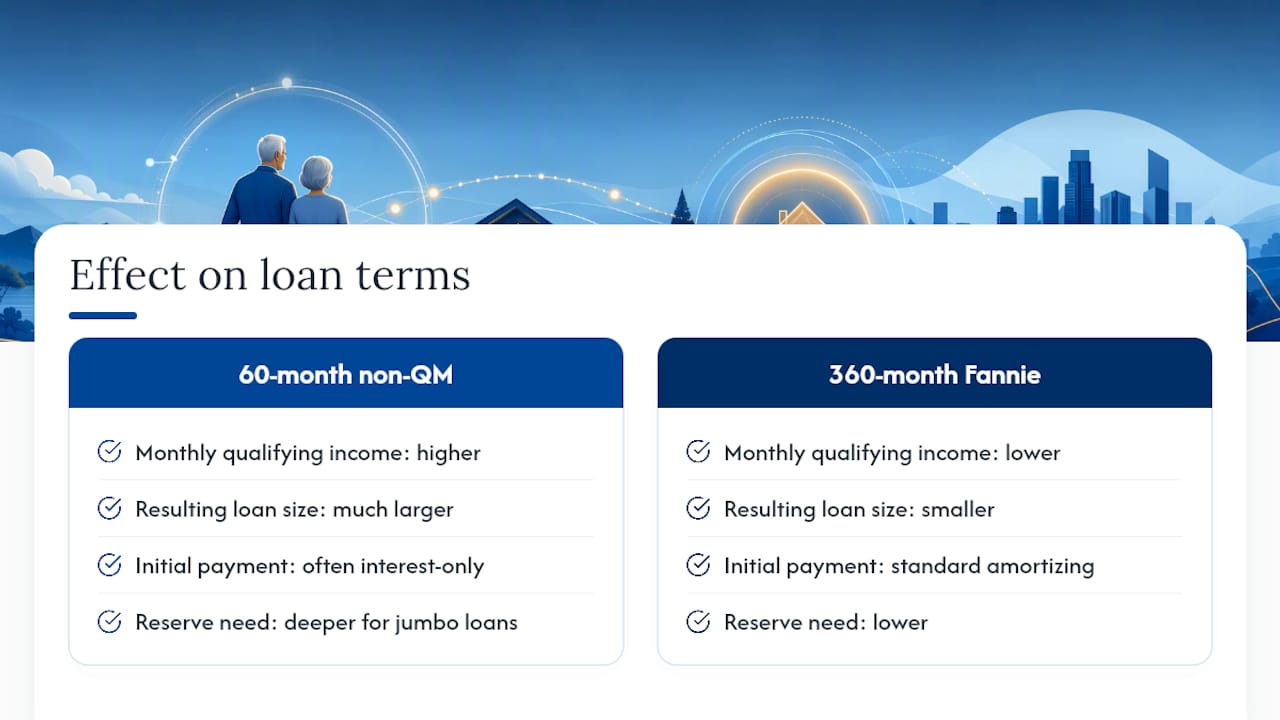
A shorter divisor raises your monthly qualifying income, which in turn raises the loan amount your debt‑to‑income ratio can support. That's why a borrower using a 60‑month non‑QM divisor might qualify for a loan several times larger than the same borrower would get under Fannie Mae's 360‑month formula, even with identical assets. But loan size isn't the only thing that shifts. Non‑QM programs that offer those shorter divisors frequently attach interest‑only payment options for the first several years, which lowers your initial payment but means you're not building equity through principal reduction during that period.
Jumbo loan sizing is where this becomes especially relevant for high‑net‑worth borrowers. Properties priced well above conforming loan limits often require the higher qualifying income that only a non‑QM divisor can produce, since agency programs simply won't generate enough monthly income from a given asset pool to support a jumbo‑sized payment at reasonable debt ratios. Reserve requirements also scale with loan size. A $3 million jumbo asset depletion loan will typically demand deeper post‑close reserves than a $600,000 conforming loan, sometimes twelve months of payments or more, which pulls a larger slice out of the asset pool before the depletion formula even runs.
Loan‑to‑value ratios move too. Fannie Mae's age‑62 carveout lets qualifying retirees access higher LTVs than the standard asset depletion rules allow, a meaningful advantage for older borrowers who'd rather preserve capital than make a large down payment. Understanding how jumbo loans compare with conforming options helps clarify which loan limit thresholds apply to your specific purchase price.
Tax Considerations Behind the Asset Depletion Number
The income figure an underwriter calculates from your assets exists purely for qualifying purposes. It's not income you report to the IRS, and it doesn't create a new tax liability just by appearing on a loan application.
That said, the assets behind the number carry their own tax consequences worth understanding before you commit funds to a down payment or reserves. Withdrawing from a traditional 401(k) or IRA before age 59½ can trigger both ordinary income tax and a 10% early withdrawal penalty, which is exactly why lenders discount those accounts more heavily for younger borrowers and ease up once penalty‑free access kicks in. Selling brokerage holdings to fund a down payment can also trigger capital gains tax, depending on how long you've held the position and your basis in it.
None of this changes the depletion formula itself, but it changes the real cost of using a given asset to satisfy it. A retiree pulling funds from a Roth IRA faces a very different tax picture than one pulling from a traditional IRA or a taxable brokerage account, even though a lender might treat both as similarly liquid. Before you decide which accounts to draw down for a down payment or which to preserve as reserves, it's worth reviewing the tax treatment with an accountant alongside your mortgage broker. The mortgage math and the tax math don't always point to the same accounts.
A Practical Take on Asset Depletion Lending
The industry's own name for this product undercuts it. "Asset depletion" implies you're required to draw down your portfolio, but the OCC's framework treats it as a hypothetical annuity calculation, not a liquidation mandate. Most clients I've seen described in this space never touch the underlying assets at all.
The real caution is pricing and reserves. A rate premium plus a year of locked reserves is a meaningful commitment, and it deserves a candid conversation with a broker before you assume the math works in your favor.
Ready to Run Your Numbers? Here's How to Start
Lending Bankers handles asset depletion mortgages from the first document request through closing, running your file against agency and non‑QM formulas side by side rather than settling for whichever divisor a single lender happens to offer.

To get started, bring two to three months of statements for every account you want counted, along with documentation for any large recent deposits and proof of penalty‑free access to retirement funds where it applies. That paperwork lets the team model your qualifying income under multiple divisors quickly, so you know your real purchasing power before you start touring properties. Once you have a working income figure, run it through the mortgage calculator to see how it translates into an estimated monthly payment, or reach out directly through Lending Bankers to start a file review.
Where to Verify the Rules Yourself
- The OCC's bulletin on asset dissipation underwriting lays out the regulatory expectations banks must follow.
- Fannie Mae's selling guide on asset‑based qualifying income spells out the exact formula and the age‑62 LTV exception.
- NMLS Consumer Access lets you confirm any broker's or lender's licensing before you share financial documents.
This article is general information, not a substitute for advice from a qualified financial advisor. Consult a qualified financial professional about your own circumstances before acting on anything here.
Sources
- Mortgage Lending: Lending Standards for Asset Dissipation Underwriting | OCC
- Fannie Mae selling guide — employment-related assets qualifying income
- The Asset-Based Mortgage Master Guide 2026: Qualify on Assets, Not Income | LoanWise
- What Is An Asset Depletion Mortgage? | How It Works - TheMortgageReports