
If you can comfortably handle a higher monthly payment and want to cut your total interest cost, a 15-year mortgage usually wins. If you need lower payments and more borrowing flexibility, a 30-year term is the better fit. That's the short answer to the 15 year vs 30 year debate, but the right choice depends on your income stability, your down payment, and how long you plan to stay in the home.
Before you decide, take these steps:
- Run a calculator first. Plug your actual loan amount and current rates into a mortgage calculator before assuming either term is affordable.
- Check your DTI. A 15-year payment can push your debt-to-income ratio past what a lender allows, even if the lower rate looks appealing on paper.
- Match the term to your timeline. If you expect to move within five to seven years, the equity difference between terms matters less than the monthly cash flow.
Key Takeaways
Choosing between a 15-year and 30-year mortgage comes down to whether your budget can absorb a higher payment in exchange for lower lifetime interest and faster equity.
| Point | Details |
|---|---|
| Rate spread favors 15-year | 15-year rates typically run about 0.5 to 0.8 percentage points below 30-year rates. |
| Payment gap is smaller than it looks | Total monthly housing cost on a 15-year loan often runs about 30% higher, not double, since taxes and insurance stay flat. |
| DTI is the real limiter | Lenders often cap DTI between 43% and 50%, which can block a 15-year term even when the rate is better. |
| Extra payments mimic a 15-year payoff | Choosing a 30-year term and adding principal payments preserves qualifying flexibility while cutting years off the loan. |
| Lending Bankers models your scenario | Lending Bankers runs personalized 15-year vs 30-year comparisons for Florida borrowers using your actual rate and loan amount. |
Table of Contents
- 15 Year Mortgage Comparison to 30 Year: A Worked Example
- How to Use a 15 vs 30 Year Mortgage Calculator
- 15-Year vs. 30-Year Pros and Cons for Everyday Borrowers
- How Loan Term Affects Qualifying and Buying Power
- A Checklist for Choosing Your Mortgage Term
- How Lending Bankers Helps Florida Borrowers Decide
- What Actually Drives This Decision
- Get a Personalized 15 vs 30 Year Scenario From Lending Bankers
- Sources
15 Year Mortgage Comparison to 30 Year: A Worked Example
Numbers make this decision concrete faster than any explanation. Take a $400,000 loan and assume illustrative note rates of 6.0% for a 30-year fixed and 5.4% for a 15-year fixed, roughly the historical spread between the two terms.
- 30-year fixed: Monthly principal and interest is lower with higher total interest paid over the term.
- 15-year fixed: Monthly principal and interest is higher with significantly less total interest paid.
Statistic Callout: The 15-year payment is notably higher monthly, but it results in substantial interest savings over the life of the loan.
Equity tells a similar story. After five years, the 30-year loan's balance is still close to $373,000, since amortization is front-loaded with interest. The 15-year loan's balance after five years drops to about $269,000. After ten years, the gap widens even further: the 30-year borrower still owes around $337,000, while the 15-year borrower has paid the loan down to roughly $125,000.

These figures are illustrative, not a quote. Actual rates shift with the market, your credit profile, and the lender. Run your own numbers through a mortgage calculator using today's pricing before you commit to either term.
How to Use a 15 vs 30 Year Mortgage Calculator
A good calculator only helps if you feed it the right inputs. Getting the comparison right means including every cost that shows up on your monthly statement, not just principal and interest.
- Loan amount and down payment
- Two note rates, one for each term, since 15-year loans typically price lower than 30-year loans
- Property taxes, homeowners insurance, and PMI if your down payment is under 20%
- HOA dues, where applicable
- Any planned extra principal payments
The note rate is not the same as your APR, which folds in points and certain fees. Historically, 15-year rates run about 0.5 to 0.8 percentage points below 30-year rates, though the exact spread moves with the broader rate environment.
Pro Tip: Always add taxes and insurance into your comparison. A 15-year loan's higher principal and interest payment looks less extreme once you see it against your full monthly housing cost, which stays the same regardless of term.
15-Year vs. 30-Year Pros and Cons for Everyday Borrowers
The tradeoffs come down to cash flow now versus savings later, and neither answer is wrong for every household.
15-year mortgage:
- Lower interest rate and far less total interest paid
- Builds equity faster, which matters if you plan to sell or refinance within a decade
- Higher monthly payment that can strain your budget or limit what you qualify for
30-year mortgage:
- Lower monthly payment, which increases your buying power and leaves room for savings or investing
- More flexibility if your income varies month to month
- Meaningfully higher lifetime interest cost compared to a 15-year term
A dual-income household with stable jobs and a paid-off car often leans toward the 15-year term. A self-employed buyer or a growing family stretching toward their max budget usually does better with the 30-year payment and the breathing room it provides.
How Loan Term Affects Qualifying and Buying Power
Your loan term doesn't just change your payment, it changes what you can borrow in the first place. A higher monthly payment on a 15-year loan raises your debt-to-income ratio, and most lenders cap that ratio somewhere between 43% and 50%, depending on the loan program. That can shrink your maximum loan amount or push you toward a smaller home than you'd qualify for on a 30-year term.
If a 15-year payment stretches your DTI too far, you have options:
- Increase your down payment to lower the loan amount and the resulting payment.
- Take the 30-year term and make consistent extra principal payments equal to the 15-year difference, which mimics the payoff speed without the qualifying risk.
- Look into different loan programs. HomeReady and Home Possible loans allow down payments as low as 3% for qualifying income levels, which changes what loan size and term actually make sense for you.
Pro Tip: If your DTI is tight, work through our guide on qualifying with a less-than-ideal DTI ratio before you assume a 15-year term is out of reach.
A Checklist for Choosing Your Mortgage Term
Work through these questions before you lock in a rate:
- How stable is your income? Commission-based or self-employed earners often do better with the payment cushion a 30-year term provides.
- What's in your emergency fund? A 15-year payment leaves less monthly slack for surprises, so your reserve fund matters more.
- Do you carry other high-interest debt? Paying off credit cards before accelerating a mortgage almost always saves more money.
- How long do you plan to stay? Equity builds faster on a 15-year loan, which matters most if you expect to sell within ten years.
- Would investing the payment difference beat your mortgage rate? This is the classic "invest vs. pay down" question, and it depends on assumptions about market returns that aren't guaranteed.
Avoid overstretching to hit a 15-year payment just to say you'll be debt-free faster. A mortgage matched to your broader financial goals beats one chosen for bragging rights.
How Lending Bankers Helps Florida Borrowers Decide
Choosing between a 15-year and 30-year mortgage isn't a formula, it's a conversation about your income, your timeline, and your comfort with risk — learn more with our detailed guide on FHA vs Conventional: Which Mortgage Wins for You?. Lending Bankers has spent more than two decades guiding Miami and Florida borrowers through exactly this decision, from first-time buyers to seasoned investors comparing conventional and non-conventional loan structures.
Common patterns our advisors see:
- Dual-income households with strong reserves often move toward the 15-year term once they see the interest savings.
- Buyers near their max qualifying limit typically take the 30-year term and add extra principal payments once income grows.
- Investors weighing loan programs across jumbo and conforming limits frequently need a custom scenario run rather than a generic comparison.
Ask us for a free scenario model built around your actual numbers, not a generic example.
What Actually Drives This Decision
Most articles treat 15-year versus 30-year as a math problem, and the math genuinely matters. But the research behind this comparison keeps surfacing a more human constraint: the monthly payment jump, not the interest rate, is what disqualifies most borrowers from the 15-year term. The rate spread is real and worth chasing when you can afford it, yet DTI limits are the actual gatekeeper for most households.
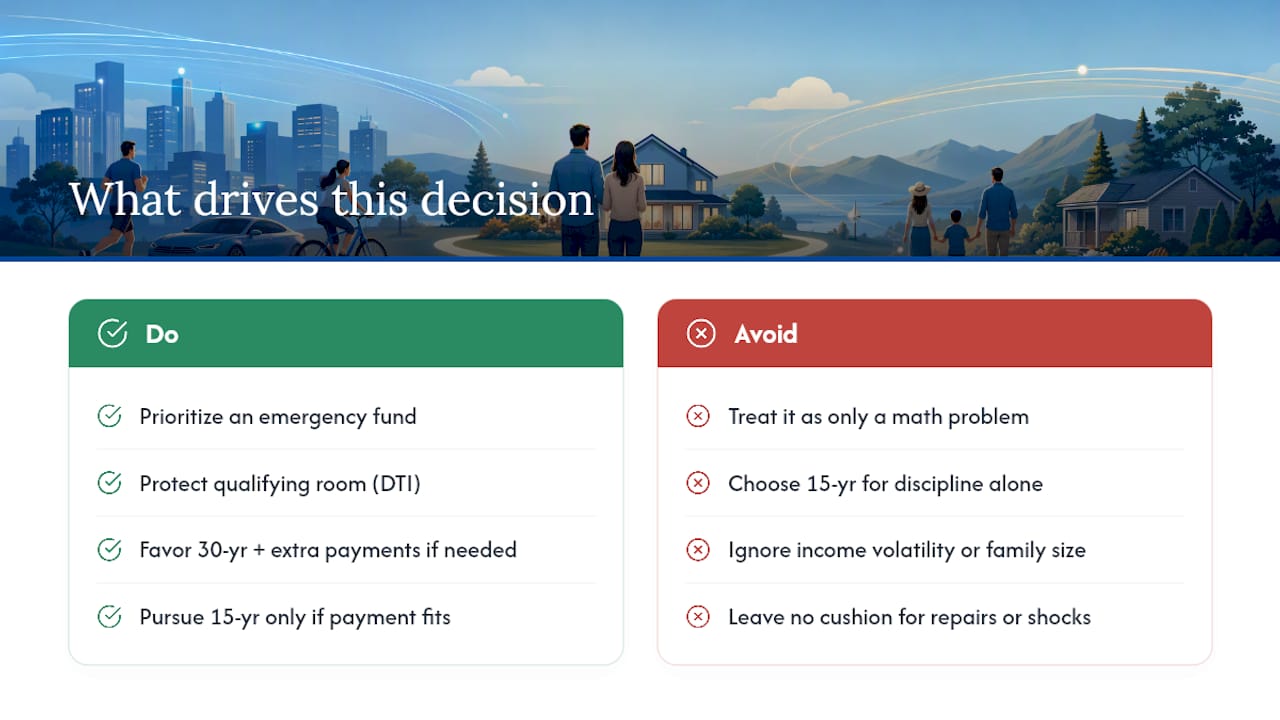
Conventional advice tends to frame this as a simple discipline question, pick the 15-year if you're serious about paying off debt. That framing ignores how income volatility, family size, and local home prices in a market like Florida change the calculation entirely. A buyer stretching to afford a home in Miami with a 30-year term and extra payments often ends up in a stronger position than someone who forced a 15-year term and then had no cushion left for repairs or a rate shock.
Prioritize your emergency fund and your qualifying room first. The interest savings from a 15-year term are real, but they mean nothing if the payment leaves you one unexpected expense away from missing it.
Get a Personalized 15 vs 30 Year Scenario From Lending Bankers
The examples above use illustrative rates. Your actual numbers depend on your credit profile, your down payment, and where mortgage rates stand the week you apply, and that's exactly the gap a generic online calculator can't close on its own.

Lending Bankers builds real scenario comparisons for Florida borrowers weighing loan terms, whether you're a first-time buyer in Miami or an investor comparing loan programs across multiple properties. David and the team can run your specific loan amount against both terms, layer in your taxes, insurance, and PMI, and show you what a 30-year term with extra payments would actually save compared to a straight 15-year loan. Start by running your numbers through our mortgage calculator, then request a free scenario review to see how the details in your file change the recommendation.
Sources
- 15 Year vs 30 Year Mortgage Calculator: Calculate Current 15yr FRM or 30yr Monthly Fixed Rate Mortgage Refinance Payments
- 15-Year vs. 30-Year Mortgage | Chase
- 15-year vs 30-year mortgage comparison | Zillow
- 15 vs 30 Year Loans — MyFICO calculator/explainer
- HomeReady and Home Possible: 3% Down Mortgages - NerdWallet
This article is general information, not a substitute for advice from a qualified financial advisor. Consult a qualified financial professional about your own circumstances before acting on anything here.